
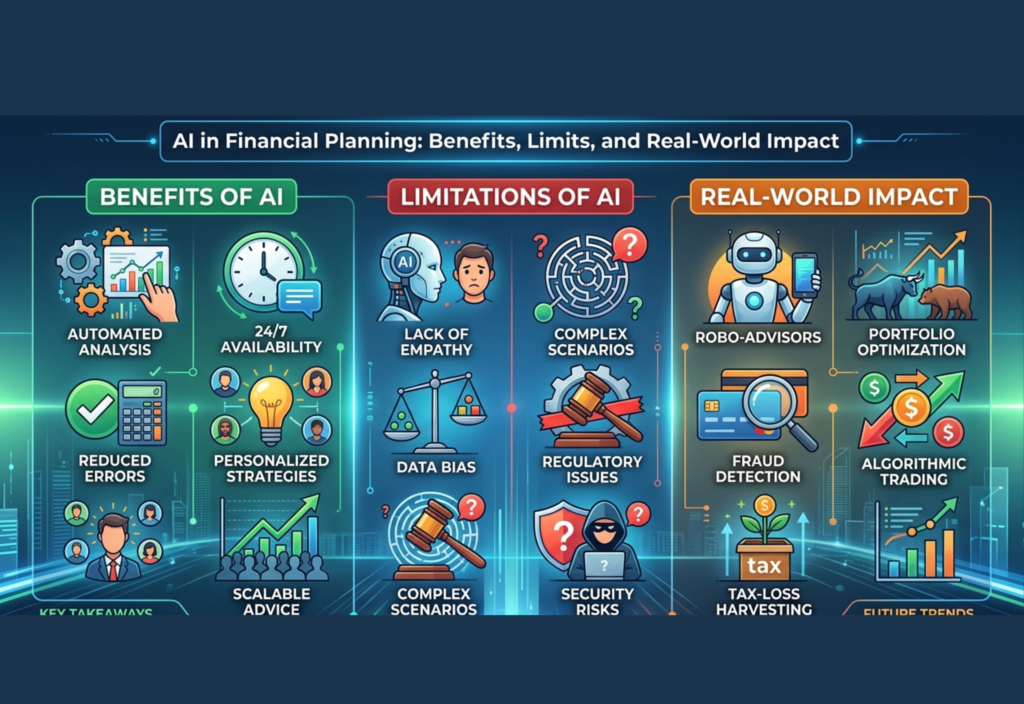
Artificial Intelligence (AI) is reshaping the financial world at a very fast pace. From personal budgeting apps to advanced investment systems used by banks, AI in financial planning is helping individuals and organizations make smarter, faster, and more data-driven decisions.
Today, financial decisions are no longer based only on human experience or guesswork. Instead, AI systems analyze large amounts of data, detect patterns, predict outcomes, and provide recommendations. However, while AI brings major improvements in efficiency and accuracy, it also has clear limitations that must be understood.
In this article, we will explore how AI is changing financial planning, its key benefits, limitations, real-world use cases, and its future impact.
What is AI in Financial Planning?
AI in financial planning means using artificial intelligence technologies to support money management, investment decisions, budgeting, and financial forecasting.
These systems use machine learning, data analytics, and predictive modeling to study financial behavior and provide useful insights.
AI is widely used in:
- Personal budgeting apps
- Investment platforms (robo-advisors)
- Banking systems
- Insurance companies
- Financial risk analysis tools
- Fraud detection systems
- Credit scoring models
Instead of manually analyzing financial data, AI processes it instantly and produces meaningful results that help users make better decisions.
How AI is Transforming Financial Planning
AI is completely changing how financial planning works by making it faster, more accurate, and highly personalized.
Earlier, people relied heavily on financial advisors and manual calculations. Now, AI tools can perform many of these tasks automatically.
For example:
- AI tracks income and expenses in real time
- Investment apps automatically adjust portfolios
- Banks detect suspicious transactions instantly
- AI chatbots provide 24/7 financial support
- Predictive systems forecast future spending patterns
This transformation is making financial services more accessible to everyone, even people with little financial knowledge.
Key Benefits of AI in Financial Planning
AI brings several powerful advantages that are changing the financial industry.
Faster and More Accurate Financial Analysis
One of the biggest advantages of AI is speed.
AI can process huge amounts of financial data in seconds. It can analyze spending habits, investment performance, and market trends much faster than humans.
This helps individuals and businesses make quick and accurate decisions.
Personalized Financial Recommendations
AI systems learn from user behavior and financial history.
Based on this data, they provide customized advice such as:
- Saving suggestions
- Budget limits
- Investment plans
- Debt management strategies
This level of personalization was not possible in traditional financial planning systems.
Smarter Investment Decisions
AI is widely used in investment platforms through robo-advisors.
These systems:
- Analyze market trends
- Suggest diversified portfolios
- Reduce emotional investing
- Automatically rebalance assets
This helps users invest more confidently, even without deep financial knowledge.
Strong Fraud Detection and Security
Security is a major area where AI is highly effective.
Banks and financial institutions use AI to:
- Monitor transactions in real time
- Detect unusual activity
- Block suspicious payments
- Prevent identity theft
This significantly reduces financial fraud risks.
Reduced Human Errors in Finance
Manual financial processes often involve mistakes.
AI reduces errors in:
- Accounting
- Tax calculations
- Data entry
- Financial reporting
This improves reliability and efficiency across financial systems.
24/7 Financial Assistance
AI-powered chatbots and virtual assistants provide instant help at any time.
Users can:
- Check account balances
- Ask financial questions
- Get budgeting advice
- Understand loan options
This improves customer experience and saves time.
Real-World Impact of AI in Financial Planning
AI is already deeply integrated into real financial systems worldwide.
AI in Banking Systems
Banks use AI for multiple important tasks such as:
- Fraud detection
- Loan approval processes
- Credit scoring
- Customer service automation
- Risk management
This improves speed and reduces operational costs.
AI in Investment Platforms
Investment companies rely on AI to analyze stock markets and manage portfolios.
Robo-advisors are now popular because they offer low-cost automated investment solutions.
They help users invest money without needing expert-level knowledge.
AI in Personal Finance Applications
Modern apps use AI to help users improve their financial habits.
These apps can:
- Track spending automatically
- Create monthly budgets
- Send saving reminders
- Identify unnecessary expenses
This encourages better financial discipline.
AI in Insurance Industry
Insurance companies use AI for:
- Claim processing
- Fraud detection
- Risk evaluation
- Customer support
This speeds up claim approvals and improves accuracy in risk assessment.
Limitations of AI in Financial Planning
Even though AI is powerful, it is not perfect and has several limitations.
Lack of Human Judgment and Emotion
AI cannot fully understand human emotions, personal circumstances, or ethical considerations.
Financial decisions are often deeply personal and may require empathy and experience, which AI cannot provide.
Dependence on Data Quality
AI systems depend completely on the data they receive.
If the data is incomplete, outdated, or biased, AI may produce incorrect results or misleading recommendations.
Privacy and Data Security Risks
AI systems handle sensitive financial information such as income, transactions, and investments.
This creates risks related to:
- Data leaks
- Cyberattacks
- Unauthorized access
- Misuse of personal information
Strong security systems are essential to reduce these risks.
Inability to Predict Uncertain Events
Financial markets are affected by unpredictable events like:
- Political changes
- Global crises
- Natural disasters
- Economic shocks
AI cannot always predict these sudden changes accurately.
Ethical and Personal Financial Limitations
Some financial decisions depend on personal values or religious beliefs.
AI may not fully understand these preferences unless specially programmed to do so.
Can AI Replace Financial Advisors?
AI is powerful, but it cannot fully replace human financial advisors.
Human advisors provide:
- Emotional understanding
- Ethical decision-making
- Personalized life planning
- Long-term relationship support
- Experience-based judgment
The future of financial planning is not AI vs humans—it is AI working with humans.
Future of AI in Financial Planning
The future of AI in finance looks very promising.
In the coming years, AI is expected to become even more advanced, offering:
- Real-time financial coaching
- Smarter investment predictions
- Fully automated financial assistants
- Better fraud detection systems
- Advanced risk management tools
Financial systems will become more efficient, but human oversight will still be important.
Best Practices for Using AI in Finance
To use AI effectively and safely, individuals should:
- Combine AI insights with human thinking
- Avoid blindly trusting AI recommendations
- Use secure and trusted platforms
- Protect personal financial data
- Improve basic financial knowledge
AI should be treated as a support tool, not a full replacement for financial understanding.
Final Thoughts
AI in financial planning is revolutionizing the way people manage money, invest, and plan for the future. It brings speed, accuracy, automation, and personalization that traditional systems cannot match.
At the same time, it has limitations such as lack of human judgment, data dependency, and privacy concerns.
The most effective approach is to use AI as a smart assistant while keeping human control and responsibility in financial decisions.
As technology continues to evolve, AI will play an even greater role in shaping the future of global financial systems, making them more efficient, accessible, and intelligent.