The Best AI Models 2026 are shaping a new era of artificial intelligence where AI agents are no longer limited to basic automation or scripted responses. Today’s AI agents are intelligent, context-aware, and capable of handling complex multi-step tasks with minimal human intervention. They can plan, reason, analyze data, and even collaborate with other AI agents to achieve goals.
From customer service bots and virtual assistants to autonomous research systems and enterprise automation tools, AI agents are transforming how businesses operate. However, the performance of these systems depends heavily on the AI models powering them.
Choosing the right AI model is not just a technical decision—it is a strategic one. The right model can improve performance, scalability, efficiency, and reliability, while the wrong choice can lead to poor results and system limitations.
In this guide, we explore the Best AI Models 2026 that are driving the future of smart, scalable, and high-performance AI agents.
Why GPT-5 is Essential
AI agents often need to perform tasks like planning, decision-making, and problem-solving. GPT-5 excels in these areas by combining reasoning with contextual awareness. It allows agents to think ahead, adapt to new inputs, and handle unexpected situations.
Best Use Cases
- AI-powered personal assistants
- Automated business workflows
- Content generation systems
- Coding and debugging agents
Key Advantage
Its ability to act as a “central brain” for AI agents makes it indispensable for high-level tasks.
2. Claude 4 – Reliability, Safety, and Long-Context Mastery
Claude 4 is designed with a strong focus on safety, alignment, and reliability. In industries where accuracy is critical, this model stands out as a trusted solution.
One of its biggest strengths is its ability to process long documents and maintain context over extended interactions. This makes it highly effective for knowledge-heavy applications.
Why Claude 4 Matters
AI agents are increasingly being used in sensitive domains like healthcare, finance, and legal services. In these areas, even small errors can have serious consequences. Claude 4 minimizes risks by producing more accurate and controlled outputs.
Best Use Cases
- Legal document analysis
- Medical research assistants
- Enterprise knowledge management
- Compliance and risk assessment systems
Key Advantage
It provides consistent and safe outputs, making it ideal for mission-critical AI agents.
3. Gemini 2.5 – The Power of Multimodal Intelligence
Gemini 2.5 takes AI capabilities beyond text by introducing advanced multimodal intelligence. It can process and understand multiple types of data, including text, images, audio, and video.
This allows AI agents to interact with the real world in a more meaningful way.
Why Gemini 2.5 is a Game-Changer
Modern applications require AI systems that can analyze visual content, interpret speech, and respond intelligently across different formats. Gemini 2.5 enables this by combining multiple data streams into a unified understanding.
Best Use Cases
- Video and image analysis
- Smart surveillance systems
- AI tutors with visual learning
- Real-time monitoring agents
Key Advantage
Its ability to “see, hear, and understand” makes AI agents more versatile and powerful.
4. Mistral Large – Performance Meets Efficiency
Mistral Large is known for delivering high performance while maintaining cost efficiency. It is particularly popular among startups and developers who need powerful AI without high operational expenses.
Why Mistral Large is Important
Running AI systems at scale can be expensive. Mistral Large addresses this challenge by offering fast inference speeds and lower computational costs, making it ideal for scalable deployments.
Best Use Cases
- SaaS platforms
- Real-time AI applications
- Chatbots at scale
- Lightweight AI systems
Key Advantage
It strikes the perfect balance between speed, cost, and performance.
5. LLaMA 3 – Flexibility Through Open-Source Innovation
LLaMA 3 continues to lead the open-source AI movement. It provides developers with the flexibility to customize and fine-tune models according to their specific needs.
Why LLaMA 3 Stands Out
Unlike closed models, LLaMA 3 allows full control over data, deployment, and customization. This is especially important for organizations that prioritize privacy and independence.
Best Use Cases
- Private AI deployments
- Custom-trained industry models
- Research and experimentation
- On-premise AI systems
Key Advantage
Its open nature empowers developers to build highly tailored AI agents.
Building Smart and Scalable AI Agents
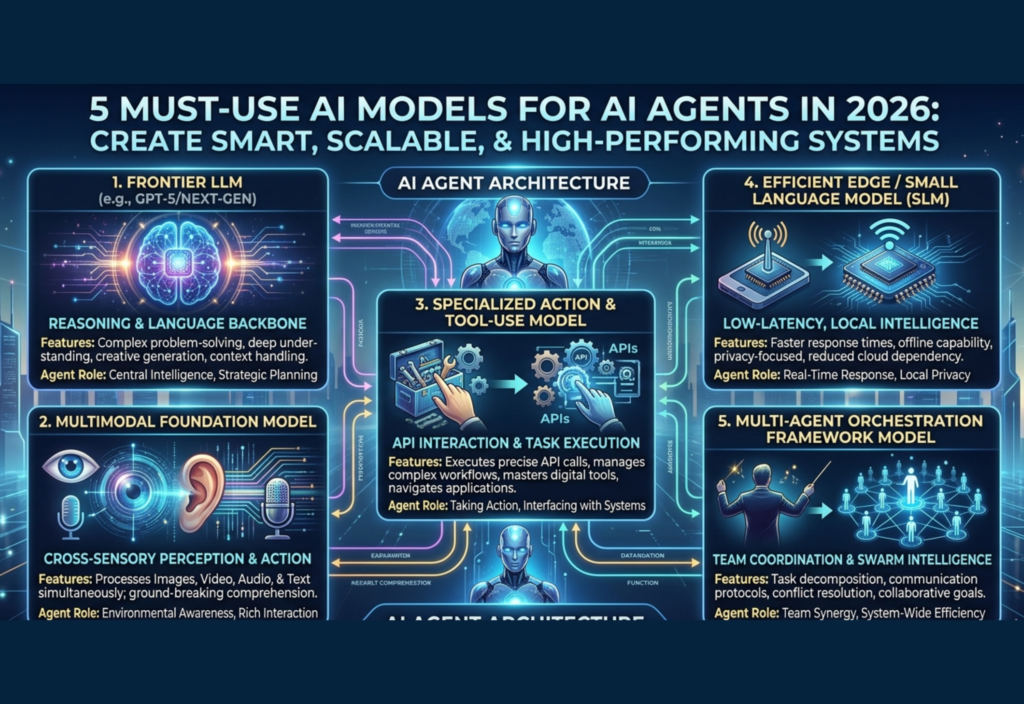
Creating a powerful AI agent in 2026 is not about using a single model—it’s about combining the strengths of multiple models.
Hybrid AI Systems
Many advanced AI agents now use hybrid architectures, where:
- GPT-5 handles reasoning and decision-making
- Claude 4 ensures safety and accuracy
- Gemini 2.5 processes multimodal inputs
- Mistral Large optimizes performance
- LLaMA 3 enables customization
This approach allows developers to build systems that are not only intelligent but also scalable and efficient.
Key Factors to Consider When Choosing an AI Model
When selecting a model for your AI agent, consider the following:
1. Performance
Can the model handle complex tasks efficiently?
2. Scalability
Will it perform well as your system grows?
3. Cost
Is it affordable for long-term use?
4. Flexibility
Can it be customized to your needs?
5. Safety
Does it produce reliable and ethical outputs?
Balancing these factors is crucial for building successful AI systems.
The Future of AI Agents
The future of AI agents is incredibly promising. As models continue to evolve, we can expect:
- Fully autonomous digital workers
- AI systems that collaborate with each other
- Real-time intelligent decision-making
- Deep personalization in user experiences
AI agents will become an essential part of everyday life, transforming industries and redefining productivity.
Conclusion
In 2026, AI agents are at the forefront of technological innovation, and their success depends largely on the models that power them. The five models discussed—GPT-5, Claude 4, Gemini 2.5, Mistral Large, and LLaMA 3—represent the best tools available for building smart, scalable, and high-performing systems.
By understanding their strengths and applying them strategically, businesses and developers can unlock the full potential of AI and stay ahead in a rapidly evolving digital landscape.