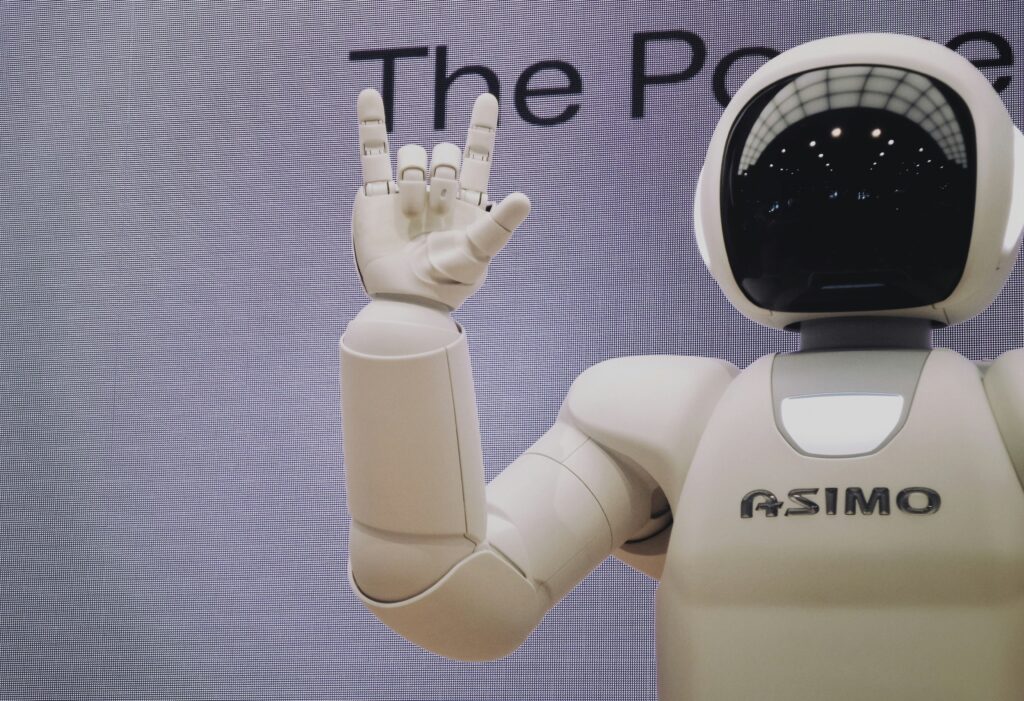
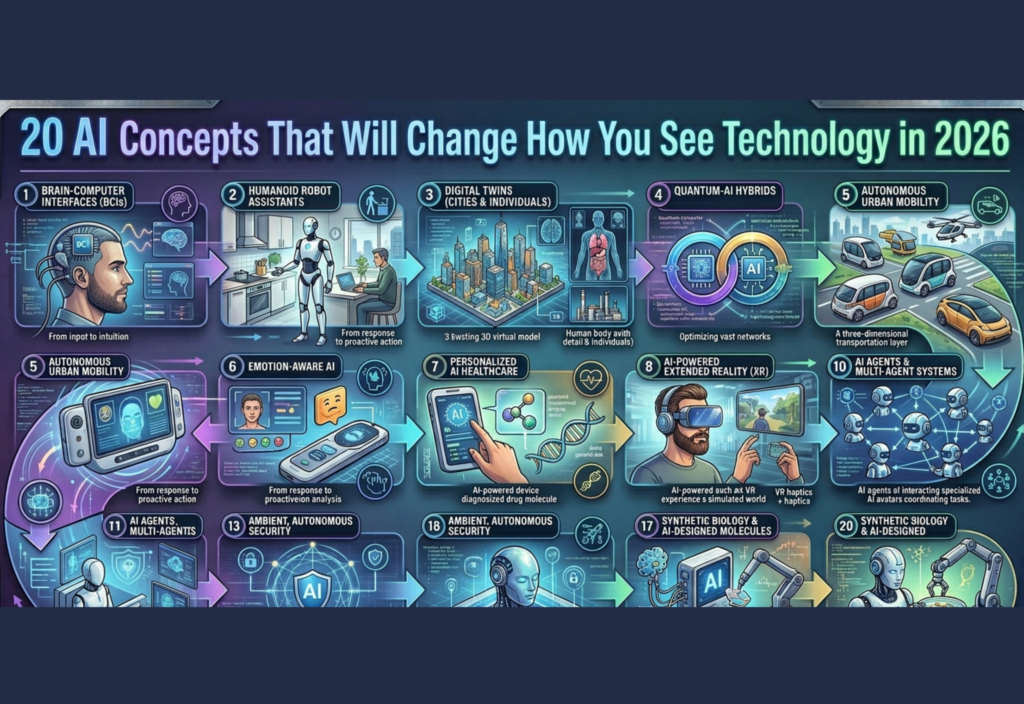
Artificial Intelligence is no longer just a buzzword or a futuristic idea reserved for big tech companies. It has become a core part of modern digital systems, and understanding AI concepts 2026 is now essential for anyone interested in technology. These AI concepts 2026 are shaping how businesses grow, how people communicate, and how decisions are made across almost every industry.
By 2026, AI is expected to become even more deeply embedded in daily life, from simple mobile apps to advanced autonomous systems. To truly understand where technology is heading, it’s important to explore the key AI concepts 2026 behind it. Below are 20 detailed AI concepts that will completely change how you see technology in 2026 and beyond.
2. Deep Learning
Deep Learning is a more advanced form of Machine Learning that uses multiple layers of neural networks. These layers allow the system to learn very complex patterns in data.
Deep Learning powers:
- Facial recognition systems
- Voice assistants like Siri or Google Assistant
- AI image generators
- Self-driving car perception systems
It is one of the biggest reasons AI has advanced so rapidly in recent years.
3. Neural Networks
Neural networks are inspired by the human brain. They consist of nodes (like neurons) that process information and pass it forward.
They are used for:
- Pattern recognition
- Classification tasks
- Prediction models
The more layers a neural network has, the more “deep” it becomes, leading to better learning capability.
4. Natural Language Processing (NLP)
NLP allows machines to understand and interact using human language. It bridges the gap between human communication and machine understanding.
Applications include:
- Chatbots
- Language translation tools
- Voice assistants
- AI writing tools
Without NLP, AI could not understand or respond to human instructions naturally.
5. Generative AI
Generative AI is one of the most revolutionary developments in recent years. It allows machines to create new content instead of just analyzing data.
It can generate:
- Text (articles, emails, stories)
- Images and artwork
- Music and audio
- Videos and animations
This is the technology behind tools that can “create” like humans.
6. Large Language Models (LLMs)
LLMs are advanced AI models trained on massive amounts of text data. They understand context, language structure, and meaning.
They are capable of:
- Answering complex questions
- Writing content
- Summarizing documents
- Translating languages
These models are becoming the backbone of modern AI assistants.
7. Reinforcement Learning
Reinforcement Learning is based on trial and error. AI systems learn by receiving rewards for correct actions and penalties for wrong ones.
It is widely used in:
- Robotics
- Game-playing AI (like chess or Go)
- Autonomous systems
This concept mimics how humans learn from experience.
8. Computer Vision
Computer Vision allows machines to interpret and understand visual information from the world.
It is used in:
- Face recognition
- Medical imaging
- Object detection
- Self-driving cars
It gives machines the ability to “see” like humans.
9. Autonomous Systems
Autonomous systems can operate without human control. They use AI to make decisions in real-time environments.
Examples include:
- Self-driving vehicles
- Delivery drones
- Automated factory machines
These systems are transforming transportation and logistics.
10. Predictive Analytics
Predictive analytics uses AI to analyze historical data and predict future outcomes.
Used in:
- Business forecasting
- Stock market analysis
- Customer behavior prediction
- Healthcare risk assessment
It helps companies make smarter decisions.
11. AI Ethics
AI Ethics focuses on responsible use of artificial intelligence. It ensures AI systems are fair, transparent, and safe.
Key concerns include:
- Privacy protection
- Fair decision-making
- Avoiding misuse of AI
- Human rights considerations
As AI grows, ethics becomes extremely important.
12. Bias in AI
AI systems can inherit bias from the data they are trained on. This can lead to unfair or incorrect outcomes.
Example:
- Biased hiring systems
- Unequal facial recognition accuracy
Reducing bias is a major focus in AI development.
13. Explainable AI (XAI)
Explainable AI is designed to make AI decisions understandable to humans. Instead of “black box” systems, XAI provides reasoning behind decisions.
This is important in:
- Healthcare
- Finance
- Legal systems
It builds trust in AI systems.
14. Edge AI
Edge AI processes data directly on devices instead of sending it to cloud servers. This improves speed and privacy.
Used in:
- Smartphones
- Smart cameras
- IoT devices
It reduces delay and increases efficiency.
15. AI in Cybersecurity
AI is widely used in cybersecurity to detect threats and prevent attacks.
It helps:
- Identify hacking attempts
- Detect malware
- Monitor suspicious activity
AI makes digital systems more secure.
16. Human-AI Collaboration
Instead of replacing humans, AI is increasingly working alongside them.
Examples:
- Doctors using AI for diagnosis
- Writers using AI for content creation
- Engineers using AI for design
This collaboration improves productivity and accuracy.
17. Multimodal AI
Multimodal AI can understand multiple types of data at once—text, images, audio, and video.
This allows:
- Better understanding of real-world context
- Smarter AI assistants
- More human-like interactions
It is a major step toward advanced AI systems.
18. AI Agents
AI agents are systems that can independently perform tasks, make decisions, and take actions.
They can:
- Schedule tasks
- Manage workflows
- Perform research
- Automate digital work
They are like digital assistants with autonomy.
19. Synthetic Data
Synthetic data is artificially created data used for training AI models when real data is limited or sensitive.
Benefits:
- Protects privacy
- Reduces data collection costs
- Improves AI training efficiency
It is widely used in healthcare and finance.
20. Artificial General Intelligence (AGI)
AGI is the concept of AI that can perform any intellectual task that a human can do.
It is still theoretical, but if achieved, AGI would:
- Think like humans
- Learn any skill
- Solve complex problems independently
It is considered the ultimate goal of AI research.
Final Conclusion
By 2026, AI will no longer be just a tool—it will become a partner in decision-making, creativity, automation, and problem-solving. These 20 concepts are not just technical terms; they represent the foundation of the next digital revolution.
Understanding them today means preparing yourself for the future of technology tomorrow.