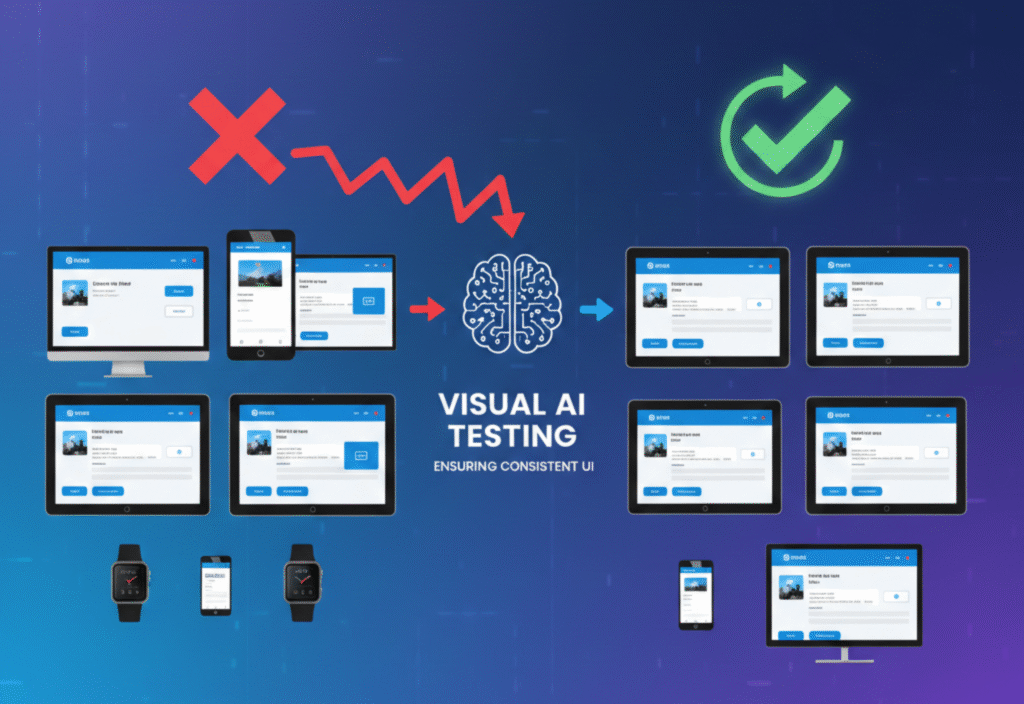
Visual AI Testing UI Consistency has become a critical requirement for modern applications that run across multiple platforms, devices, and screen sizes. Users expect a seamless and visually consistent interface whether they access an app on desktop, mobile, or tablet, making visual accuracy just as important as functionality.
Understanding Visual AI Testing
Visual AI Testing is an advanced testing approach that uses artificial intelligence and machine learning to analyze the visual appearance of an application. Instead of checking only the code or functional behavior, it compares screenshots of the UI and detects visual differences that may affect the user experience.
Visual AI Testing can identify:
Layout shifts
Font inconsistencies
Color changes
Broken or missing UI elements
Overlapping text or buttons
Responsive design issues
Unlike pixel-by-pixel comparison, Visual AI understands context, allowing it to ignore irrelevant changes (like dynamic content) while highlighting real visual defects.
The Challenge of UI Consistency Across Platforms
Maintaining UI consistency is harder than it seems. Applications today must support:
Multiple browsers (Chrome, Firefox, Safari, Edge)
Different operating systems (Windows, macOS, Android, iOS)
Various screen sizes and resolutions
Frequent UI updates and design changes
Even a minor CSS change or browser update can cause unexpected visual issues on certain devices. Manually testing all these combinations is time-consuming, expensive, and error-prone.
Why Traditional Testing Is Not Enough
Traditional automated testing focuses mainly on functional correctness—checking whether buttons work, forms submit, or APIs respond correctly. While this is important, it completely ignores how the UI looks.
Limitations of Traditional Testing:
Cannot detect visual misalignments
Misses design regressions
Fails to catch responsive UI issues
Requires constant script maintenance
Relies heavily on manual visual checks
As a result, many visual bugs reach production, affecting real users.
Why Visual AI Testing Is Essential
1. Ensures True UI Consistency
Visual AI Testing validates that the UI appears the same across all platforms and devices. It ensures that branding, layout, fonts, and colors remain consistent, providing a unified user experience.
2. Detects Visual Bugs Early
By catching visual regressions during development, Visual AI Testing prevents UI defects from reaching production. This reduces costly fixes and emergency rollbacks.
3. Saves Time and Cost
Manual visual testing is slow and repetitive. Visual AI Testing automates visual validation, significantly reducing testing time while improving coverage.
4. Improves User Experience
Users judge an application within seconds. A visually broken UI can instantly drive users away. Visual AI Testing ensures a polished and professional interface that builds trust.
5. Scales Easily with Agile and DevOps
Modern development cycles move fast. Visual AI Testing integrates seamlessly with CI/CD pipelines, enabling continuous UI validation with every release.
6. Reduces False Positives
Unlike traditional screenshot comparison tools, Visual AI understands which changes matter and which don’t. This reduces noise and allows teams to focus on real issues.
Visual AI Testing for Responsive Design
Responsive design is a major challenge in UI development. What looks perfect on a desktop may break on a mobile device.
Visual AI Testing:
Validates UI across multiple screen sizes
Detects mobile-specific layout issues
Ensures elements adapt correctly to different resolutions
Confirms touch-friendly spacing and alignment
This makes it invaluable for mobile-first and cross-platform applications.
Visual AI Testing vs Manual Visual Testing
| Feature | Manual Testing | Visual AI Testing |
|---|---|---|
| Speed | Slow | Fast |
| Accuracy | Human error possible | Highly accurate |
| Scalability | Limited | Highly scalable |
| Cost | High over time | Cost-effective |
| Coverage | Partial | Comprehensive |
Visual AI Testing does not replace human testers but enhances their efficiency, allowing them to focus on exploratory and usability testing.
Industries That Benefit Most from Visual AI Testing
Visual AI Testing is especially critical for industries where UI consistency directly impacts revenue and trust, including:
E-commerce platforms
Banking and financial services
SaaS products
Healthcare applications
Media and streaming services
Enterprise software
In these industries, even a small visual glitch can lead to user frustration or financial loss.
The Future of UI Testing
As applications become more complex and design-driven, Visual AI Testing will become a standard requirement rather than an optional tool. With advancements in AI, visual testing tools will become smarter, faster, and more accurate, making UI quality assurance easier than ever.
Organizations that adopt Visual AI Testing early gain a competitive advantage by delivering consistent, high-quality user experiences across all platforms.
Conclusion
Visual AI Testing is no longer a luxury—it is a necessity for modern software development. Traditional testing methods cannot keep up with the growing complexity of cross-platform UI design. Visual AI Testing fills this gap by ensuring visual accuracy, consistency, and reliability.