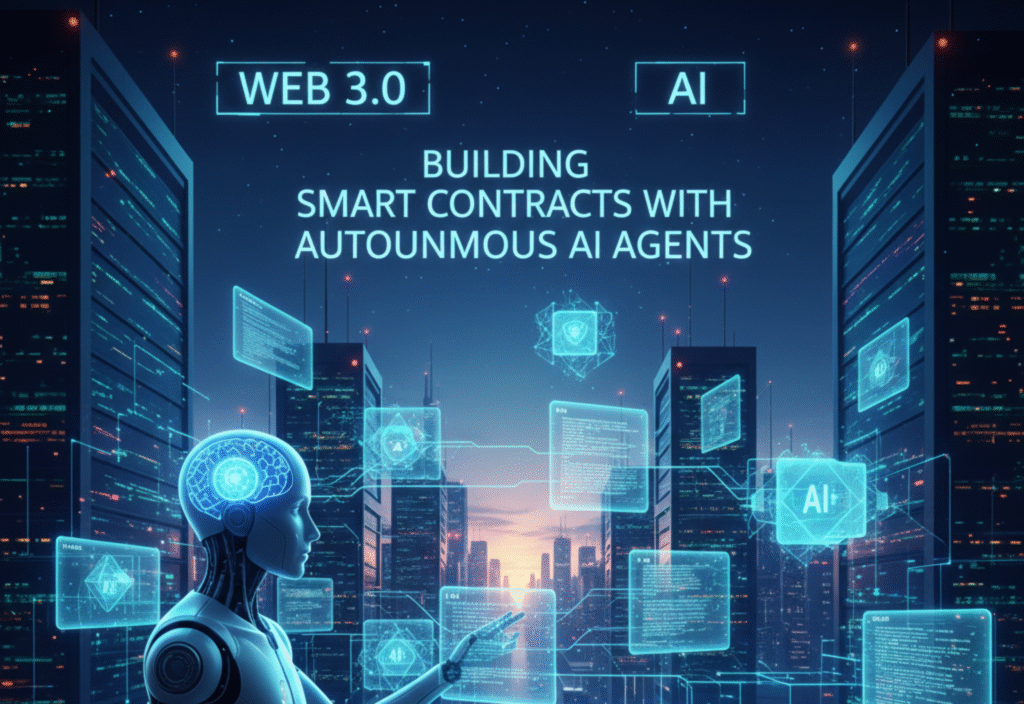
The digital landscape is evolving at a breathtaking pace, driven by innovations in Web 3.0 and artificial intelligence (AI). These two technologies, while powerful on their own, create even greater possibilities when combined. Web 3.0 promises a decentralized internet where users regain control over their data, digital assets, and identity, while AI introduces automation, predictive analytics, and intelligence that can make systems self-learning. One of the most transformative intersections of these fields is in smart contracts—self-executing programs on blockchain networks that can now be enhanced with autonomous AI agents to perform complex, dynamic tasks without human intervention.
This article explores how Web 3.0 and AI are converging, the benefits of AI-powered smart contracts, practical applications, implementation strategies, challenges, and the future possibilities of this revolutionary combination.
Understanding Web 3.0 and Its Role in Smart Contracts
Web 3.0 is the next evolution of the internet, characterized by decentralization, blockchain technology, and user-centric applications. Unlike Web 2.0, where data and control are centralized in the hands of tech giants, Web 3.0 allows users to maintain ownership of their data, digital assets, and identities.
At the core of Web 3.0 is blockchain technology, a secure, transparent, and immutable distributed ledger. On top of these networks, smart contracts operate as self-executing programs that follow predefined rules. For example:
Releasing payments automatically upon product delivery
Distributing royalties to multiple content creators
Managing decentralized finance (DeFi) operations like lending, borrowing, and staking
Traditionally, smart contracts are deterministic, meaning they execute strictly according to pre-set rules. While this ensures reliability and transparency, it limits their adaptability to dynamic, real-world conditions.
Autonomous AI Agents: Making Smart Contracts Smarter
Autonomous AI agents are intelligent software programs capable of performing tasks, making decisions, and learning from data without constant human supervision. Integrating these agents with smart contracts enables:
Dynamic Decision-Making
AI agents can evaluate real-time data and modify contract behavior accordingly. For instance, a DeFi contract could adjust interest rates automatically based on current market conditions, providing optimal returns for users while minimizing risk.Predictive Analytics
AI agents can forecast trends, detect anomalies, and anticipate potential issues. In insurance smart contracts, AI could analyze flight delays, natural disasters, or health data to automatically trigger claims processing, reducing administrative delays.Automated Negotiation
AI agents can negotiate terms with other contracts or agents autonomously. For example, in decentralized marketplaces, AI agents can secure better deals for buyers or sellers without human intervention.Continuous Learning
Unlike traditional smart contracts, which remain static, AI-enhanced contracts can evolve over time. Machine learning models can learn from previous contract executions to improve performance, reduce errors, and adapt to changing conditions.Enhanced Security
AI agents can detect anomalies or suspicious behavior in real-time, adding an extra layer of protection to smart contracts and decentralized systems.
How AI-Powered Smart Contracts Work
Integrating AI with smart contracts requires combining blockchain development skills with AI and machine learning capabilities. Here’s a step-by-step approach:
1. Define Objectives
Start by identifying the purpose of the smart contract and the specific role of the AI agent. Examples include supply chain management, decentralized finance optimization, or autonomous trading.
2. Select a Blockchain Platform
Choose a blockchain that aligns with your project’s needs. Ethereum remains popular due to its extensive smart contract ecosystem, while networks like Solana, Polygon, or Avalanche offer faster transactions and lower fees.
3. Develop the Smart Contract
Use languages such as Solidity (Ethereum) or Rust (Solana) to write contract logic, including:
Conditions for execution
Payment or asset transfer rules
Interfaces for interacting with external data sources
4. Integrate AI Agents
AI agents can be integrated using APIs, decentralized oracles, or on-chain machine learning frameworks. These agents analyze incoming data, make decisions, and influence contract execution.
5. Simulate and Test
Before deployment, simulate multiple scenarios to ensure AI agents make correct decisions and contracts respond appropriately to unexpected events. This helps prevent costly errors or security breaches.
6. Deploy and Monitor
After successful testing, deploy the contract to the blockchain. Continuous monitoring is essential to track AI agent actions, update machine learning models, and ensure compliance with regulations.
Real-World Use Cases
1. Decentralized Finance (DeFi)
AI agents can optimize lending, borrowing, and trading strategies autonomously, maximizing user returns while reducing risks. Dynamic interest rate adjustment, portfolio rebalancing, and predictive risk analysis are possible.
2. Supply Chain Management
AI-enhanced smart contracts can verify product authenticity, track shipments, and automatically trigger payments when goods are delivered. This increases transparency, reduces fraud, and ensures timely transactions.
3. Insurance
Insurance smart contracts powered by AI can evaluate claims in real-time, detect fraudulent requests, and execute payouts instantly, eliminating delays and reducing administrative costs.
4. NFT Marketplaces
AI agents can dynamically price NFTs, predict market trends, manage royalties for creators, and even assist in automated auctions, making digital asset trading more efficient and profitable.
5. Decentralized Autonomous Organizations (DAOs)
AI agents can automate governance decisions, evaluate proposals, and ensure resource allocation aligns with collective goals, streamlining decision-making in DAOs.
Challenges and Considerations
While promising, integrating AI with smart contracts is not without hurdles:
Security Risks: Increased complexity introduces potential vulnerabilities. Auditing AI-driven contracts is crucial to prevent exploits.
Data Quality: AI depends on accurate, reliable data. Oracles that provide data to contracts must be trustworthy.
Regulatory Compliance: Autonomous contracts in finance, insurance, or healthcare must comply with local laws and regulations, which are evolving rapidly.
Explainability: AI decisions can be opaque. Users and regulators need transparency mechanisms to understand contract actions.
Resource Management: AI computation can be resource-intensive. Efficient models are necessary to avoid high on-chain costs.
The Future of AI and Web 3.0
The integration of AI with Web 3.0 signals a future where smart contracts are no longer rigid, rule-bound programs but intelligent, self-learning systems. This convergence could lead to:
Fully autonomous financial systems
Smart supply chains that predict and adapt to disruptions
Decentralized marketplaces operating efficiently without human intermediaries
Governance models in DAOs that are faster, fairer, and data-driven
As blockchain networks scale and AI models grow more sophisticated, autonomous AI agents will play an increasingly vital role in executing and optimizing smart contracts, ushering in a truly intelligent decentralized ecosystem.