Financial markets never move in a straight line. They move through different regimes — periods of high volatility, low volatility, strong trends, sideways consolidations, and sudden crashes.
For traders and quantitative analysts, identifying these regimes correctly is one of the most important tasks, because a strategy that works in one regime often fails completely in another.
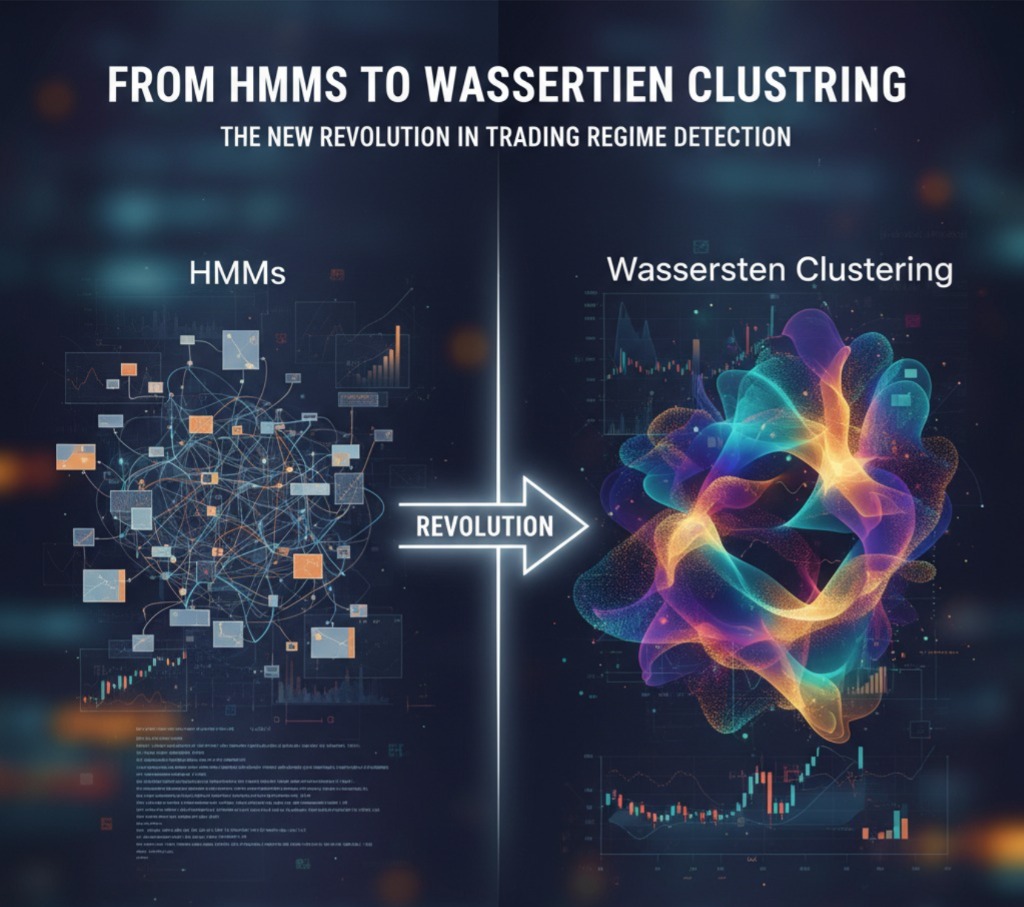
In recent years, Wasserstein Clustering in trading regime detection has emerged as a powerful alternative to traditional methods like Hidden Markov Models (HMMs). This approach allows traders to better understand market structure and adapt more effectively to changing conditions.
Understanding Trading Regimes
A trading regime is simply a market environment defined by specific characteristics such as:
Volatility level (high or low)
Trend strength (trending or ranging)
Liquidity conditions
Market momentum
Behavioral patterns of market participants
For example:
A strong bull market with low volatility is one regime.
A high-volatility bear market crash is another regime.
A slow sideways consolidation is another.
Different regimes require different trading strategies. If a trader can accurately detect regime changes, they can adjust their strategy before losses occur.
Why Traditional HMMs Are No Longer Enough
Hidden Markov Models (HMMs) have been widely used in regime detection for years.
They assume that the market switches between hidden states and that each state has certain observable characteristics.
However, modern markets have changed significantly.
Limitations of HMMs in Today’s Markets:
Markets are no longer smooth — they are highly chaotic and noisy.
Regimes often overlap instead of switching cleanly.
High-frequency trading creates micro-structure noise.
Global events change market conditions within minutes.
AI trading systems create complex feedback loops.
HMMs rely heavily on probabilistic transitions between clear states. But in reality, market regimes are not always clean or linear.
This is where Wasserstein Clustering becomes far more effective.
What is Wasserstein Clustering?
Wasserstein Clustering is based on optimal transport theory.
Instead of only comparing probabilities like HMMs, it compares the entire distribution of market data.
It measures the “cost” or “effort” needed to transform one data distribution into another.
This allows it to capture deeper structural changes in the market.
In trading regime detection, Wasserstein Clustering helps analyze:
Price movement distributions
Volatility distributions
Return patterns
Order flow structure
Market microstructure
Instead of just asking “What state are we in?”,
it asks “How different is the current market behavior from previous market behaviors?”
How Wasserstein Clustering Helps in Trading Regime Detection
1. Identifying Clear Market Transitions
It detects when the market starts behaving differently at a structural level, not just statistically.
2. Detecting Subtle Regime Shifts
Even small changes in volatility structure or liquidity flow can be identified early.
3. Handling Overlapping Regimes
Unlike HMMs, this method handles mixed market behavior much better.
4. Adapting to Non-Linear Market Behavior
Markets are rarely linear. Wasserstein Clustering handles complexity without assuming clean state separation.
Real-World Applications in Trading
Wasserstein Clustering is useful in many real-world trading scenarios:
1. Strategy Switching
A trader can switch between trend-following and mean-reversion strategies based on the detected regime.
2. Risk Management
When a high-risk regime is detected, position sizes can be reduced automatically.
3. Portfolio Allocation
Different asset classes behave differently in different regimes. This method helps rebalance intelligently.
4. Algorithmic Trading
Quants can integrate Wasserstein Clustering into their trading bots for real-time regime detection.
Why It’s Superior to Other Clustering Methods
Compared to normal clustering (like K-Means or Gaussian Mixture Models), Wasserstein Clustering offers:
Better handling of complex distributions
Robustness to noise
More accurate detection of structural market changes
More meaningful distance measurement between regimes
It captures the shape of the data, not just averages or variances.
The Role of AI and Machine Learning
Wasserstein Clustering works exceptionally well with modern AI systems.
When combined with:
Neural networks
Reinforcement learning
Deep learning models
It creates intelligent regime detection systems that can adapt in real-time.
These systems can identify:
Momentum regime changes
Volatility explosions
Liquidity dry-ups
Structural market breaks
Much faster than any traditional method.
Risks and Limitations
Even though Wasserstein Clustering is powerful, it’s not perfect.
Some challenges include:
High computational cost
Requires strong mathematical understanding
Needs good data preprocessing
Interpretation requires domain knowledge
However, compared to older models, it still offers far superior performance in complex markets.
The Future of Trading Regime Detection
As markets continue to evolve, simplistic models will become less effective.
Wasserstein-based regime detection is likely to become a standard tool in quantitative trading.
Professional traders and institutions are increasingly moving towards methods that:
Understand structure instead of just statistics
Adapt to changing conditions dynamically
Integrate seamlessly with AI-driven systems
In the future, successful traders will not just predict price —
they will predict market behavior shifts before they fully unfold.
Conclusion
The financial market is no longer a simple game of indicators and patterns.
It is a complex, dynamic system driven by algorithms, global events, and human psychology.
Wasserstein Clustering in trading regime detection provides a modern solution to this complexity.
It allows traders to identify regime changes more accurately, reduce risk, and improve strategy performance.
For those serious about quantitative trading and market analysis, understanding and applying this approach could be a major competitive advantage.