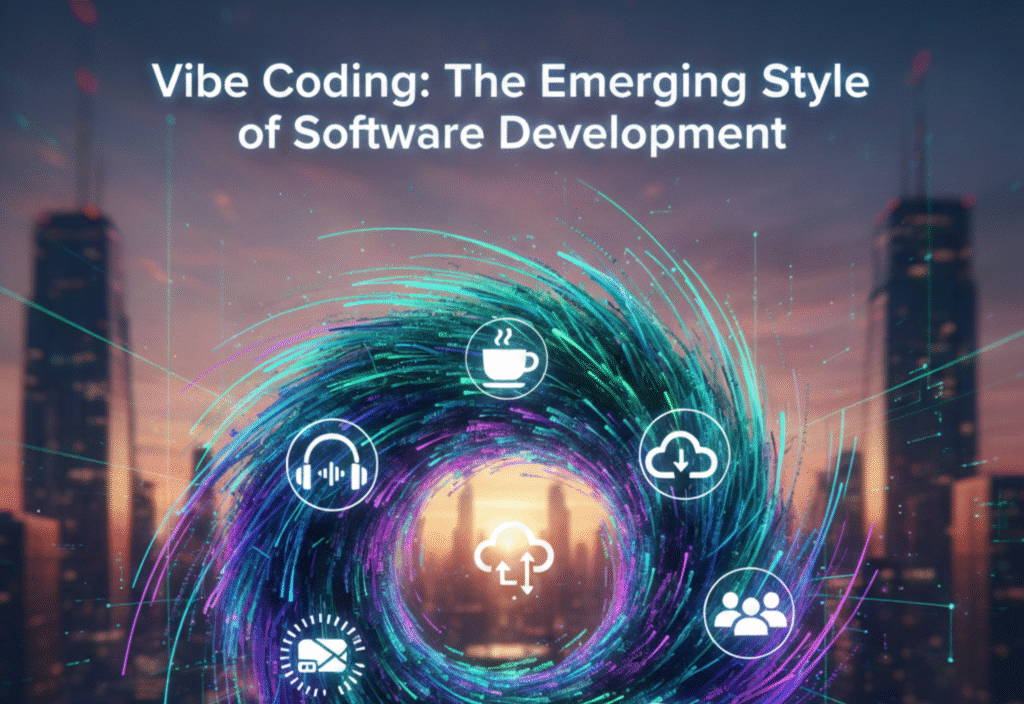
Vibe Coding is transforming how software is created. Unlike traditional programming that focuses on syntax and manual implementation, this method emphasizes intent, clarity, and collaboration with AI tools. By prioritizing what developers aim to achieve, this approach enables faster, more efficient, and responsible software development.
Over time, software development has evolved from machine-level instructions to high-level programming languages, frameworks, and AI-assisted platforms. Today, this emerging style represents the next step, focusing on intent-driven development and ethical, human-centered design.
What Is Vibe Coding?
Vibe Coding is a development approach where the goal and behavior of software are clearly defined before implementation. Developers describe desired outcomes, constraints, and system behavior, while AI assists in generating functional code.
Key aspects include:
Intent-driven development: Focus on what the system should do rather than how each line is coded.
Human-AI collaboration: AI aids in generating code, but developers maintain oversight.
Ethical software creation: Ensures security, privacy, and transparency.
Why Vibe Coding Matters
1. Managing Modern Software Complexity
Applications today are distributed, cloud-native, and integrated with multiple services. Writing every line manually is inefficient. This approach allows developers to work at a higher abstraction level, focusing on system behavior rather than repetitive coding.
2. Leveraging AI Assistance
Modern AI tools can:
Generate code
Refactor logic
Detect errors
Suggest workflow improvements
By combining human intent with AI support, developers can achieve faster and more reliable outcomes.
3. Faster and Responsible Development
Organizations demand rapid iteration without compromising quality or ethics. Intent-driven coding enables secure and efficient development while keeping human oversight intact.
How It Works
Step 1: Define Intent
Development starts by clearly specifying:
The problem to solve
Desired behaviors
Security, privacy, and usability constraints
Example:
“Build a secure onboarding system that adapts to user behavior while safeguarding sensitive information.”
Step 2: AI-Assisted Implementation
AI tools generate code structures, workflows, and documentation from the defined intent.
Step 3: Human Review
Developers validate outputs to ensure:
Correctness
Ethical compliance
Alignment with business requirements
This ensures AI enhances productivity without replacing human responsibility.
Benefits of Vibe Coding
Increased Productivity
Developers can focus on architecture, system design, and user experience by reducing repetitive coding tasks.Enhanced Collaboration
Clear intent allows product managers, designers, and domain experts to contribute meaningfully.Ethical and Transparent Development
Decisions are explainable, systems are trustworthy, and accountability is maintained.
Challenges and Best Practices
Responsible use of this style is essential:
Ambiguity: Ensure instructions to AI are clear to prevent misinterpretation.
Code Quality and Security: Always audit and test AI-generated code.
Avoid Over-Reliance on AI: Developers must maintain control and judgment.
By following these guidelines, developers can maximize benefits while minimizing risks.
Vibe Coding vs Traditional Development
| Traditional Development | Vibe Coding |
|---|---|
| Syntax-focused | Intent-focused |
| Manual coding | AI-assisted generation |
| Slower prototyping | Rapid iteration |
| Developer-only workflow | Human + AI collaboration |
This emerging style complements rather than replaces traditional methods.
Who Can Benefit
Startups building MVPs
AI-native organizations exploring rapid prototyping
Educational institutions teaching modern coding
Enterprises managing complex, distributed systems
For sensitive applications, combine this approach with stricter validation and review.
The Future of Vibe Coding
As AI improves in understanding context, constraints, and ethics, intent-driven development will become standard. Developers will focus on guiding AI, ensuring ethical, secure, and reliable software creation.
This represents a shift toward human-centered, responsible, and efficient development.
Conclusion
Vibe Coding is redefining software development. By focusing on intent, collaboration, and ethical practices, it empowers developers to create secure, reliable, and user-friendly applications. This approach demonstrates how humans and AI can work together responsibly to build meaningful software.