The AI alone capabilities are often misunderstood. Artificial Intelligence (AI) has exploded in popularity, promising to generate text, images, music, and even entire websites. But what can AI truly build by itself, and where do human skills remain essential?
What AI Can Do Today
AI tools have made remarkable strides, and some things are genuinely impressive:
1. Content Generation
Modern AI language models, like GPT-4 and its successors, can generate:
Articles, blogs, and essays
Social media content
Marketing copy and ad campaigns
Code snippets in multiple programming languages
Reality check: While AI can generate coherent and structured text, it often needs human oversight for accuracy, tone, and context. For example, complex technical documentation or highly niche topics may still require expert intervention.
2. Image and Video Creation
AI-powered image generators like DALL·E, MidJourney, and Stable Diffusion can:
Produce photorealistic or stylized images from prompts
Generate concept art, illustrations, and marketing visuals
Even create short AI-assisted videos
Reality check: AI-generated images are impressive, but they often require multiple iterations, prompt engineering, and human curation. AI cannot fully understand cultural context, ethical considerations, or branding guidelines without guidance.
3. Code Automation and Development
AI coding assistants like GitHub Copilot or Tabnine can:
Write boilerplate code
Suggest solutions to programming problems
Generate simple applications
Reality check: AI can speed up development but cannot replace a human developer entirely. Complex projects, architecture design, debugging, and system integration still require human decision-making.
4. Music and Audio Production
AI tools like AIVA, Amper Music, and OpenAI’s Jukebox can:
Compose original music tracks
Generate background scores and sound effects
Convert text prompts into musical compositions
Reality check: While AI can create unique music, human input is often needed to guide style, emotion, and quality. AI compositions may feel generic without careful editing and mixing.
5. AI in Business Processes
AI is increasingly used to automate workflows:
Customer service chatbots
Data analysis and predictive insights
Automated reporting and summarization
Reality check: AI can handle repetitive tasks effectively, but decision-making, strategy, and creative problem-solving remain human responsibilities.
What AI Cannot Do (Yet)
Despite the hype, AI has clear limitations:
True Creativity: AI can remix existing ideas but struggles with genuine innovation that requires context and human emotion.
Ethics and Morality: AI cannot inherently understand what is ethically right or wrong without human guidance.
Complex Project Management: Building large-scale applications, coordinating teams, and integrating multiple systems still requires human oversight.
Contextual Understanding: AI often fails to grasp nuance, humor, or cultural references fully.
The Middle Ground: AI + Human Collaboration
The most practical approach today is human + AI collaboration:
Humans guide strategy, creativity, and quality
AI handles repetitive tasks, ideation, and rapid prototyping
For example:
Designers use AI for initial mockups but refine visuals manually
Developers use AI to generate boilerplate code but architect systems themselves
Writers use AI for draft content but edit for style and accuracy
This combination allows for faster iteration, cost savings, and innovative results, while avoiding the pitfalls of relying entirely on AI.
Case Studies: What People Are Actually Building
AI-Generated Blogs & Newsletters: Startups use AI to draft content, then human editors polish it.
Marketing & Social Media Campaigns: AI generates multiple ad variations quickly, enabling rapid A/B testing.
Prototyping Apps: Entrepreneurs use AI to create MVPs (Minimum Viable Products) with functional front-ends and basic back-end logic.
Art & Music Projects: Indie creators experiment with AI-generated art and music, then adapt it for commercial or personal use.
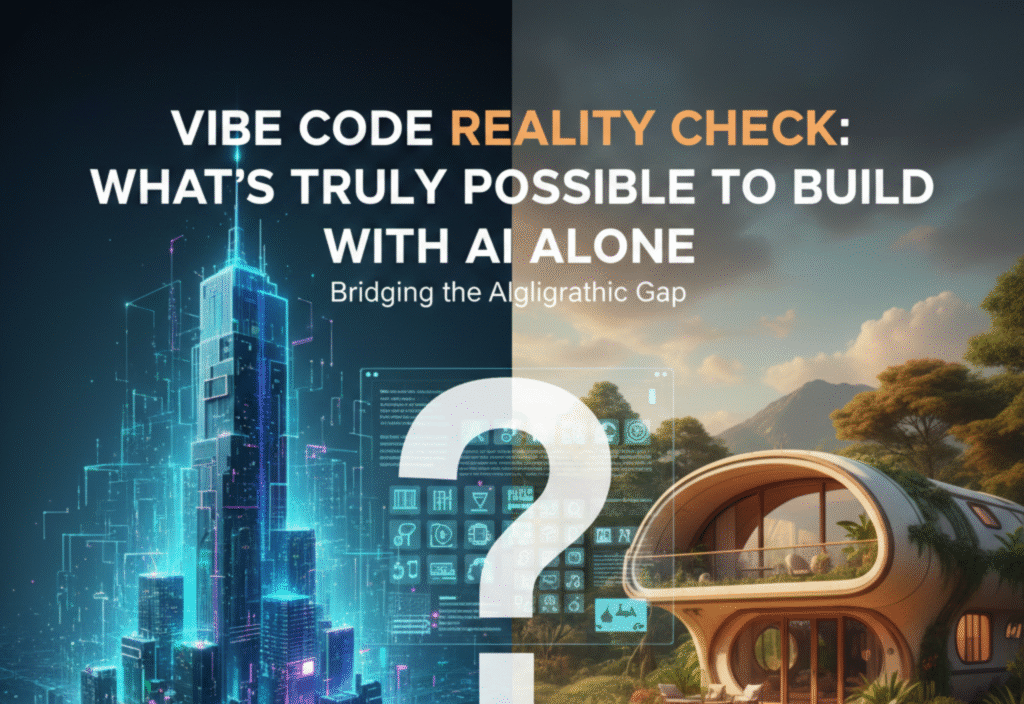
Conclusion: The Vibe Code Reality Check
AI alone is not a magic wand, but it is a powerful collaborator. Today’s AI can accelerate creative and technical workflows, generate ideas, and handle repetitive tasks, but human judgment, creativity, and strategy remain essential.