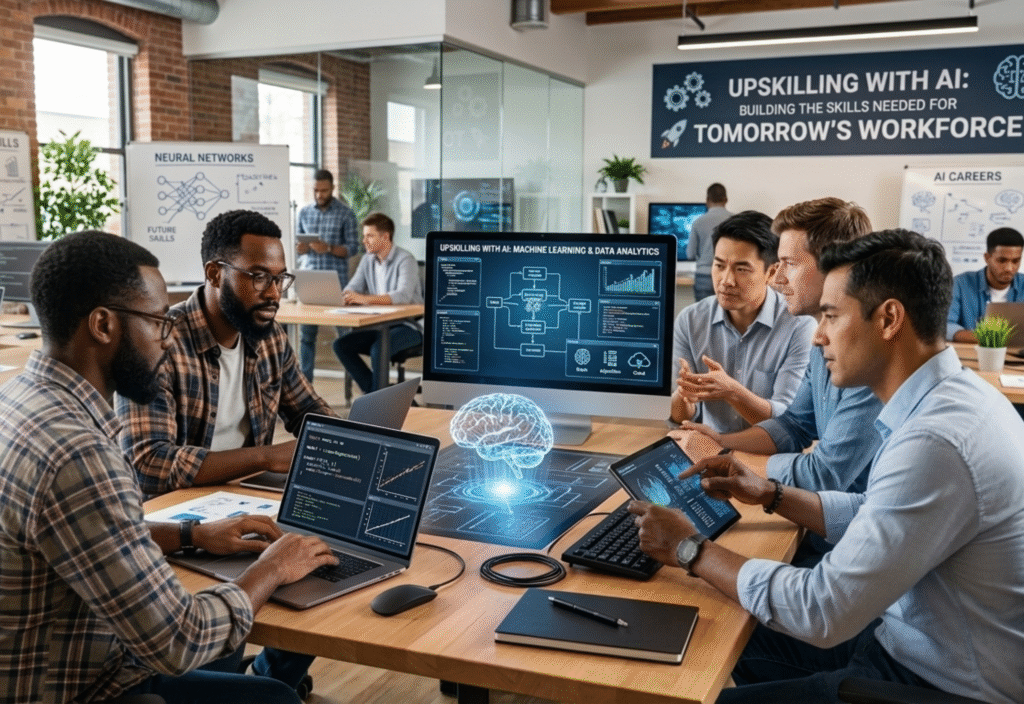
As the pace of technological change accelerates, the modern workforce faces an unprecedented challenge: keeping skills relevant in a rapidly evolving environment. Artificial Intelligence (AI) is no longer a futuristic concept—it is reshaping industries, job roles, and daily business operations. For employees and organizations to thrive, upskilling with AI has become an essential strategy, allowing individuals to acquire the knowledge and abilities needed to succeed in tomorrow’s workplace.
AI is transforming the way we work. Routine tasks are increasingly automated, decision-making is more data-driven, and companies are leveraging AI to enhance productivity, customer experience, and innovation. This evolution requires workers to not only understand technology but also learn how to collaborate effectively with AI systems.
In this article, we will explore why AI upskilling is critical, the most important skills to develop, strategies to implement AI learning, real-world applications, and how this movement is shaping the workforce of the future.
Why AI Upskilling is Critical
The rise of AI has profound implications for the global workforce. Research shows that a large percentage of jobs will be transformed by AI and automation in the next decade. This does not necessarily mean job loss; rather, the nature of work is changing. Roles increasingly require digital literacy, critical thinking, and the ability to work alongside AI-powered tools.
Employees who embrace AI upskilling will benefit from:
Enhanced employability: Workers with AI and data skills remain in high demand.
Better decision-making: AI knowledge enables employees to use insights effectively.
Adaptability: Employees can navigate technological shifts with confidence.
For organizations, the benefits are equally significant. Companies with AI-literate teams are more innovative, efficient, and capable of implementing AI-driven solutions across departments. In addition, they can respond more quickly to market changes and customer needs.
Core Skills for Tomorrow’s Workforce
Upskilling with AI is about more than understanding technology—it’s about combining technical proficiency with human-centric abilities. Here are the key skill areas:
1. Data Literacy
Data is the foundation of AI. Employees must understand how to collect, interpret, and analyze data. This includes:
Using data analytics tools
Visualizing data insights for decision-making
Understanding data quality and accuracy
For example, a marketing professional trained in data literacy can leverage AI to analyze customer behavior, predict trends, and optimize campaigns efficiently.
2. AI and Machine Learning Fundamentals
Even non-technical employees benefit from understanding AI basics:
How AI models function
Common AI applications in their industry
Ethical considerations and bias mitigation
By knowing AI fundamentals, employees can collaborate effectively with technical teams and make informed decisions when implementing AI solutions.
3. Digital Problem-Solving
AI does not replace human problem-solving but enhances it. Employees need to develop skills to:
Integrate AI insights into workflows
Use predictive analytics for decision-making
Optimize processes with AI recommendations
For instance, a supply chain manager might use AI to predict inventory shortages and adjust logistics plans accordingly, saving costs and improving efficiency.
4. Human-Centric Skills
Soft skills remain essential in the AI era. Workers must excel in:
Leadership in AI-driven projects
Collaboration across hybrid human-AI teams
Creativity and innovation in applying AI to solve business challenges
These skills ensure that employees complement AI rather than compete with it, making technology a tool to amplify human potential.
Effective Strategies for AI Upskilling
Implementing AI upskilling initiatives requires careful planning. Organizations and individuals can adopt several strategies to maximize learning outcomes:
1. Personalized Learning Paths
Employees have different starting points and career goals. Tailored learning programs help each person develop skills relevant to their role and experience level.
2. Hands-On Learning
Practical experience is key. Working directly with AI tools, participating in projects, and experimenting with AI applications accelerate learning and build confidence.
3. Continuous Learning Culture
AI and technology evolve rapidly. Encouraging employees to participate in ongoing training, workshops, and online courses ensures skills remain up-to-date.
4. Cross-Functional Collaboration
Collaboration between departments exposes employees to diverse applications of AI. For example, marketing teams working with data scientists can learn to use AI for personalized campaigns, while HR teams may implement AI in recruitment or performance analytics.
Real-World Applications of AI Upskilling
AI skills are valuable across all industries. Some examples include:
Healthcare: Medical staff trained in AI can analyze patient data, support predictive diagnostics, and optimize treatment plans.
Finance: Professionals can leverage AI for fraud detection, credit scoring, and risk management.
Marketing: AI skills allow teams to analyze customer data, personalize campaigns, and forecast trends.
Manufacturing: Employees can use AI-driven predictive maintenance, quality control, and inventory management.
Education: Teachers and administrators can implement AI tools to personalize learning and analyze student performance.
These examples illustrate that AI upskilling is relevant for both technical and non-technical roles.
Benefits of AI Upskilling
For Employees:
Increased employability and career mobility
Enhanced problem-solving capabilities
Improved confidence in using AI tools
For Organizations:
Greater efficiency and productivity
Improved decision-making using AI insights
Increased innovation and competitive advantage
Better talent retention and attraction
By investing in upskilling, organizations can create a workforce that is adaptable, knowledgeable, and ready for the future.
Overcoming Challenges
While AI upskilling provides significant benefits, challenges exist:
Resistance to Change: Employees may fear AI replacing jobs. Clear communication about AI as an assistant, not a replacement, is essential.
Resource Constraints: Training programs require investment. Online courses and free AI tools can help mitigate costs.
Rapid Technological Evolution: AI technologies evolve quickly. Continuous learning initiatives are necessary to avoid skill gaps.
Organizations that proactively address these challenges create a culture of adaptability and growth.
The Future of the Workforce
AI will continue to reshape industries, but humans remain central to the process. The workforce of tomorrow will be a collaboration between people and intelligent machines. Employees with AI skills will be able to make better decisions, innovate faster, and take on strategic roles that require creativity, empathy, and judgment.
By upskilling today, workers prepare for a future where AI is a co-worker, decision-support tool, and productivity enhancer, rather than a threat. Organizations that prioritize AI learning gain a competitive advantage while empowering their employees to thrive in a dynamic environment.
Conclusion
Upskilling with AI is not optional—it is a necessity. Employees who develop skills in data literacy, AI fundamentals, problem-solving, and human-centric capabilities will be better equipped for tomorrow’s workforce. Organizations that invest in AI learning programs foster innovation, productivity, and adaptability.
The combination of human expertise and AI intelligence will define the workforce of the future. By embracing AI upskilling, both employees and organizations can create a smarter, more capable, and resilient workplace, ready to meet the challenges and opportunities of the next decade.
As technology continues to evolve at an unprecedented pace, businesses and employees alike face the pressing need to adapt. Artificial Intelligence (AI) is no longer a futuristic concept—it is transforming industries, workflows, and job roles across the globe. To remain competitive, workers must embrace upskilling with AI, acquiring new skills that match the demands of tomorrow’s workforce.
This article explores why AI upskilling is crucial, the skills most in demand, strategies to implement learning, and the long-term benefits for both employees and organizations.
Why AI Upskilling Matters
The rise of AI technologies is reshaping job markets. Repetitive tasks are increasingly automated, and decision-making processes are becoming data-driven. According to industry studies, a significant portion of current roles will evolve, with new skill requirements emerging in AI literacy, data analysis, and digital problem-solving.
Upskilling with AI ensures that employees:
Stay relevant in rapidly changing industries
Contribute to AI-driven projects and decision-making
Develop a growth mindset that aligns with technological advancements
Organizations benefit as well, by building teams that are adaptable, innovative, and capable of leveraging AI to drive efficiency and competitiveness.
Key Skills Needed for Tomorrow’s Workforce
AI upskilling is not limited to understanding machine learning models. The modern workforce needs a combination of technical, analytical, and human-centric skills.
1. Data Literacy and Analysis
Understanding and interpreting data is essential. Employees should be able to:
Extract insights from data sets
Visualize information for decision-making
Use AI-powered analytics tools effectively
2. AI and Machine Learning Basics
Even non-technical workers benefit from understanding:
How AI models work
Practical applications of AI in their industry
Ethical considerations in AI deployment
3. Digital Problem-Solving
AI complements human problem-solving by providing insights and predictive analytics. Employees need to:
Integrate AI recommendations into workflows
Adapt processes based on data-driven insights
Collaborate with AI tools to enhance productivity
4. Soft Skills Enhanced by AI
Human skills remain critical. AI cannot replace empathy, creativity, or communication. Upskilling should include:
Leadership in AI-driven projects
Effective teamwork in hybrid human-AI environments
Creativity in leveraging AI to innovate processes
Strategies for Effective AI Upskilling
Organizations and individuals can adopt various strategies to ensure successful AI skill development.
1. Personalized Learning Paths
Each employee has different proficiency levels. Tailored training programs ensure that workers receive relevant instruction, whether they are beginners or advanced users.
2. Hands-On Experience
Learning by doing is highly effective. Employees should work with AI tools, participate in projects, and experiment with AI-driven decision-making.
3. Continuous Learning Culture
AI and technology evolve rapidly. Encouraging continuous learning through workshops, online courses, and mentorship ensures that skills remain up to date.
4. Collaboration Between Departments
Cross-functional teams help employees understand AI applications in diverse contexts. For instance, marketing teams can collaborate with data scientists to implement AI-driven campaigns.
Real-World Applications of AI Upskilling
Upskilling with AI has practical benefits across industries:
Healthcare: Staff trained in AI can analyze patient data, optimize treatment plans, and support predictive diagnostics.
Finance: Employees learn to use AI for fraud detection, risk assessment, and automated reporting.
Marketing: Teams use AI to analyze customer behavior, personalize campaigns, and predict trends.
Manufacturing: Workers use AI-driven predictive maintenance, quality control, and supply chain optimization.
These examples demonstrate that AI skills are not limited to tech roles—they are valuable across all sectors.
Benefits of AI Upskilling
Both employees and organizations reap rewards from AI-focused learning initiatives.
For Employees:
Increased employability and career growth
Enhanced ability to solve complex problems
Improved confidence in working alongside AI
For Organizations:
Higher productivity and efficiency
Better decision-making through AI insights
Stronger adaptability to market changes
Talent retention and attraction
Overcoming Challenges in AI Upskilling
While upskilling offers many advantages, challenges exist:
Resistance to Change: Employees may fear AI replacing their jobs. Communicating the value of AI as a tool, not a replacement, is essential.
Resource Limitations: Companies must invest in training programs, which can be costly. Leveraging online courses and open-source AI tools can mitigate costs.
Rapid Technology Evolution: AI evolves quickly; continuous learning is crucial to avoid skill gaps.
Addressing these challenges ensures sustainable and effective upskilling programs.
Future Outlook
As AI becomes more integrated into workplaces, upskilling will be less optional and more essential. Employees who embrace AI learning will be better equipped for roles that demand adaptability, creativity, and technical acumen. Meanwhile, organizations that foster AI literacy will remain competitive, innovative, and resilient in the face of change.
AI is transforming the workforce, but humans remain central. Upskilling ensures that technology enhances human potential rather than replaces it.
Conclusion
Upskilling with AI is a strategic necessity for both employees and organizations. By developing skills in data literacy, AI basics, problem-solving, and human-centric competencies, the workforce can thrive in an AI-driven world.
Investing in AI learning today prepares individuals and organizations for the challenges of tomorrow, creating a future where humans and AI collaborate effectively, driving innovation, productivity, and sustainable growth.