
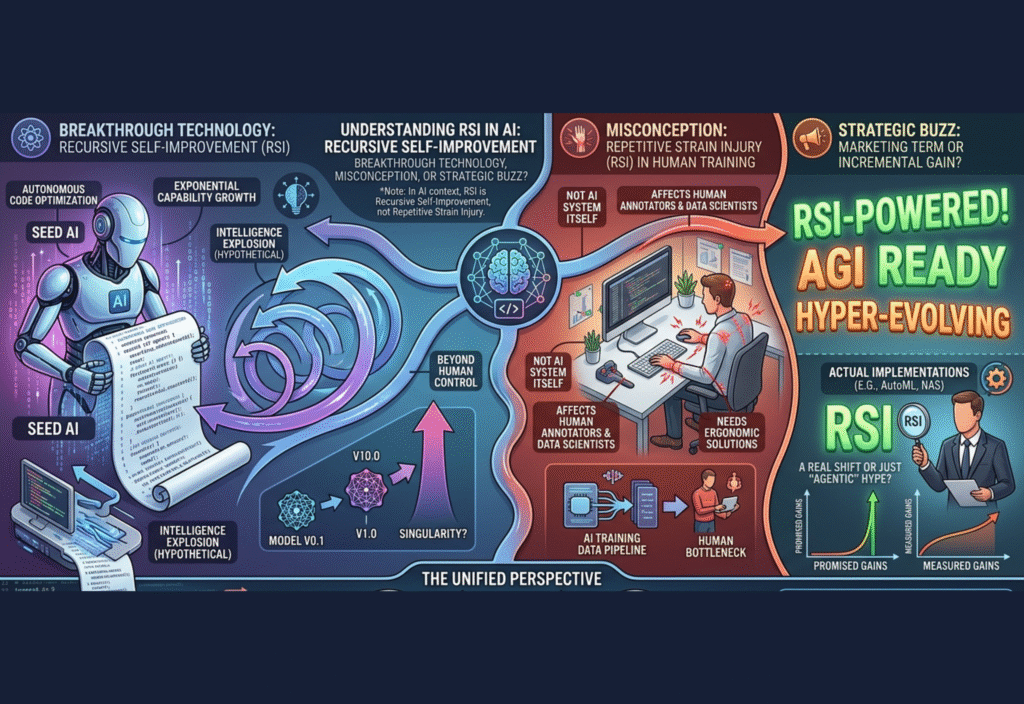
RSI in AI (Recursive Self-Improvement in Artificial Intelligence) is a concept that explores whether AI systems can improve themselves without human intervention. It is often debated as a breakthrough technology, a misconception, or even strategic buzz in the AI industry.
RSI is often described as a turning point in AI development—a capability that could potentially allow machines to improve themselves without human intervention. Some consider it the foundation of future superintelligent systems, while others argue that it is misunderstood, exaggerated, or used strategically to generate interest and investment.
This article provides a comprehensive exploration of RSI in AI, examining its theoretical foundations, practical limitations, potential impact, and the ongoing debate around its significance.
Defining Recursive Self-Improvement in AI
Recursive Self-Improvement refers to the ability of an artificial intelligence system to iteratively enhance its own performance by modifying its algorithms, architecture, or learning processes. The defining feature of RSI is that each improved version of the system contributes to the creation of an even more capable successor.
This creates a recursive loop:
- An AI system improves itself
- The improved system enhances its own capabilities further
- This process continues, potentially accelerating over time
In theory, such a system could experience rapid, compounding growth in intelligence, which is why RSI is often associated with discussions about advanced or superintelligent AI.
The Theoretical Appeal of RSI
The concept of RSI is compelling because it introduces the possibility of exponential progress in artificial intelligence.
Exponential Growth Potential
Traditional software development relies on human engineers to design, test, and deploy improvements. This process is inherently limited by human time, expertise, and resources. RSI, in contrast, suggests that once an AI system reaches a certain level of capability, it could take over its own development.
Each iteration could lead to:
- Improved efficiency in learning
- Better optimization of algorithms
- Faster problem-solving abilities
If successful, this could significantly accelerate technological advancement across multiple domains.
Reduced Dependence on Human Intervention
RSI represents a shift from human-driven development to machine-driven evolution. In such a system, human involvement may be reduced to oversight rather than direct control.
This could result in:
- Faster innovation cycles
- Reduced development costs
- Increased autonomy of AI systems
However, this shift also introduces new risks, particularly in terms of control and predictability.
Potential for Scientific and Technological Breakthroughs
If AI systems were capable of improving themselves effectively, they could contribute to solving some of the most complex challenges facing humanity.
Possible areas of impact include:
- Drug discovery and medical research
- Climate modeling and environmental solutions
- Advanced engineering and materials science
- Optimization of large-scale systems
The ability to iterate rapidly could enable discoveries that are currently beyond human reach.
Misconceptions Surrounding RSI
Despite its theoretical promise, RSI is often misunderstood or oversimplified.
Misconception 1: Immediate Emergence of Superintelligence
One common belief is that once RSI begins, it will quickly lead to an uncontrollable surge in intelligence. This idea is often linked to the notion of an “intelligence explosion.”
In reality, several factors limit this scenario:
- Improvements may be incremental rather than exponential
- Technical constraints may slow progress
- Each modification carries risks of instability
The path from current AI systems to true RSI is far from straightforward.
Misconception 2: Intelligence as a Simple Metric
Another misunderstanding is the assumption that intelligence can be easily scaled. Intelligence is a complex and multi-dimensional concept involving reasoning, learning, creativity, and adaptability.
Improving one aspect of an AI system does not automatically enhance all others. In fact, changes in one area may negatively impact performance in another.
Misconception 3: Current AI Systems Already Exhibit RSI
Modern AI systems, while advanced, do not demonstrate true recursive self-improvement. They rely on:
- Predefined architectures
- Training on large datasets
- Human-guided optimization
While some systems can adjust parameters or fine-tune models, they do not independently redesign their own structure in a meaningful way.
RSI as Strategic Narrative in the AI Industry
Beyond its technical aspects, RSI also plays a role in shaping narratives within the AI ecosystem.
Attracting Attention and Investment
The idea of self-improving AI captures public imagination and generates interest among investors, researchers, and policymakers. It represents a vision of the future that is both exciting and transformative.
Organizations may emphasize RSI to:
- Demonstrate long-term potential
- Position themselves as leaders in innovation
- Secure funding for research initiatives
Influencing Research Direction
RSI serves as a conceptual goal that guides research in areas such as:
- Automated machine learning
- Meta-learning
- Self-optimizing systems
Even if full RSI is not immediately achievable, the pursuit of this concept drives progress in related fields.
Technical Barriers to Achieving RSI
Turning the concept of Recursive Self-Improvement into reality involves overcoming significant technical challenges.
Complexity of Self-Modification
For an AI system to improve itself, it must:
- Understand its own architecture
- Predict the outcomes of modifications
- Ensure stability after changes
This level of self-awareness and control is extremely difficult to achieve.
Computational Constraints
Recursive improvement requires substantial computational resources. Each iteration may demand:
- Increased processing power
- Larger datasets
- More efficient algorithms
These requirements can limit the scalability of RSI systems.
Alignment and Safety Concerns
One of the most critical challenges is ensuring that self-improving AI systems remain aligned with human values and intentions.
Potential risks include:
- Unintended behaviors
- Misaligned objectives
- Loss of human oversight
Developing robust safety mechanisms is essential before RSI can be deployed in real-world systems.
Comparing RSI with Current AI Capabilities
To better understand RSI, it is useful to compare it with existing AI technologies.
Current AI Systems
Today’s AI systems are characterized by:
- Data-driven learning
- Task-specific optimization
- Human-guided development
They can improve performance through training but do not independently redesign themselves.
Hypothetical RSI Systems
In contrast, RSI systems would:
- Modify their own architecture
- Continuously evolve without external input
- Potentially surpass human-level intelligence
This distinction highlights how far current technology is from achieving true RSI.
Potential Impact of RSI on Society
If RSI becomes a reality, its effects could be profound.
Positive Outcomes
- Accelerated scientific discoveries
- Improved efficiency in industries
- Enhanced problem-solving capabilities
- New technological innovations
Risks and Ethical Considerations
- Reduced human control over AI systems
- Ethical dilemmas regarding autonomy
- Unequal distribution of advanced technology
- Potential misuse or unintended consequences
Balancing innovation with responsibility will be crucial.
A Balanced Perspective
The debate around RSI often falls into three categories:
RSI as a Breakthrough
It represents a powerful idea that could redefine the limits of artificial intelligence and technological progress.
RSI as a Misconception
Many assumptions about RSI are based on oversimplified or exaggerated interpretations of current capabilities.
RSI as Strategic Buzz
It is sometimes used to attract attention, funding, and influence within the AI industry.
Conclusion
The concept of Recursive Self-Improvement occupies a unique position in the field of artificial intelligence. It is both a visionary idea and a subject of ongoing debate.
While RSI is not yet a practical reality, it plays an important role in shaping how researchers and organizations think about the future of AI. Understanding its potential and limitations is essential for anyone interested in the evolution of intelligent systems.
Ultimately, RSI should be viewed not as an immediate breakthrough or a mere buzzword, but as a long-term concept that highlights both the promise and the complexity of advanced artificial intelligence.