
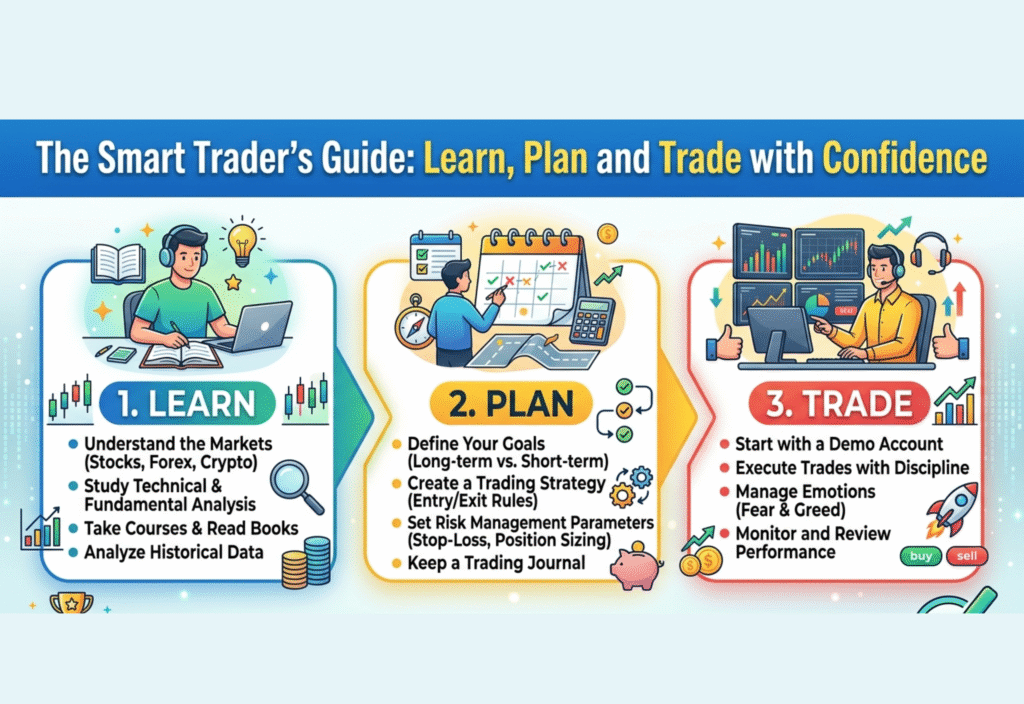
The smart trader’s guide helps you become a confident trader by following a clear plan, strong risk management, and simple strategies. This guide will help you understand how to learn, plan, and trade step by step while building real market skills.
This guide explains everything step by step in a clear and ethical way, helping you build real market skills without shortcuts or risky behavior.
1. What Is a Smart Trader?
A smart trader is not someone who wins every trade, but someone who:
- Follows a clear trading plan
- Manages risk carefully
- Learns from both profits and losses
- Avoids emotional decisions
- Focuses on consistency instead of luck
Smart trading is about discipline, not guessing.
2. Learn Trading Before You Start
Before placing any trade, you must understand the basics of trading:
- What is buying and selling in markets
- Different types of trading (intraday, swing, long-term)
- How markets move (supply and demand)
- Important terms like margin, leverage, and lot size
Without proper knowledge, trading becomes risky and unpredictable.
3. Understand the Market Structure
Markets always move in patterns. Learning these patterns helps you make better decisions.
Types of market trends:
- Uptrend: Prices are making higher highs and higher lows
- Downtrend: Prices are making lower highs and lower lows
- Sideways Market: Price moves within a range
Recognizing trends is one of the most important skills in trading.
4. Learn Technical Analysis Step by Step
Technical analysis is the study of price charts to predict future movements.
Important concepts:
- Support and Resistance: Price levels where reversals often occur
- Trendlines: Show the direction of the market
- Candlestick Patterns: Show buying and selling pressure
- Indicators: Tools like RSI, MACD, Moving Averages
You can practice chart reading on platforms like TradingView, which is widely used by traders worldwide.
5. Learn Fundamental Analysis
Fundamental analysis focuses on real-world events that affect prices:
- Economic news and reports
- Interest rates and inflation
- Government policies
- Company earnings (for stocks)
For example, strong economic data can strengthen a currency, while negative news can weaken it. Understanding fundamentals helps you trade with real market awareness.
6. Create a Proper Trading Plan
A trading plan is your guide for every trade. Without a plan, trading becomes gambling.
A good trading plan includes:
- Entry point (when to buy or sell)
- Exit point (profit target)
- Stop-loss (risk limit)
- Risk-reward ratio
- Time and market conditions
Smart traders always follow their plan strictly.
7. Practice on a Demo Account
Before using real money, practice on a demo account.
Platforms like MetaTrader 4 and MetaTrader 5 provide virtual trading environments.
Benefits of demo trading:
- No financial risk
- Learn trading platform
- Test strategies
- Build confidence
Practice until you feel comfortable and consistent.
8. Risk Management: The Key to Survival
Risk management is more important than making profits.
Follow these essential rules:
- Risk only 1–2% of your capital per trade
- Always use stop-loss
- Avoid high leverage
- Do not overtrade
- Protect your capital first
A smart trader focuses on staying in the game for the long term.
9. Control Your Emotions
Emotions are one of the biggest reasons traders lose money.
Common mistakes:
- Fear of losing
- Greed for more profit
- Revenge trading after a loss
- Overconfidence after a win
To stay disciplined:
- Stick to your plan
- Take breaks when needed
- Accept losses as part of trading
Emotional control is a powerful trading skill.
10. Build Confidence with Practice
Confidence does not come from reading alone—it comes from experience.
To build confidence:
- Start with small trades
- Focus on learning, not earning
- Practice regularly
- Review your trades
Confidence grows naturally as your skills improve.
11. Keep Learning and Improving
Markets are always changing, so continuous learning is important.
You can:
- Study new strategies
- Analyze your past trades
- Follow market news
- Improve your technical and fundamental skills
A smart trader never stops learning and adapting.
12. Avoid Common Trading Mistakes
Beginners often make mistakes like:
- Trading without knowledge
- Ignoring stop-loss
- Overtrading
- Following random signals
- Expecting quick profits
Avoiding these mistakes can save you from big losses.
13. Develop a Long-Term Mindset
Trading is not a shortcut to wealth—it is a long-term skill.
Focus on:
- Consistency instead of big wins
- Discipline over emotions
- Learning over earning
- Growth over time
Success in trading comes from patience and steady progress.
Conclusion
The smart trader’s guide is about building skills step by step. By learning the basics, practicing on demo accounts, creating a solid plan, and managing risk properly, you can trade with confidence.
Remember, trading is a journey. Stay patient, stay disciplined, and keep improving your skills. Over time, with the right mindset and continuous effort, you can become a confident and successful trader.