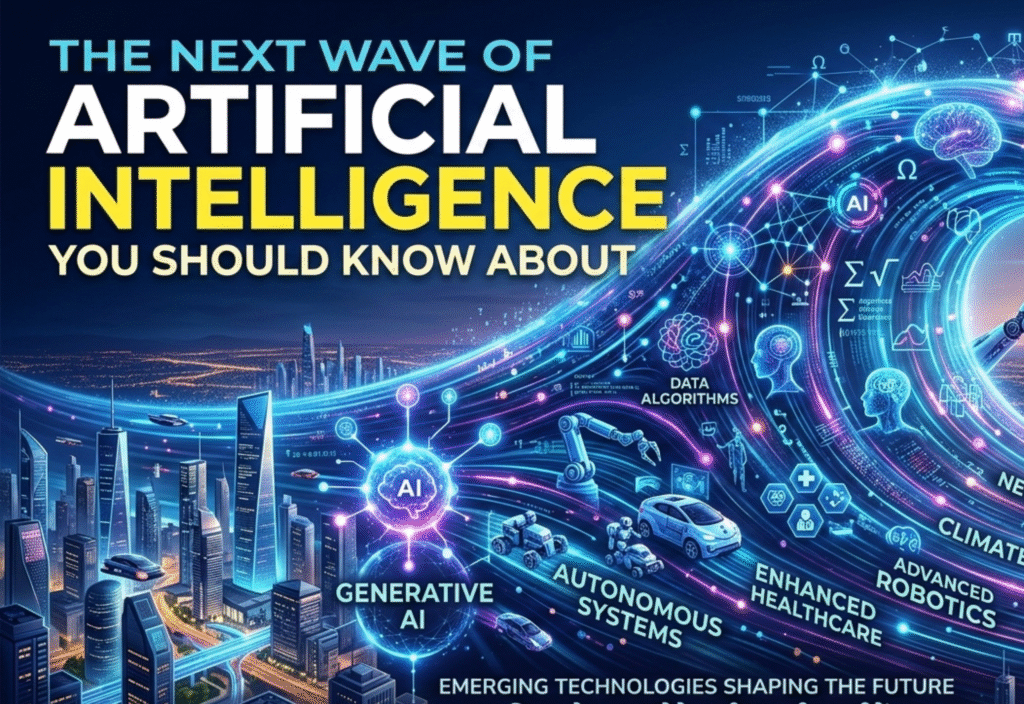
The next wave of artificial intelligence is set to transform industries, businesses, and daily life like never before. Unlike early AI systems, which focused mainly on narrow, single-purpose tasks, this emerging generation of AI emphasizes autonomous decision-making, multi-agent collaboration, and generative capabilities. By integrating advanced machine learning, natural language understanding, and real-time automation, the next wave of AI promises to deliver greater efficiency, smarter problem-solving, and innovative solutions across all sectors.
Organizations and individuals who understand and embrace this next wave of artificial intelligence will gain a significant competitive advantage as it reshapes technology, society, and the way humans interact with machines.
What Defines the Next Wave of Artificial Intelligence?
The next wave of artificial intelligence is distinguished by several key characteristics:
Autonomy and Independent Decision-Making
Unlike previous AI systems that acted only on direct commands, the next wave of AI can plan actions, make decisions, and adjust strategies based on environmental feedback.Generative Intelligence
Generative AI systems create new content such as text, images, audio, or even 3D models. These systems move beyond analyzing data to producing original outputs based on learned patterns.Multi-Agent Collaboration
Modern AI increasingly operates through networks of autonomous agents. These AI agents work together to solve complex problems, share insights, and complete multi-step tasks efficiently.Contextual and Semantic Understanding
AI systems in this next wave can interpret context, understand nuanced information, and act based on intent rather than simple instructions.Human-AI Symbiosis
The next wave emphasizes collaboration between humans and AI, enhancing human creativity, decision-making, and productivity rather than fully replacing human roles.
Key Technologies Driving the Next Wave of Artificial Intelligence
Several advanced technologies are fueling this next wave:
1. Large Language Models (LLMs)
LLMs are capable of understanding and generating human-like text at unprecedented scale. They power chatbots, virtual assistants, content creation tools, and more. By leveraging LLMs, organizations can automate communication, documentation, and analysis in ways that were previously impossible.
2. Generative AI
Generative AI allows machines to produce new content autonomously. Applications include:
Writing articles, reports, or marketing copy
Creating visuals, 3D models, and designs
Composing music or audio
Producing code for software development
3. Autonomous AI Agents
Autonomous agents act independently to complete tasks. When combined in networks, these agents can manage complex operations, such as coordinating supply chains, conducting research, or performing multi-step problem solving without direct human supervision.
4. Edge AI
Edge AI brings computational intelligence directly to devices rather than relying solely on cloud infrastructure. This enables real-time decision-making in robotics, autonomous vehicles, IoT devices, and industrial machinery.
5. Explainable AI (XAI)
Transparency is crucial in the next wave. XAI ensures that AI decisions can be interpreted and trusted by humans, which is especially critical in sectors like healthcare, finance, and legal compliance.
6. AI-Enhanced Robotics
Next-wave AI powers robots capable of performing multiple functions, adapting to dynamic environments, and learning from their experiences. These systems are being deployed in manufacturing, logistics, healthcare, and agriculture.
Applications Across Industries
Healthcare
AI is reshaping healthcare by enabling personalized medicine, advanced diagnostics, patient monitoring, and drug development. Generative AI assists medical researchers in designing new treatments, while autonomous agents optimize hospital workflows and resource allocation.
Finance
AI improves fraud detection, investment strategies, and regulatory compliance. Autonomous agents monitor market trends in real time, analyze risks, and make informed recommendations to financial professionals.
Manufacturing
The next wave of artificial intelligence powers smart factories. AI-driven robots and multi-agent systems manage assembly, quality control, predictive maintenance, and supply chain optimization, improving efficiency and reducing human error.
Education
AI-powered personalized learning platforms provide students with tailored lessons, real-time assessments, and feedback. Educators can leverage AI insights to understand learning patterns and improve teaching strategies.
Retail and E-Commerce
AI optimizes inventory management, personalized recommendations, dynamic pricing, and marketing campaigns. Generative AI can create product descriptions, promotional materials, and even visual assets, enhancing customer engagement.
Smart Cities
AI agents manage urban infrastructure, including traffic systems, energy distribution, public safety, and environmental monitoring. Multi-agent coordination ensures efficiency, safety, and real-time responsiveness.
Benefits of the Next Wave of Artificial Intelligence
Increased Efficiency – Automates complex workflows, reducing time and resources.
Enhanced Creativity – Generative AI supports creative content and innovative problem solving.
Better Decision-Making – AI analyzes massive datasets to deliver actionable insights.
Scalability – Multi-agent and edge AI allow solutions to be deployed across large networks.
Real-Time Responsiveness – AI systems process and act on information instantly in dynamic environments.
Challenges and Considerations
While promising, the next wave of AI comes with challenges:
Ethical Concerns – Autonomous AI may introduce bias, fairness issues, or unintended consequences.
Security Risks – Complex AI networks can be vulnerable to cyberattacks or misuse.
Regulatory Compliance – Governments and organizations must establish frameworks to ensure safe deployment.
Workforce Impact – Some job roles may evolve or be displaced, requiring retraining and adaptation programs.
Responsible AI practices, transparency, and human oversight are critical to addressing these challenges.
The Future Outlook
The next wave of artificial intelligence will continue to evolve over the next decade, characterized by:
Fully autonomous AI ecosystems
Seamless collaboration between humans and AI agents
AI embedded into everyday life
Widespread adoption in healthcare, finance, education, logistics, and smart cities
Organizations that adopt these innovations early will gain strategic advantages in productivity, efficiency, and innovation.
Conclusion
The next wave of artificial intelligence is a transformative force, combining autonomous agents, generative capabilities, multi-agent collaboration, and human-AI symbiosis. It represents more than just technological progress—it is a paradigm shift in how humans and machines work together.