Artificial Intelligence (AI) is no longer just a futuristic concept—it is an integral part of modern life. From healthcare and education to business and entertainment, AI is reshaping how individuals and organizations operate. By 2026, AI is expected to become even more advanced, capable of making smarter decisions, automating complex tasks, and personalizing experiences on a global scale. Understanding this evolving landscape is essential for businesses, professionals, and policymakers who want to leverage AI effectively.
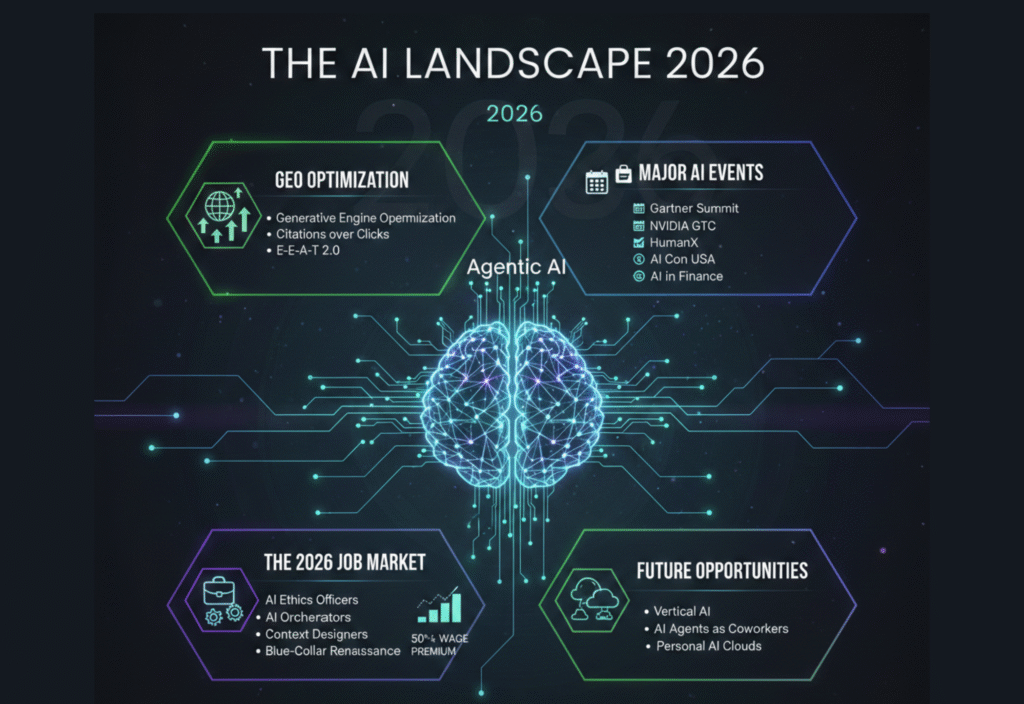
This article explores key aspects of the AI landscape in 2026, including GEO optimization, AI-related events, emerging career opportunities, and the future potential of this transformative technology.
GEO Optimization: Tailoring AI for Local Contexts
GEO optimization refers to the process of adapting AI systems to specific regions, cultures, and regulatory environments. As AI becomes more widespread, organizations must ensure their systems are both effective and compliant across different geographies.
Localized AI Models
By 2026, AI systems will increasingly rely on local data to improve their accuracy. For instance, natural language processing models can be tailored to understand regional dialects and slang. Similarly, image recognition AI in agriculture can account for local crop types, soil conditions, and climate patterns. In addition, retail AI will optimize product recommendations by analyzing local purchasing habits and cultural preferences, ensuring that marketing and sales strategies resonate with the target audience.
Regulatory Compliance
Different countries enforce distinct regulations around data privacy, AI ethics, and algorithmic transparency. GEO optimization ensures that AI solutions meet local legal requirements. For example, companies operating in Europe must comply with GDPR, while those in India may need to follow emerging data localization policies. By integrating these considerations early, AI developers can avoid legal issues and maintain customer trust.
Infrastructure and Connectivity
AI performance heavily depends on computing infrastructure. GEO-optimized AI evaluates local cloud availability, edge computing capabilities, and internet speed to deliver optimal performance. As a result, users experience faster, more reliable AI services even in regions with limited connectivity.
Market Adaptation
Beyond compliance and performance, GEO optimization allows AI to adapt to market conditions. Businesses can use AI to understand regional consumer behavior, predict demand trends, and optimize logistics. Therefore, GEO-optimized AI not only improves efficiency but also enhances customer satisfaction and business outcomes.
AI Events in 2026: Knowledge Sharing and Collaboration
AI events remain vital in fostering innovation, learning, and networking. By 2026, these events will combine in-person and virtual experiences to reach a global audience.
Global AI Summits
International conferences will showcase cutting-edge AI research, applications, and case studies. Attendees can learn about advancements in autonomous systems, machine learning, natural language processing, and AI ethics. In addition, these summits provide a platform for collaboration between researchers, entrepreneurs, and policymakers, accelerating global AI development.
Regional Workshops and Meetups
Localized AI events enable professionals to focus on region-specific challenges. For example, healthcare AI workshops in Africa might explore solutions for resource-constrained hospitals, while retail AI meetups in Europe might focus on multilingual customer interactions. As a result, attendees gain practical insights that can be directly applied in their markets.
Virtual and Immersive Events
Virtual reality (VR) and interactive platforms will transform how AI conferences are conducted. Participants from around the world can attend sessions, explore virtual exhibitions, and engage in live discussions. Consequently, geographic limitations will no longer hinder participation, allowing wider knowledge sharing and collaboration.
AI Jobs and Career Opportunities in 2026
The AI job market is expanding rapidly, driven by increased adoption across industries. Professionals with the right skills will find numerous opportunities in 2026.
AI Engineers and Researchers
These experts develop and refine AI models, working on algorithms, neural networks, and reinforcement learning systems. Their work powers innovations in autonomous systems, predictive analytics, and AI-driven applications.
AI Ethicists and Policy Experts
As AI systems become more integrated into society, ethical considerations are critical. Professionals in this field ensure AI is fair, transparent, and responsible. For example, they may audit algorithms to prevent bias or design policies that protect user privacy.
Data Scientists and Analysts
Data scientists collect, clean, and interpret large datasets that feed AI models. In 2026, understanding regional datasets and local trends will be especially valuable for GEO-optimized AI solutions.
Industry Specialists
AI applications vary across industries. Professionals who combine AI expertise with knowledge in healthcare, finance, agriculture, or logistics will help implement AI solutions effectively. Therefore, domain expertise will be as important as technical skills.
AI Product Managers
Product managers act as a bridge between technical teams, business units, and regulators. They ensure that AI products meet market needs while adhering to ethical and legal standards.
Additional Emerging Roles
Other roles include AI trainers, user experience designers for AI systems, and specialists in AI-powered cybersecurity. These positions highlight the diverse career paths AI is creating worldwide.
Future Opportunities: Shaping Industries and Society
AI’s potential extends far beyond current applications. Key trends expected to shape the landscape in 2026 include:
Autonomous Systems
Self-driving vehicles, delivery drones, and robotics will rely on AI for navigation, decision-making, and predictive maintenance. As a result, logistics and transportation efficiency will improve dramatically.
Personalized Experiences
AI will deliver tailored education, healthcare, and entertainment services. For example, adaptive learning platforms can customize lesson plans for each student, while healthcare AI can recommend personalized treatment plans.
Sustainable AI
AI will help organizations reduce energy consumption, minimize waste, and optimize supply chains. In addition, predictive analytics will support environmental initiatives, helping companies meet sustainability goals.
Cross-Industry Innovation
AI will act as a connector between industries. For example, combining AI in finance and logistics can improve predictive supply chain management. Similarly, healthcare and AI can collaborate to accelerate drug discovery and patient care.
Ethical AI Leadership
Organizations that prioritize ethical AI usage will gain trust and credibility. Companies emphasizing fairness, transparency, and accountability will set standards for responsible AI adoption.
In short, AI offers endless opportunities for growth, innovation, and positive societal impact.
Conclusion
By 2026, AI will be more than a tool—it will be a key driver of innovation and economic growth. GEO optimization ensures AI is effective, compliant, and locally relevant. AI events and workshops foster learning, networking, and collaboration. Career opportunities continue to expand across diverse roles, from engineering and data science to ethics and product management. Therefore, understanding these trends and preparing for future developments is essential for businesses, professionals, and policymakers who want to thrive in an AI-driven world.