
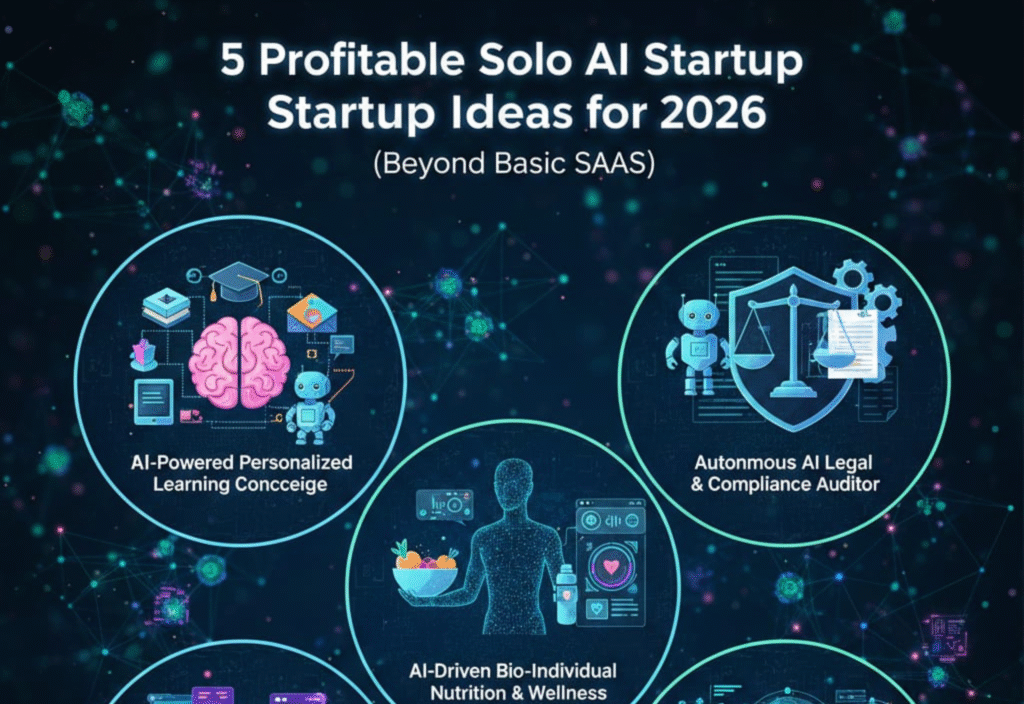
Solo AI startup ideas 2026 are opening new opportunities for solo founders. With AI tools becoming more powerful, it’s now possible to launch profitable, scalable businesses without a large team.
But not all AI startups are created equal. Many founders still get stuck in basic SaaS ideas, launching tools that barely differentiate themselves in a crowded market. The real opportunity lies in innovative AI-driven products that solve specific problems, automate critical workflows, or provide actionable intelligence.
1. AI-Powered Niche Market Research Tool
Market research is expensive and time-consuming — especially for small businesses, content creators, or indie entrepreneurs.
Why it’s profitable:
Businesses are willing to pay for actionable insights that save time.
AI can analyze competitors, trends, and consumer sentiment in real-time.
How a solo founder can do it:
Use AI models for scraping, summarizing, and analyzing online data.
Create dashboards that show trends, competitor analysis, and keyword opportunities.
Offer a subscription-based model with monthly insights.
Example: A tool that tracks emerging trends in micro-niches like “eco-friendly gadgets” or “indie game development” and sends alerts to subscribers.
2. AI Personal Productivity & Task Automation Agent
Productivity is a universal pain point. AI agents that automate repetitive tasks, schedule workflows, and manage communications are in high demand.
Why it’s profitable:
Professionals, freelancers, and solopreneurs want AI assistants to save time.
One agent can serve hundreds or thousands of users with minimal maintenance.
How a solo founder can do it:
Build an AI chatbot integrated with email, calendar, or project management tools.
Focus on automating a specific workflow (e.g., meeting summaries, email triaging).
Monetize via subscriptions or premium features.
Example: An AI agent that reads your inbox, summarizes key points, and suggests actions automatically.
3. AI-Powered Creative Content Studio
Generative AI is transforming content creation — from writing and design to video and music. Solo founders can capitalize on this by offering AI-powered creative services as a product.
Why it’s profitable:
Content demand is exploding for marketing, social media, and e-learning.
Small businesses and creators often lack resources to produce high-quality content consistently.
How a solo founder can do it:
Use AI tools for writing, design, or video generation.
Offer a platform where users can generate niche-specific content quickly.
Implement a freemium model or charge per output (microtransactions).
Example: An AI tool for YouTube creators that automatically generates scripts, thumbnail designs, and video outlines based on trending topics.
4. AI-Powered Personalized Learning & Coaching Platform
Learning and skill-building are booming markets. AI can create personalized learning paths and coaching experiences that adapt to individual users.
Why it’s profitable:
People are willing to pay for efficient, tailored learning.
AI reduces the need for large teams of human coaches or educators.
How a solo founder can do it:
Build an AI engine that evaluates user knowledge and generates a personalized curriculum.
Offer micro-courses, practice exercises, and progress tracking.
Monetize via subscriptions, course bundles, or coaching upsells.
Example: An AI platform for aspiring AI developers that generates personalized coding challenges based on user skill level.
5. AI-Powered Niche E-commerce Recommendation Engine
E-commerce businesses constantly struggle to improve conversion rates and personalization. AI can provide predictive recommendations, customer segmentation, and dynamic pricing.
Why it’s profitable:
Even small e-commerce stores are willing to pay for AI solutions that increase sales.
AI can provide real-time insights with minimal human intervention.
How a solo founder can do it:
Build an AI plugin or microservice for Shopify, WooCommerce, or other platforms.
Focus on a niche like fashion, electronics, or digital products.
Monetize through subscriptions or per-transaction fees.
Example: An AI engine that recommends products dynamically based on browsing behavior and social media trends.
Why Solo AI Startups Are Thriving in 2026
Several factors make solo AI startups more viable than ever:
Low-cost AI tools: Platforms like OpenAI, Hugging Face, and Ollama provide APIs for building AI products without massive infrastructure.
Automation reduces workload: Many processes, from customer support to content generation, can be fully automated.
Remote-first ecosystem: Cloud infrastructure, payment solutions, and global marketplaces allow solo founders to operate anywhere.
Subscription economy: AI products fit perfectly into recurring revenue models, ensuring predictable income.
Tips for Building a Successful Solo AI Startup
Focus on a niche problem: Solve a specific pain point instead of trying to build a generic platform.
Leverage no-code/low-code AI tools: Rapidly prototype your idea without heavy technical overhead.
Validate before scaling: Start with a small audience or beta testers to ensure product-market fit.
Iterate quickly: Use user feedback and AI analytics to improve features.
Build community and content: Position yourself as an expert to attract users organically.
Final Thoughts
2026 is a golden era for solo AI founders. With the right idea, tools, and execution strategy, a single founder can build highly profitable AI startups beyond basic SaaS.