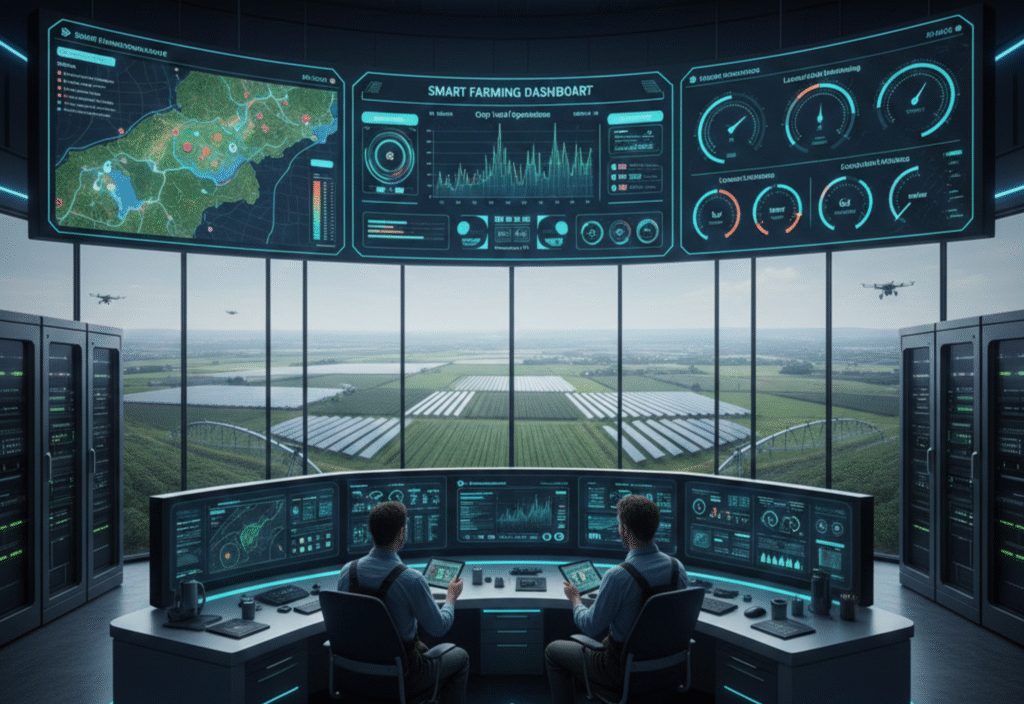
Agriculture is undergoing a major transformation as digital technologies become more integrated into farming practices. One of the most impactful innovations is the smart farming dashboard using IoT, which allows farmers to monitor crops, soil conditions, weather data, and equipment performance in real time. By combining Internet of Things (IoT) sensors with data visualization dashboards, farmers can make informed decisions, improve productivity, and reduce waste.
This technological shift is helping agriculture become more efficient, sustainable, and responsive to changing environmental conditions. As global food demand increases, smart farming solutions offer practical ways to enhance crop yields while conserving resources.
Understanding Smart Farming Dashboards
A smart farming dashboard is a digital platform that collects, analyzes, and displays agricultural data from IoT sensors. These dashboards provide farmers with easy-to-understand insights about their fields, livestock, irrigation systems, and environmental conditions.
Typically, IoT devices placed across farms gather data such as soil moisture, temperature, humidity, nutrient levels, and weather patterns. This information is then processed and presented through dashboards accessible on smartphones, tablets, or computers.
The main goal is to transform raw data into actionable insights that help farmers optimize daily operations.
Key Features of IoT-Based Farming Dashboards
Real-Time Monitoring
Farmers can view live data from their fields, enabling quick responses to environmental changes. For example, soil moisture sensors can signal when irrigation is needed.
Automated Alerts
Dashboards can notify farmers about unusual conditions, such as temperature drops, equipment malfunctions, or pest risks.
Data Visualization
Graphs, charts, and reports simplify complex agricultural data, helping farmers easily understand trends and performance.
Remote Control
Some advanced systems allow farmers to control irrigation, lighting, or machinery remotely through connected devices.
Benefits for Modern Agriculture
Improved Crop Productivity
Accurate data allows farmers to make better decisions about watering, fertilization, and pest control.
Resource Efficiency
IoT-based dashboards help reduce water, fertilizer, and energy waste, making farming more sustainable.
Cost Savings
Automation and predictive analytics lower operational costs and reduce unnecessary labor.
Environmental Sustainability
Smart farming promotes responsible resource usage, reducing environmental impact.
Role of Data Analytics
Data analytics plays a crucial role in smart farming dashboards. By analyzing historical and real-time data, farmers can identify patterns and predict future outcomes. For example:
Predicting optimal planting times
Detecting disease risks early
Forecasting weather impacts
Planning irrigation schedules efficiently
These insights enable proactive decision-making rather than reactive problem solving.
Challenges in Implementation
Despite its benefits, adopting IoT-based farming dashboards comes with challenges:
Initial Investment
Setting up IoT infrastructure may require significant upfront costs.
Technical Knowledge
Farmers may need training to use digital tools effectively.
Connectivity Issues
Reliable internet access is essential for real-time monitoring.
Data Security
Protecting farm data and system integrity is important.
Addressing these challenges through education, infrastructure development, and support programs can accelerate adoption.
Future of Smart Farming Technology
The future of agriculture will likely see deeper integration of IoT, artificial intelligence, robotics, and predictive analytics. Smart dashboards may evolve to include:
AI-driven crop health analysis
Automated machinery coordination
Climate-adaptive farming recommendations
Integration with satellite imagery and drone monitoring
These advancements will make agriculture more efficient, resilient, and technologically advanced.
Conclusion
The smart farming dashboard using IoT represents a significant step forward in modern agriculture. By providing real-time insights, improving resource management, and enabling data-driven decisions, these systems help farmers enhance productivity while maintaining sustainability.