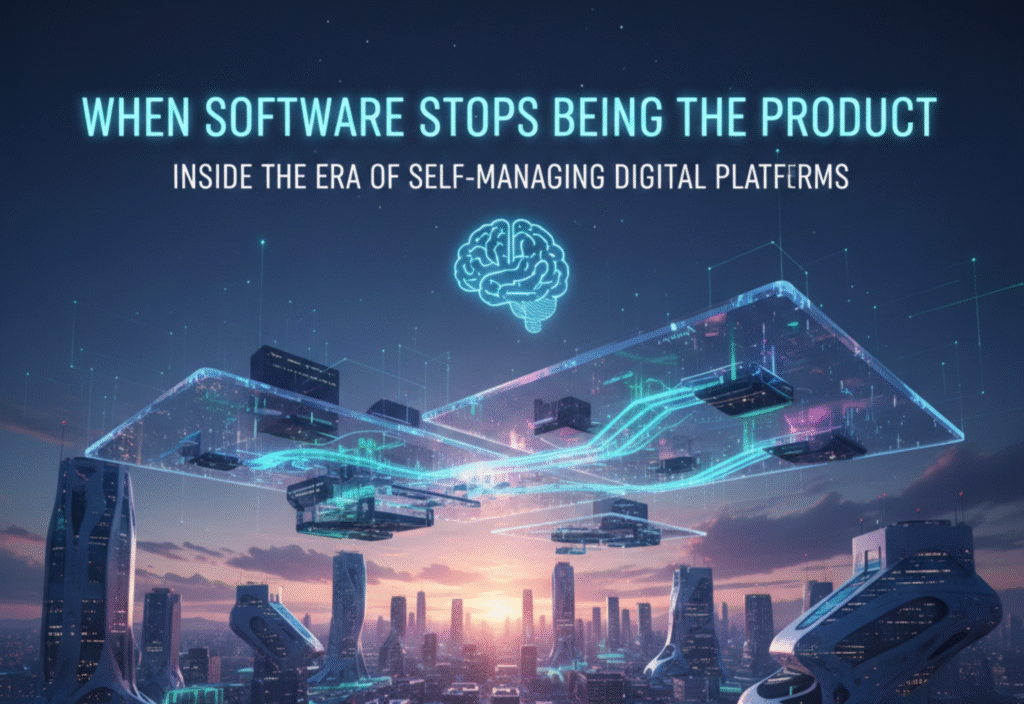
The world of software is evolving rapidly. In the past, software was primarily a tool — like a word processor, accounting program, or a simple website. But today, we have entered a new era where software is no longer just a product. Instead, it has become a platform that can manage, optimize, and evolve itself.
This article explores the concept of self-managing digital platforms, why they matter, and how they are transforming the traditional idea of software as a product.
1. When Software Was Just a Product
Traditional software examples include:
Operating systems (Windows, macOS)
Applications (Microsoft Office, Adobe Photoshop)
Websites and mobile apps
These were sold as products. Customers purchased software, installed it, and used it. Updates and patches followed a scheduled lifecycle.
Limitations of the Traditional Model:
Predictable functionality
Fixed update schedule
Limited automation
Manual configuration required
2. The Shift: Rise of Platforms
Modern software is no longer just a set of code. It has become a living ecosystem.
Self-managing platforms are systems that:
Monitor and optimize their own resources
Improve themselves using data
Make decisions and scale without human intervention
This shift means software is no longer a static product — it is an experience and ecosystem.
3. What Are Self-Managing Digital Platforms?
Definition
Self-managing digital platforms are software systems that automate operations, enhance performance, and adapt to their environment with minimal human involvement.
Key Characteristics
| Trait | Description |
|---|---|
| Automation | Reduces manual tasks |
| Self-Optimization | Continuously improves performance |
| Self-Healing | Detects and fixes problems automatically |
| Adaptability | Adjusts to changing conditions |
| Continuous Learning | Evolves based on data and feedback |
4. Non-Technical Example
Imagine a farmer with a traditional irrigation system:
Old System: Manually turn pumps on/off, monitor soil moisture, check weather forecasts. Everything requires human effort.
New Self-Managing System: Sensors measure soil moisture, pumps adjust automatically, weather data guides water distribution — with minimal human intervention.
This is exactly what self-managing software platforms do in the digital world.
5. How Do Self-Managing Platforms Work?
A) Data Collection
Systems gather data from users, performance metrics, and environmental conditions.
B) Intelligent Analysis
Machine learning algorithms detect patterns, predict future actions, and optimize processes.
C) Automated Actions
Platforms allocate resources, fix errors, and optimize performance without constant human input.
6. Benefits
Increased Efficiency
Routine tasks are automated, freeing humans for more strategic work.
Fewer Errors
Automation reduces the risk of human mistakes.
Scalability
Systems can automatically scale resources as demand grows.
Better User Experience
Users get seamless, responsive, and adaptive experiences.
7. Challenges
Complexity
Designing and implementing self-managing systems is technically challenging.
Initial Investment
Advanced infrastructure and intelligent tools are required.
Trust & Control
Organizations may hesitate to rely entirely on automated systems, especially for critical operations.
8. Real-World Examples
Cloud Services (AWS, Azure, Google Cloud) — Automatic scaling and workload management.
Content Delivery Networks — Dynamic allocation of resources based on traffic.
Autonomous IT Operations — Monitoring and optimizing servers and networks without manual intervention.
These examples illustrate the shift from software as a product to software as an intelligent platform.
9. The Future
The future belongs to platforms that can:
Predict issues
Adapt automatically
Execute decisions autonomously
Software is no longer just a fixed tool — it is a dynamic system combining intelligence and automation.
Conclusion
Software is no longer just a product. It has become:
An ecosystem
An intelligent platform
A self-managing system
This transformation brings:
Increased productivity
Faster innovation
Reduced human effort
We are moving toward a digital future where software is more powerful, adaptive, and meaningful than ever before.