
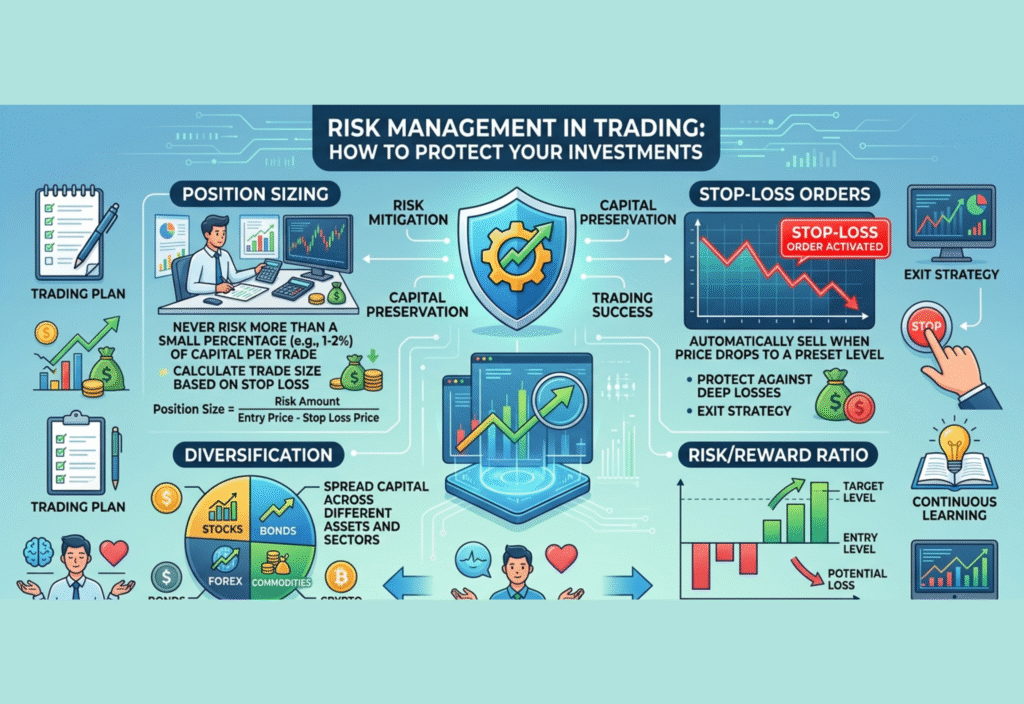
Trading in financial markets can be highly rewarding; however, it also comes with significant risks. Whether you are trading stocks, forex, or cryptocurrencies, understanding how to manage risk is essential for protecting your capital. Moreover, successful traders focus not only on profits but also on minimizing losses.
Risk management does not mean avoiding losses completely. Instead, it focuses on controlling losses so that no single trade can harm your entire account. Therefore, learning proper risk management techniques is one of the most important skills in trading.
What Is Risk Management in Trading?
Risk management in trading refers to the process of identifying, analyzing, and controlling potential losses in your trades. In addition, it involves deciding how much capital you are willing to risk on each trade.
Since markets are unpredictable, prices can move in any direction. For this reason, traders must prepare for unexpected changes and protect their investments.
A strong risk management approach ensures that even after multiple losing trades, your account remains safe. As a result, you can continue trading without facing major financial damage.
Why Risk Management Is Important
Many traders fail because they ignore risk management. However, experienced traders understand that protecting capital is more important than chasing profits.
Risk management helps you in several ways:
It protects your trading capital
It reduces emotional decision-making
It ensures long-term consistency
It helps survive losing streaks
It improves overall trading discipline
For example, even if you face a series of losses, proper risk control ensures your account is still active. Therefore, you remain in the game longer and increase your chances of success.
Key Principles of Risk Management
1. Risk Only a Small Percentage per Trade
One of the most effective strategies is to risk only a small portion of your account on each trade. Typically, traders risk 1% to 2% per trade.
For instance, if your account balance is $10,000, risking 1% means you only risk $100 per trade. This approach ensures that even if you lose multiple trades, your account will not be heavily affected.
2. Always Use Stop-Loss Orders
A stop-loss order is a crucial tool in trading. It automatically closes your trade when the price reaches a specific level, limiting your losses.
Without a stop-loss, losses can grow quickly. However, by setting a stop-loss, you control the maximum risk before entering a trade. As a result, you avoid emotional decisions and stay disciplined.
3. Maintain a Risk-to-Reward Ratio
The risk-to-reward ratio compares your potential loss to your potential gain.
For example, a 1:2 ratio means you risk $1 to make $2. This is important because even if you win only half of your trades, you can still be profitable.
Moreover, this strategy helps ensure that your winning trades are larger than your losing trades.
4. Avoid Overtrading
Overtrading happens when traders take too many trades without proper analysis. This usually occurs due to greed or impatience.
As a result, overtrading increases your risk and can lead to unnecessary losses. Instead, focus on quality trades rather than quantity.
5. Diversify Your Trades
Diversification means spreading your investments across different assets. This reduces the impact of a single loss.
For example, instead of investing all your money in one trade, you can trade multiple assets. Consequently, if one trade fails, others may balance your overall performance.
Emotional Control in Trading
Trading is not only about technical skills; it also requires strong emotional control. Fear and greed are two emotions that can negatively impact your decisions.
Fear may stop you from taking good opportunities, while greed can push you into risky trades. Therefore, maintaining emotional balance is essential.
By following a proper risk management plan, you can reduce emotional pressure and make better decisions.
Common Risk Management Mistakes
Many traders make avoidable mistakes that increase their risk. Some common ones include:
Not using stop-loss orders
Risking too much on one trade
Ignoring risk-to-reward ratios
Trading without a clear plan
Letting emotions control decisions
However, by avoiding these mistakes, you can significantly improve your trading performance.
Building a Strong Risk Management Strategy
A solid risk management strategy is an essential part of your trading plan. It should clearly define:
How much to risk per trade
Where to place stop-loss levels
Your risk-to-reward ratio
Entry and exit rules
Additionally, having a written plan helps you stay disciplined and consistent. Therefore, you can avoid random decisions and follow a structured approach.
Risk Management Across Different Markets
Risk management principles apply to all trading markets. However, each market has unique characteristics.
In stock trading, risks depend on company performance and market conditions. In forex trading, leverage can increase both profits and losses. Meanwhile, cryptocurrency markets are highly volatile, making risk control even more important.
Despite these differences, the core principle remains the same: protect your capital.
The Importance of Discipline
Discipline is the foundation of successful risk management. Without discipline, even the best strategy can fail.
A disciplined trader follows rules consistently and avoids impulsive decisions. Moreover, discipline helps maintain long-term stability in trading.
Over time, disciplined habits lead to better performance and reduced losses.
Conclusion
Risk management is one of the most important aspects of trading. Without it, traders can quickly lose their capital. However, by applying proper techniques, you can protect your investments and grow steadily.
Using stop-loss orders, maintaining a risk-to-reward ratio, and controlling emotions are essential steps. In addition, staying disciplined and following a clear plan will help you succeed in the long run.
Ultimately, trading is not just about making profits; it is about protecting your capital and ensuring long-term growth. Therefore, always prioritize risk management in every trade you take.