Python has grown to become one of the world’s most popular programming languages, powering web development, data science, AI, machine learning, automation, and more. Its clean syntax, simplicity, and readability make it accessible to both beginners and experienced developers. However, the terms Python and CPython often confuse programmers, especially when diving into performance, runtime behavior, or low-level implementation details.
Understanding the distinction between Python and CPython, how Python executes code, and the role of different implementations is crucial for optimizing code, debugging efficiently, and choosing the right environment for your projects.
This article explores Python’s internals, CPython’s role as the reference implementation, other Python interpreters, and practical considerations for developers in 2026 and beyond.
What is Python?
Python is a high-level, interpreted programming language created by Guido van Rossum in 1991. Its core design emphasizes readability and simplicity, allowing developers to express ideas in fewer lines of code compared to many other languages. Key characteristics include:
Readable and clean syntax: Python’s indentation-based structure improves code clarity and maintainability.
Cross-platform support: Python runs on Windows, macOS, Linux, and many other platforms without modification.
Extensive standard library: Tools for web development, data analysis, automation, AI, and more.
Interpreted execution: Python is executed line by line by an interpreter, rather than being directly compiled into machine code.
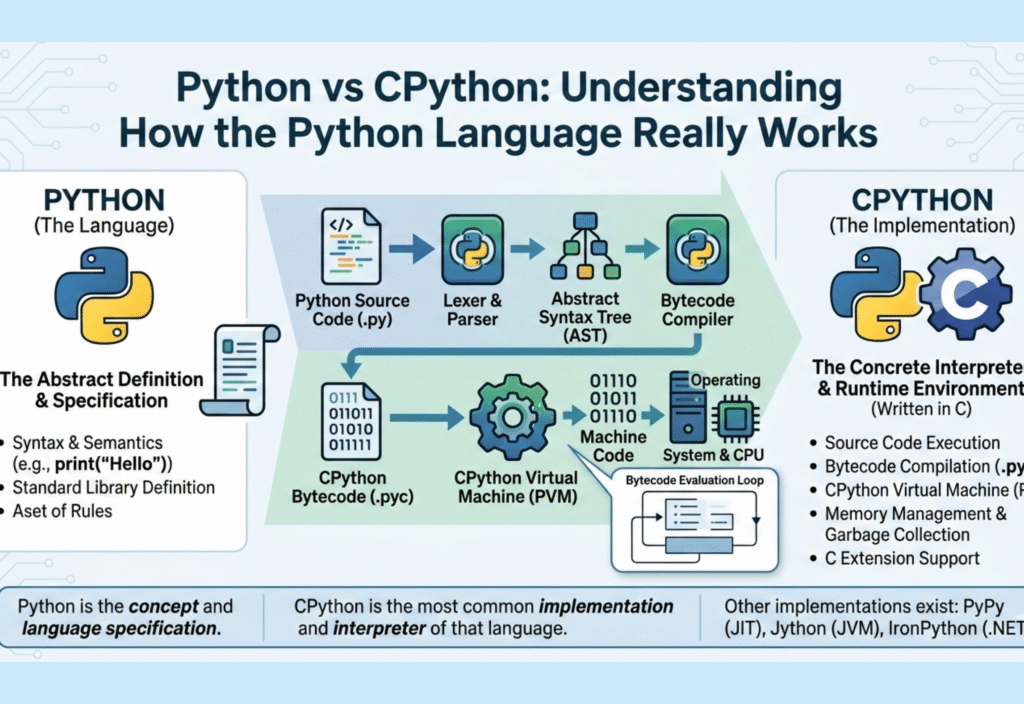
It’s important to note that Python itself is a language specification—a set of rules and syntax defining how Python code should behave. To run Python code, we need an implementation of the language, which is where CPython comes into play.
What is CPython?
CPython is the reference and most widely used implementation of Python, written in the C programming language. It is the official implementation maintained by the Python Software Foundation and serves as both a compiler and an interpreter for Python code.
Key Features of CPython:
Compiles to Bytecode: CPython first compiles Python source code into a low-level, platform-independent bytecode. These
.pycfiles help speed up program execution on subsequent runs.Interprets Bytecode: CPython executes the bytecode using the Python Virtual Machine (PVM), managing memory allocation, garbage collection, and runtime operations.
Standard Library Inclusion: CPython ships with the complete standard library, ensuring compatibility with most Python programs.
Extensible with C: Developers can write C extensions to improve performance or interface with system-level libraries.
In essence, CPython transforms Python code into something a computer can execute while adhering to Python’s language rules, making it the bridge between the abstract Python language and actual program execution.
How Python Code is Executed in CPython
Understanding the inner workings of CPython helps developers write more efficient Python code. Here’s a simplified overview of the execution pipeline:
1. Parsing the Source Code
When a Python script is executed, CPython first parses the source code to create an Abstract Syntax Tree (AST). The AST represents the logical structure of the program.
2. Compilation to Bytecode
The AST is then compiled into bytecode, which is a set of instructions that the Python Virtual Machine (PVM) can understand. Bytecode is platform-independent and stored in .pyc files for future runs, speeding up execution.
3. Execution in the Python Virtual Machine
The PVM interprets the bytecode line by line. It handles:
Memory allocation and garbage collection
Function calls and object instantiation
Dynamic typing and variable resolution
4. Runtime Operations
CPython manages dynamic features such as duck typing, object references, and exception handling. This runtime flexibility is one reason Python is slower than statically compiled languages like C, but it allows for remarkable developer productivity.
Python vs CPython: Key Differences
While the terms are often used interchangeably, it’s important to distinguish:
| Feature | Python | CPython |
|---|---|---|
| Definition | Programming language specification | Reference implementation of Python written in C |
| Execution | Conceptual rules for code behavior | Compiles Python code to bytecode and executes via PVM |
| Performance | Depends on implementation | Interpreted bytecode, can be slower than compiled alternatives |
| Compatibility | Describes how Python should work | Ensures code runs according to Python specification |
| Use Case | Learning, writing programs | Running Python code on systems reliably |
Summary: Python is the language, and CPython is the software that executes the language.
Other Python Implementations
Several alternative implementations exist to address performance, platform compatibility, or specialized use cases:
PyPy: Implements Python in Python with a Just-In-Time (JIT) compiler, significantly increasing execution speed for many workloads.
Jython: Runs Python on the Java Virtual Machine (JVM), allowing Python code to interface seamlessly with Java libraries.
IronPython: Targets the .NET framework, integrating Python with .NET applications.
MicroPython: Lightweight Python for microcontrollers and embedded devices, ideal for IoT applications.
Stackless Python: Optimized for massive concurrency, used in gaming and simulations.
Each implementation follows the Python language specification but differs in performance, library support, and platform capabilities.
Common Misconceptions About Python and CPython
Python is CPython: Beginners often assume Python and CPython are the same. While CPython is the default implementation, Python is the language specification.
Python code runs identically everywhere: Some features behave differently across implementations, especially in JIT-compiled or embedded versions.
Python is slow because of the language: Slowness is often due to interpreter overhead. Using PyPy or optimized C extensions can improve performance.
Why Understanding CPython Matters
Developers gain significant advantages by understanding CPython internals:
Performance Optimization: Knowledge of bytecode execution helps in writing faster, memory-efficient code.
Debugging: Understanding how the interpreter handles variables and memory aids in troubleshooting.
Compatibility Awareness: Some libraries or extensions work only with CPython.
Deployment Decisions: Choosing the right Python implementation can impact application scalability and system integration.
Practical Tips for Optimizing Python in CPython
Use built-in functions: CPython’s standard library is highly optimized.
Minimize loops: Vectorize operations using NumPy for better performance.
Use generators: Save memory by using generator expressions instead of large lists.
Profile code: Tools like cProfile and timeit help identify bottlenecks.
Leverage C extensions: For computation-heavy tasks, C modules can drastically improve speed.
The Future of Python and CPython
Python continues to evolve with enhancements in CPython and other implementations:
Python 3.12+ Optimizations: Improved bytecode, better error handling, and enhanced standard library features.
Integration with AI/ML: CPython remains the standard for most AI libraries like TensorFlow and PyTorch.
Cross-platform expansion: Implementations like Jython and IronPython extend Python’s reach across JVM and .NET ecosystems.
Performance-focused variants: PyPy and Stackless Python enable specialized use cases requiring speed or concurrency.
Understanding how CPython works ensures developers can leverage these advancements efficiently.
Conclusion
In conclusion:
Python is the high-level language specification that defines syntax, semantics, and behavior.
CPython is the default implementation that compiles Python code into bytecode and executes it via the Python Virtual Machine.
Knowing the difference empowers developers to write efficient, compatible, and maintainable code. It also informs decisions about which Python implementation to use, whether for speed, platform compatibility, or specialized workloads.