
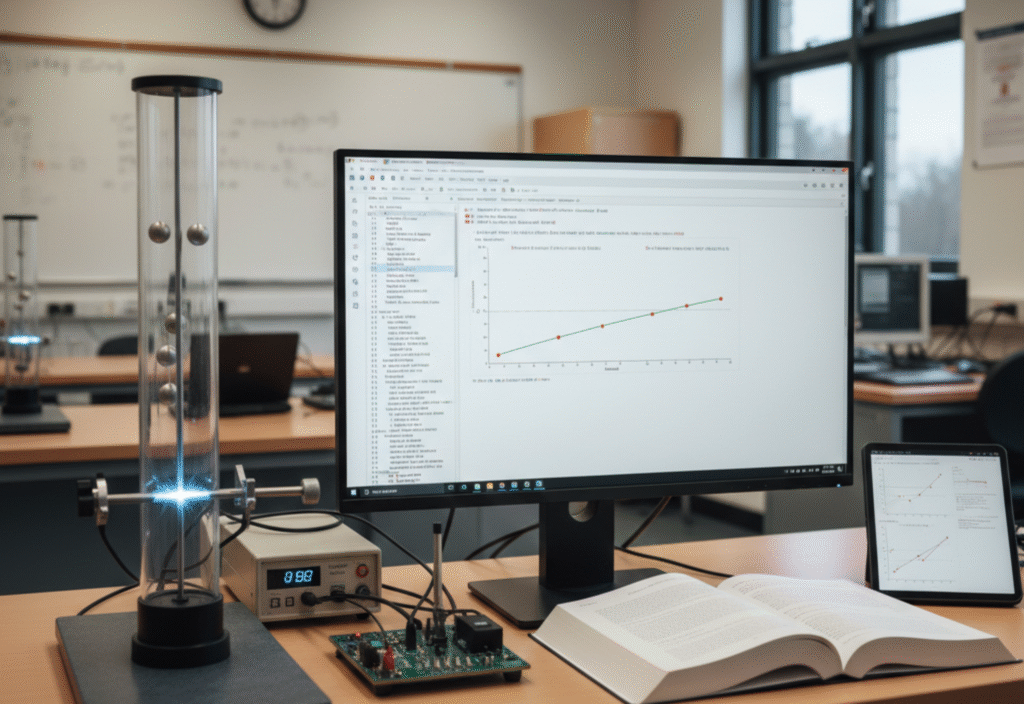
Physics experiments often involve mathematical modeling to understand how forces behave in the real world. One interesting example is calculating the electric field produced by a charged rod. With modern programming tools, students and researchers can simulate such physical systems using Python. This approach combines theoretical physics with computational analysis, making complex concepts easier to visualize and study.
Using Python in a physics lab allows precise calculations, graphical visualization, and repeated simulations without expensive laboratory equipment. It helps learners connect physical theory with practical computational skills.
Understanding Electric Fields
An electric field describes the force experienced by a charged particle placed near another charge. When a rod carries electric charge distributed along its length, it produces an electric field in the surrounding space. Unlike a point charge, a charged rod requires integration across its length because every small section contributes to the overall field.
Studying these fields helps explain phenomena in electronics, electrostatics, and material science. Understanding how electric fields behave is essential for engineering applications and scientific research.
Why Use Python for Physics Simulations
Python has become popular in scientific computing because it is easy to learn, flexible, and supported by powerful libraries. In physics laboratories, Python helps:
Perform numerical calculations efficiently
Visualize physical behavior through graphs
Simulate systems repeatedly with different parameters
Simplify complex mathematical modeling
Libraries such as NumPy, SciPy, and Matplotlib make it possible to handle large datasets and produce accurate simulations.
Mathematical Model of a Charged Rod
To calculate the electric field of a charged rod, physicists consider small charge elements along the rod. Each element contributes a small electric field, and the total field is obtained by summing or integrating these contributions.
Important factors in the calculation include:
Length of the rod
Total charge distributed along it
Distance from the observation point
Orientation of the rod
Numerical methods in Python can approximate these integrals effectively, especially when analytical solutions are complex.
Building the Python Simulation
Creating a Python-based physics lab simulation usually follows several steps:
1. Define Physical Constants
Set values for charge density, rod length, and observation points.
2. Discretize the Rod
Divide the rod into small segments so each contributes a calculable electric field.
3. Apply Electric Field Formula
Calculate field contributions from each segment using electrostatic principles.
4. Sum Contributions
Add all small fields to obtain the total electric field.
5. Visualize Results
Plot field strength versus distance or display vector fields graphically.
This structured approach makes the physics concept clearer while strengthening programming skills.
Visualization and Interpretation
Graphs help students understand how electric fields vary with distance and orientation. Visualization may show:
Field strength decreasing with distance
Direction changes in vector fields
Effects of rod length or charge variation
Such visual analysis enhances conceptual understanding beyond theoretical equations.
Educational Benefits
Using Python in a physics lab provides multiple learning advantages:
Encourages analytical thinking
Connects mathematics with real-world physics
Improves computational skills
Allows safe and repeatable experimentation
This interdisciplinary learning approach is increasingly important in modern science education.
Limitations of Simulations
While simulations are powerful, they have limitations. Results depend on assumptions, numerical accuracy, and data quality. They complement physical experiments but do not completely replace them. Understanding both theory and practical experimentation remains essential.
Conclusion
Exploring electric field calculations for a charged rod using Python is a valuable educational exercise that blends physics theory with computational modeling. By simulating electric fields numerically, students can visualize complex electrostatic interactions and deepen their understanding of physical principles.