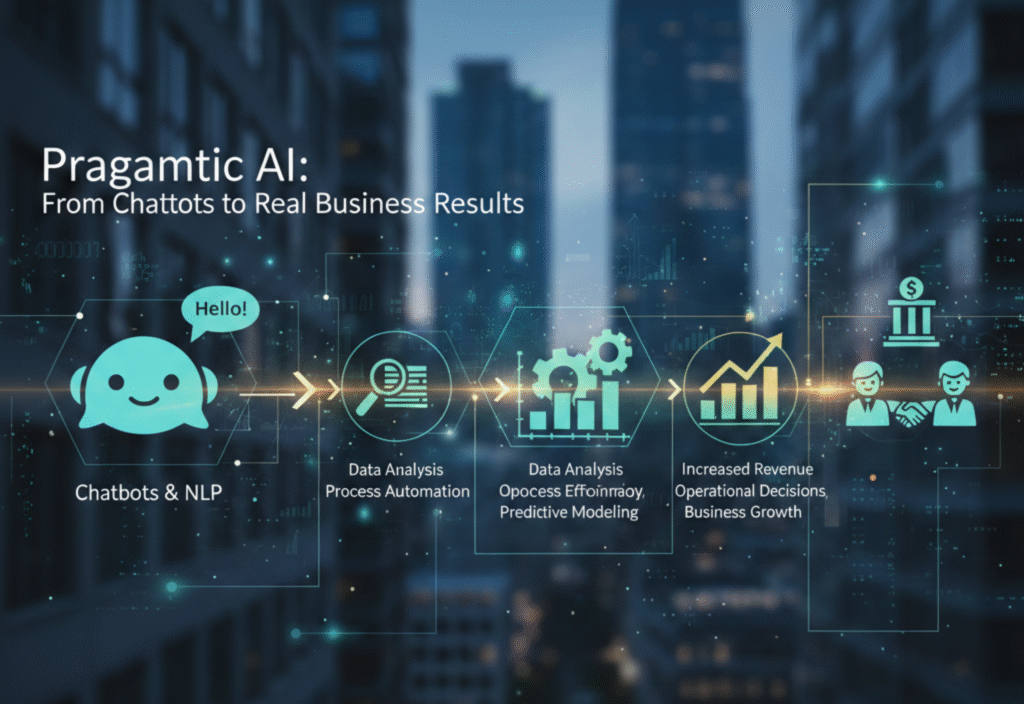
Artificial Intelligence (AI) is no longer just a futuristic concept or experimental technology. Today, organizations across industries are focusing on pragmatic AI — practical, results-driven applications that solve real business problems. While early AI adoption largely centered on chatbots and basic automation, modern businesses are now using AI to improve efficiency, enhance decision-making, reduce costs, and create better customer experiences. This shift shows how AI is evolving from simple tools into a powerful driver of measurable business success.
What Is Pragmatic AI?
Pragmatic AI refers to the practical and realistic use of artificial intelligence to achieve clear business objectives. Instead of chasing complex or hype-driven innovations, companies focus on solutions that deliver value quickly and sustainably.
Technology leaders such as IBM, Microsoft, and OpenAI have played an important role in making AI tools more accessible, allowing businesses to implement intelligent systems without needing extensive technical infrastructure.
From Chatbots to Broader AI Applications
Chatbots were among the first AI tools widely adopted by companies. They helped businesses automate customer support, answer common questions, and provide quick responses. While helpful, chatbots have limitations:
They mainly handle routine inquiries
Complex cases still require human involvement
Their business impact is often limited to customer service
Because of these limitations, organizations began expanding AI into other areas where it can deliver deeper and more strategic benefits.
Key Areas Where Pragmatic AI Creates Results
1. Smarter Decision-Making
AI analytics allows businesses to analyze large volumes of data quickly and accurately. Predictive models can forecast market trends, customer behavior, and operational risks. Cloud-based AI platforms like Google Cloud enable companies to access powerful data insights without heavy infrastructure investments.
2. Automation of Business Processes
Practical AI automates repetitive tasks such as data entry, inventory management, payroll processing, and customer communications. This improves productivity, reduces human error, and frees employees to focus on strategic work.
3. Customer Personalization
AI helps businesses understand customer preferences through data analysis. Personalized recommendations, targeted marketing campaigns, and intelligent support systems increase engagement and customer satisfaction.
4. Operational Optimization
Industries such as manufacturing, logistics, and healthcare use AI to optimize workflows, predict maintenance needs, and improve overall efficiency.
Real-World Industry Applications
Retail and E-Commerce
AI assists retailers in demand forecasting, pricing strategies, and personalized product recommendations. This leads to better sales performance and improved customer experiences.
Healthcare
Healthcare providers use AI for diagnostics support, patient monitoring, and administrative automation. These applications enhance efficiency while supporting better patient outcomes.
Finance and Banking
AI helps detect fraud, assess credit risk, and provide financial insights. Automated systems improve security and operational efficiency.
Cloud-Based Business Solutions
Platforms like Amazon Web Services allow organizations to deploy AI solutions quickly, making advanced technology accessible even for smaller businesses.
Benefits of Pragmatic AI Adoption
Increased Efficiency: Automation reduces time spent on repetitive tasks.
Cost Reduction: AI optimizes operations and minimizes errors.
Better Customer Experience: Faster and more personalized services build loyalty.
Competitive Advantage: Businesses using AI insights adapt faster to market changes.
Scalable Growth: AI solutions can expand alongside business needs.
Ethical and Responsible AI Use
Practical AI adoption must also consider ethical responsibilities. Businesses should:
Protect customer data privacy
Ensure transparency in AI decisions
Avoid biased or unfair algorithms
Use AI in ways that benefit society
Responsible implementation builds trust and long-term sustainability.
Challenges in Implementing Pragmatic AI
Despite its advantages, adopting AI can involve challenges:
Lack of high-quality data
Integration with existing systems
Limited technical expertise
Organizational resistance to change
Companies that address these issues through training, planning, and gradual implementation usually achieve better results.
The Future of Pragmatic AI
AI is expected to become an integral part of everyday business operations. Instead of focusing only on experimental technologies, organizations will prioritize practical, ROI-driven AI solutions. Automation, predictive analytics, and intelligent decision support will continue transforming industries while maintaining ethical and responsible standards.
Conclusion
Pragmatic AI represents a shift from basic chatbots to meaningful business transformation. By focusing on realistic applications, measurable outcomes, and responsible practices, businesses can unlock the true value of artificial intelligence. Organizations that adopt AI strategically — rather than following trends — are more likely to achieve efficiency, innovation, and sustainable growth in the modern digital economy.