Robotics technology has evolved significantly over the past few decades. Earlier robots were designed to perform a single, repetitive task in controlled environments such as factory assembly lines. However, modern industries now require more flexible and intelligent machines that can adapt to different tasks. This demand has led to the development of polyfunctional robots, a new generation of robotics systems capable of performing multiple tasks efficiently.
Polyfunctional robots combine advanced robotics engineering with artificial intelligence, sensor technology, and smart software systems. These machines can switch between different operations, making them more versatile than traditional robots. As businesses continue to pursue automation and productivity improvements, polyfunctional robots are becoming an important part of the future of multi-purpose automation.
Understanding Polyfunctional Robots
Polyfunctional robots are robotic systems designed to perform multiple functions using a single platform. Instead of building separate robots for each job, organizations can use one adaptable machine to complete various tasks.
Traditional industrial robots are usually programmed to repeat a single action such as welding, assembling, or packaging. In contrast, polyfunctional robots are designed with flexible programming and modular hardware that allow them to change tasks based on operational needs.
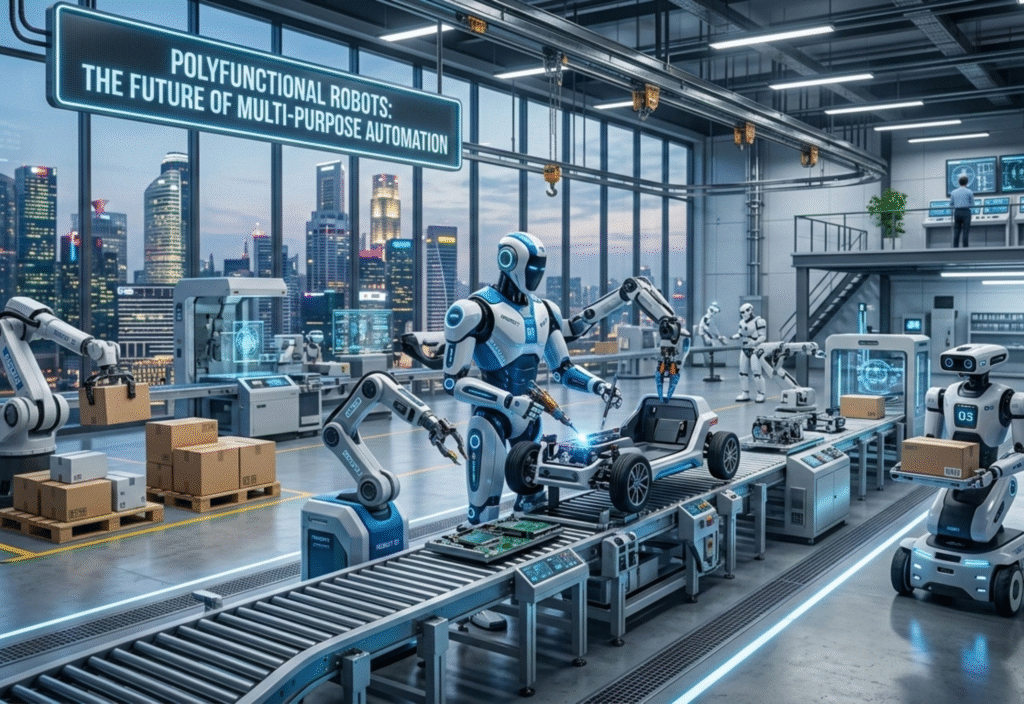
For example, a polyfunctional robot in a factory might perform the following tasks during a single work cycle:
Pick and place components
Inspect product quality
Assemble mechanical parts
Package finished goods
Transport materials within the facility
This adaptability makes them highly valuable for industries that require efficiency and scalability.
Key Technologies Behind Polyfunctional Robots
The development of polyfunctional robotics relies on several advanced technologies that allow robots to operate intelligently and safely.
Artificial Intelligence and Machine Learning
Artificial intelligence enables robots to analyze data, recognize patterns, and make decisions. Machine learning algorithms allow robots to improve their performance over time by learning from experience.
For example, a robot performing product inspection can gradually become more accurate by learning to identify defects more effectively.
Computer Vision
Computer vision systems allow robots to interpret visual information from cameras and sensors. This technology enables robots to identify objects, read labels, detect shapes, and monitor their environment.
Computer vision is especially useful in manufacturing, logistics, and healthcare applications.
Modular Hardware Systems
Many polyfunctional robots are built using modular components. This means different tools or attachments can be added depending on the task.
Examples of interchangeable tools include:
Robotic grippers
Welding tools
Inspection cameras
Cutting tools
Precision manipulators
By changing the tools, the robot can perform different functions without replacing the entire system.
Sensor Technology
Sensors play a crucial role in enabling robots to interact safely with their environment. These sensors help robots detect obstacles, measure distances, and monitor pressure or temperature.
Common sensors used in robotics include:
Proximity sensors
Force sensors
LiDAR scanners
Motion sensors
Environmental sensors
These technologies help polyfunctional robots operate safely alongside humans.
Applications of Polyfunctional Robots
Polyfunctional robots are increasingly being used in various industries due to their flexibility and efficiency.
Manufacturing and Industrial Production
Manufacturing is one of the largest adopters of robotics. Polyfunctional robots can perform several operations within a production line, such as assembling components, inspecting products, and packaging items.
This flexibility helps manufacturers quickly adapt to changes in production demand.
Logistics and Warehousing
Warehouses and distribution centers require automation to manage the growing demand for e-commerce deliveries. Polyfunctional robots can assist with tasks such as sorting packages, transporting goods, scanning inventory, and loading shipments.
These robots improve supply chain efficiency and reduce manual labor requirements.
Healthcare and Medical Assistance
In healthcare environments, robots can support medical staff by performing tasks such as delivering medical supplies, disinfecting hospital rooms, and assisting in patient monitoring.
Some advanced robotic systems are also used in surgical assistance and rehabilitation support.
Agriculture and Farming
Agriculture is another industry benefiting from polyfunctional robotics. A single robotic platform can perform tasks such as planting seeds, monitoring crop health, spraying fertilizers, and harvesting produce.
These systems help farmers improve productivity while addressing labor shortages.
Service and Domestic Robots
Polyfunctional robots are also expected to play an important role in homes and service industries. Future household robots may handle cleaning, security monitoring, elderly care, and smart home management.
As technology advances, these robots could become common in daily life.
Benefits of Polyfunctional Robots
The adoption of polyfunctional robotics offers many advantages for businesses and organizations.
Increased Operational Efficiency
By performing multiple tasks, polyfunctional robots reduce the need for separate machines. This improves operational efficiency and simplifies production processes.
Cost Savings
Although the initial investment may be high, polyfunctional robots can reduce long-term costs by replacing multiple specialized machines and reducing labor expenses.
Greater Flexibility
Businesses can quickly adapt to new tasks by reprogramming robots rather than purchasing new equipment. This flexibility is especially important in industries with rapidly changing demands.
Improved Workplace Safety
Robots can perform dangerous tasks in hazardous environments such as chemical plants, mining sites, or heavy manufacturing facilities. This helps reduce workplace injuries.
Continuous Productivity
Robots can operate continuously without fatigue, increasing production output and reducing downtime.
Challenges in Polyfunctional Robotics
Despite their advantages, polyfunctional robots still face several challenges.
High Development and Implementation Costs
Developing advanced robotic systems requires significant investment in research, design, and testing.
Technical Complexity
Building robots that can perform multiple tasks reliably requires complex software systems and sophisticated engineering.
Workforce Training
Employees must learn how to work alongside robotic systems and manage automated processes.
Ethical and Social Concerns
Automation often raises concerns about job displacement and workforce transformation. Governments and organizations must address these concerns through policies and training programs.
The Future of Polyfunctional Robotics
The future of polyfunctional robots is closely tied to advancements in artificial intelligence, robotics engineering, and sensor technology. Researchers are working to create robots that are more adaptable, autonomous, and capable of operating in dynamic environments.
In the coming years, we can expect several developments:
Smarter robots capable of autonomous decision-making
Human-robot collaboration in workplaces
Multi-purpose robots in homes and public spaces
Robotic teams working together to complete complex tasks
As technology continues to progress, polyfunctional robots will likely become an essential part of modern industries and daily life.
Conclusion
Polyfunctional robots represent a major advancement in the world of automation. Unlike traditional robots designed for single tasks, these intelligent machines can perform multiple functions using a single platform. By combining artificial intelligence, advanced sensors, and modular hardware, polyfunctional robots provide flexibility, efficiency, and productivity across many industries.