
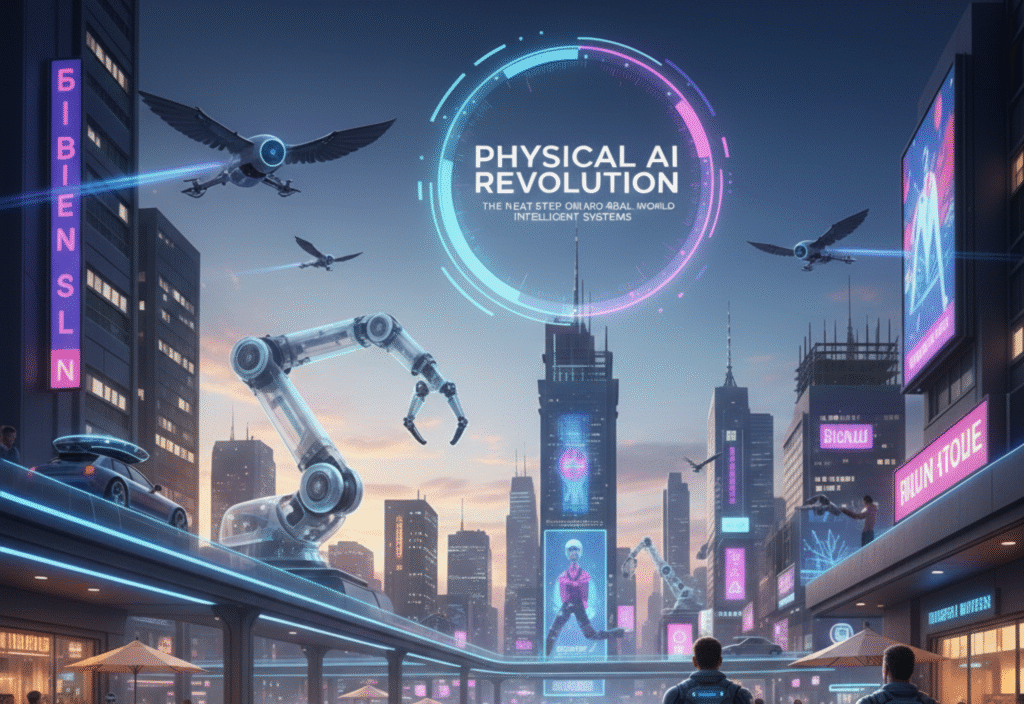
Artificial Intelligence (AI) is no longer limited to software and virtual environments. The rise of Physical AI is transforming the way machines interact with the real world. Unlike traditional AI, which mainly exists in digital interfaces, physical AI integrates intelligence into robots, drones, autonomous vehicles, and smart devices. These systems can sense their surroundings, make decisions, and act autonomously in complex, unpredictable environments.
The Physical AI revolution represents the next step in technological evolution, bridging the gap between virtual intelligence and tangible real-world applications. This shift has profound implications for industries such as manufacturing, logistics, healthcare, agriculture, and more.
What Is Physical AI?
Physical AI refers to systems in which artificial intelligence is embedded into machines that operate in the physical world. These systems combine sensors, actuators, robotics, and advanced algorithms to perceive, learn, and interact with their environment.
Key characteristics of Physical AI include:
Autonomous Decision-Making: Machines can process data from their environment and make real-time decisions without human intervention.
Adaptability: They can adjust to changing conditions, such as weather, obstacles, or equipment failure.
Sensing Capabilities: Equipped with cameras, lidar, or other sensors, Physical AI systems collect detailed environmental data.
Action-Oriented Intelligence: Unlike software-only AI, these systems can physically manipulate objects or navigate spaces.
Examples include autonomous warehouse robots, delivery drones, surgical robots, and smart farming equipment.
Applications of Physical AI
1. Manufacturing and Industry
Physical AI is revolutionizing industrial operations. Autonomous robots can assemble products, perform quality inspections, and handle repetitive or dangerous tasks. This improves efficiency, safety, and precision while reducing human error.
2. Autonomous Vehicles
Self-driving cars and trucks rely on Physical AI to interpret sensor data, navigate roads, and make split-second decisions. These systems have the potential to reduce traffic accidents and optimize transportation networks.
3. Healthcare
Medical robotics powered by Physical AI assist in surgeries, patient monitoring, and rehabilitation. These intelligent systems improve accuracy, consistency, and patient outcomes, allowing healthcare professionals to focus on critical decision-making.
4. Agriculture
Smart farming drones and robotic harvesters use Physical AI to monitor crop health, optimize irrigation, and detect pests. This reduces waste, increases efficiency, and supports sustainable agricultural practices.
5. Logistics and Supply Chain
Autonomous warehouse robots and delivery drones streamline logistics operations. Physical AI systems can handle inventory management, transportation, and package delivery with minimal human intervention.
Advantages of Physical AI
Efficiency: Tasks are completed faster and more accurately.
Safety: Dangerous or repetitive tasks are delegated to machines.
Scalability: Businesses can scale operations without proportional increases in human labor.
Adaptability: Systems respond to environmental changes in real time.
Data-Driven Decision Making: Continuous sensing and learning improve operational insights.
Challenges and Considerations
Despite its promise, Physical AI comes with challenges:
High Initial Investment: Implementing advanced robotics and sensors can be costly.
Technical Complexity: Designing adaptable AI systems requires advanced engineering and programming skills.
Ethical and Safety Concerns: Autonomous machines operating in real-world environments must follow strict safety protocols to avoid accidents or misuse.
Maintenance and Reliability: Physical AI systems require ongoing maintenance and updates to perform reliably.
The Future of Physical AI
Physical AI is expected to become more sophisticated in the coming years, combining AI, robotics, IoT, and edge computing. Emerging trends include:
Collaborative Robots (Cobots): Robots that work safely alongside humans in shared environments.
AI-Powered Smart Cities: Infrastructure that adapts to traffic, energy usage, and public safety.
Advanced Autonomous Vehicles: Smarter, safer, and more efficient transportation systems.
Human-Robot Interaction: More intuitive communication between humans and machines through voice, gesture, or AI-assisted guidance.
As technology evolves, the boundaries between virtual intelligence and the physical world will continue to blur, creating new opportunities for innovation and efficiency.
Conclusion
The Physical AI revolution marks a critical shift in how artificial intelligence is applied. By embedding intelligence into physical machines, organizations can achieve unprecedented levels of efficiency, safety, and adaptability. From healthcare and agriculture to logistics and manufacturing, Physical AI has the potential to transform industries while improving operational outcomes.