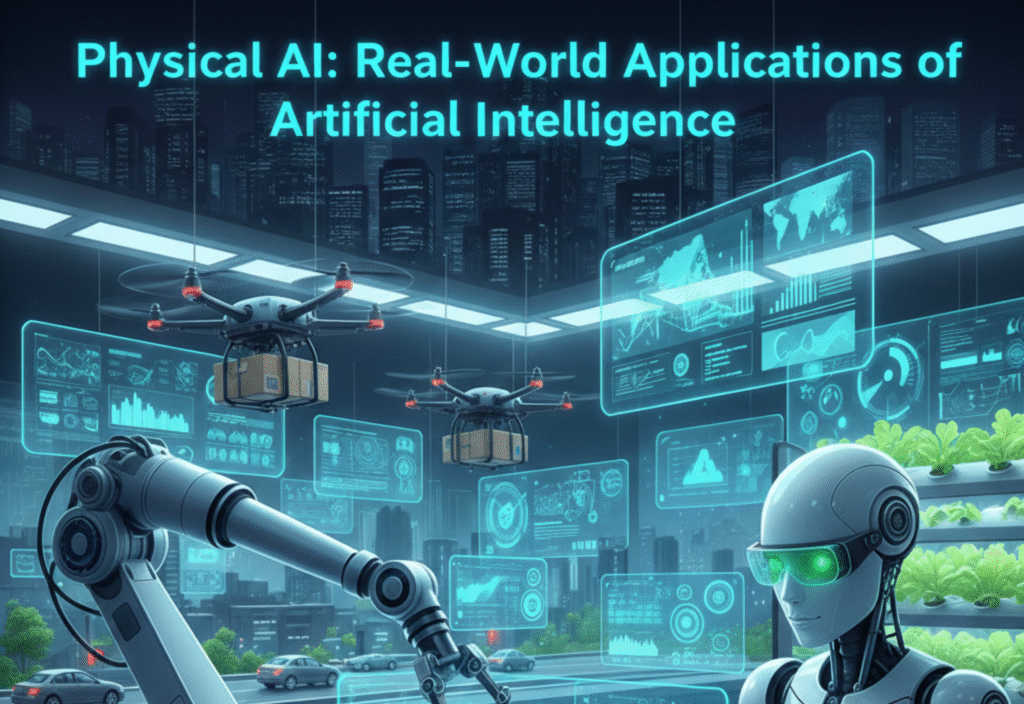
Physical AI is transforming industries by connecting digital intelligence with the real world. Unlike traditional AI, which mainly operates in software, this approach allows machines and devices to perceive, act, and adapt in physical environments. By integrating robotics, sensors, and intelligent algorithms, these AI-driven systems perform tasks autonomously, learn from experience, and enhance efficiency across sectors.
Autonomous AI systems are now deployed in manufacturing, healthcare, smart cities, agriculture, and transportation, showcasing the practical impact of real-world AI applications.
What Is Physical AI?
Physical AI refers to artificial intelligence that interacts directly with the physical environment. Its main capabilities include:
Perception: Using sensors, cameras, and devices to understand surroundings
Action: Manipulating objects, moving autonomously, or interacting safely with humans
Adaptation: Learning from outcomes to continuously improve performance
In essence, this approach blends digital intelligence with physical capabilities, enabling systems to make decisions and act in real-world environments.
Real-World Applications
1. Autonomous Vehicles
Self-driving cars exemplify Physical AI. They combine cameras, lidar, and radar to detect obstacles, navigate safely, and optimize routes.
Related: Agentic AI: How Intelligent Agents Support Smarter Businesses
Benefits:
Reduced human error
Optimized traffic flow
Enhanced safety
2. Robotics and Industrial Automation
In manufacturing, AI-driven systems assemble products, sort items, and monitor production lines. These systems adapt to changing conditions and collaborate with humans, increasing productivity while reducing operational costs.
Related: AI in Industrial Automation
3. Healthcare and Medical Devices
Healthcare is transforming with autonomous AI systems:
Surgical robots assisting precise procedures
AI-powered prosthetics adapting to user movements
Intelligent monitoring predicting health risks
These real-world AI applications enhance patient care, reduce errors, and improve outcomes.
4. Smart Cities
Intelligent systems optimize traffic, monitor air quality, manage waste, and improve public safety. By interacting with urban infrastructure, this approach makes cities more efficient and sustainable.
Related: AI for Smart Cities
5. Agriculture and Environmental Management
Farmers use AI-driven systems to:
Monitor crops and soil via drones and sensors
Automate irrigation and harvesting
Track wildlife and manage natural resources
These applications increase productivity, conserve resources, and support sustainability.
Benefits of Physical AI
Efficiency: Automates repetitive and complex tasks
Safety: Reduces human exposure to hazardous environments
Adaptability: Learns from real-world interactions
Cost Savings: Optimizes resource utilization
Challenges
Even with advantages, Physical AI must be deployed responsibly:
Safety: Systems must function reliably
Ethics: Decision-making should be transparent
Human Collaboration: Humans should supervise critical operations
Security: Systems must be protected from cyber threats
Physical AI vs Traditional AI
| Traditional AI | Physical AI |
|---|---|
| Operates in software/data | Interacts with real-world environment |
| Focused on prediction/analysis | Combines sensing, reasoning, and action |
| Limited real-world effect | Acts autonomously or semi-autonomously |
| Requires human commands | Intelligent systems perform tasks independently |
The Future
Physical AI is expected to:
Enable fully autonomous factories and logistics
Transform healthcare with adaptive surgical and rehabilitation robots
Support smart cities with real-time infrastructure management
Enhance agriculture and environmental monitoring
By combining perception, reasoning, and action, these AI-driven systems will become essential in industries worldwide.
Conclusion
Physical AI represents the next evolution of artificial intelligence, allowing machines to act, adapt, and learn in real-world environments. When implemented responsibly, this approach provides businesses, healthcare, cities, and agriculture with intelligent, adaptive, and reliable AI solutions.