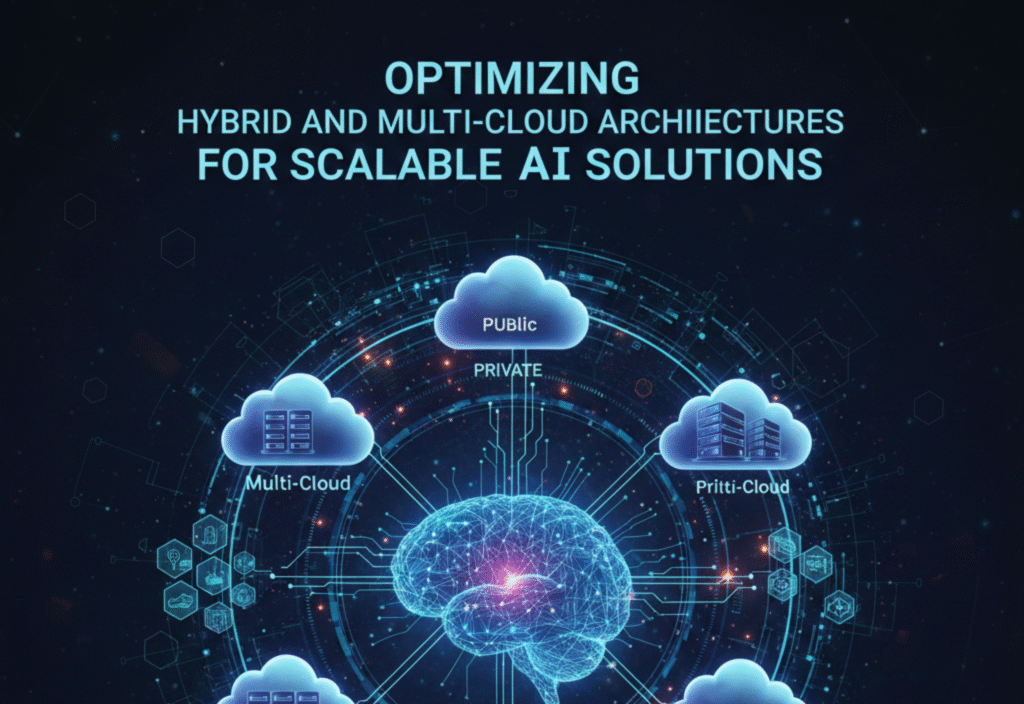
Hybrid & multi-cloud AI is transforming how organizations deploy scalable artificial intelligence systems. With AI workloads growing rapidly, relying on a single cloud or on-premise setup is no longer sufficient. Combining multiple cloud platforms with private infrastructure provides flexibility, scalability, and cost efficiency, while keeping data secure and compliant.
What is Hybrid & Multi-Cloud AI?
Hybrid cloud connects private systems with public cloud platforms, allowing sensitive workloads to remain on-premise while compute-intensive AI tasks run in the cloud.
Using multiple cloud providers reduces vendor lock-in, enhances reliability, and enables access to specialized AI tools.
Proper management of hybrid cloud and multi-cloud infrastructure ensures AI workloads perform efficiently and scale as needed.
Why It Matters
AI systems need:
High-performance computation (GPUs/TPUs)
Fast access to large datasets
Low-latency real-time processing
Regulatory compliance
Adopting multi-cloud AI systems allows organizations to balance performance, cost, and flexibility, supporting model training and deployment.
Strategies for Optimization
1. Smart Workload Placement
Distribute workloads wisely:
Model training on cloud resources
Sensitive data on private infrastructure
Multi-cloud deployment for global reach
Smart placement reduces latency, cost, and operational risk.
2. Unified Data Architecture
Centralized data lakes accessible across environments
Cloud-agnostic formats for portability
Metadata management and minimal duplication
A solid data architecture ensures AI workloads on hybrid and multi-cloud environments run efficiently.
3. Containerization and Orchestration
Containers and Kubernetes provide:
Portability across platforms
Automatic scaling
Optimized resource usage
This approach allows scalable AI solutions across multiple clouds to run seamlessly.
4. MLOps Automation
Automated pipelines handle:
Data ingestion and preprocessing
Continuous model training and evaluation
Deployment and monitoring
Automation is essential for efficient AI systems on hybrid and multi-cloud setups.
5. Security and Compliance
Unified identity and access management
Encryption in transit and at rest
Policy-based access control
AI model governance
Security and compliance are critical for trustworthy multi-cloud AI solutions.
6. Cost Optimization
Use preemptible or spot instances for training
Auto-scale inference endpoints
Monitor resource usage
Shut down idle resources
Efficient cost management ensures sustainable hybrid cloud and multi-cloud operations.
Challenges
Operational complexity
Network latency between clouds
Data consistency issues
Skills gap for multi-cloud management
Tool fragmentation
Automation and standardization help overcome these challenges.
Future Trends
AI-native cloud platforms for optimized workloads
Edge + cloud integration for low-latency AI
Self-optimizing infrastructure
Policy-driven AI governance
Organizations adopting multi-cloud AI solutions today are better positioned for future scalability.
Conclusion
Hybrid & multi-cloud AI enables organizations to scale AI systems efficiently without compromising security or flexibility. Optimizing workload placement, data architecture, automation, security, and cost ensures resilient and scalable AI solutions. Strategic multi-cloud AI adoption is essential for sustainable AI growth in today’s technology-driven world.