
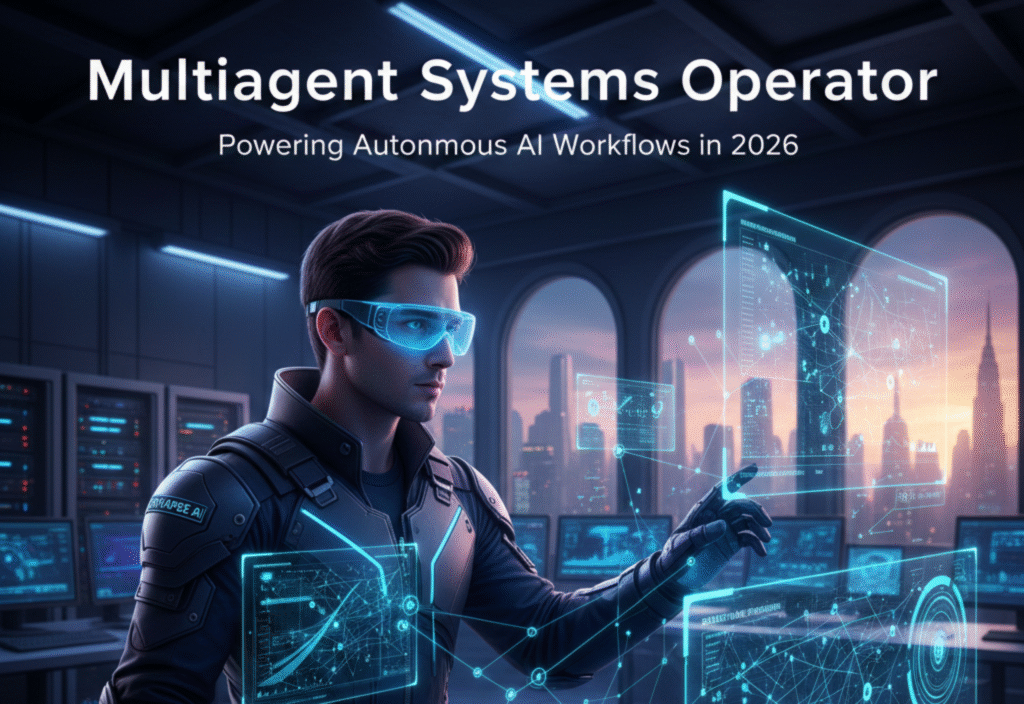
By 2026, Artificial Intelligence is no longer just a productivity tool—it has evolved into a collaborative digital workforce. Modern AI systems rarely rely on a single model. Instead, they use multiple intelligent agents working together to solve complex problems. At the center of this transformation is a new and critical role: the Multiagent Systems Operator.
This role ensures that autonomous AI systems remain efficient, controlled, ethical, and aligned with human goals, even as they grow more powerful.
Understanding Multiagent Systems
A Multiagent System (MAS) is an AI architecture where multiple autonomous agents operate within a shared environment. Each agent:
Makes independent decisions
Communicates with other agents
Handles specialized tasks
Adapts to changing conditions
Rather than one AI doing everything, tasks are distributed among agents such as planners, analysts, executors, validators, and monitors. Together, they form a coordinated intelligence that is far more scalable and resilient than single-model systems.
Who Is a Multiagent Systems Operator?
A Multiagent Systems Operator is the professional responsible for designing, supervising, and governing these AI agent ecosystems.
Their role includes:
Orchestrating how agents collaborate
Defining decision boundaries
Preventing conflicts and runaway automation
Ensuring AI outputs follow business rules and ethical standards
In simple terms, a Multiagent Systems Operator is the control layer between autonomous AI and real-world impact.
Why This Role Is Essential in 2026
As organizations adopt Agentic AI—systems that can plan, decide, and act—new risks emerge:
Uncontrolled automation
Conflicting decisions between agents
Lack of transparency
Compliance and accountability gaps
The Multiagent Systems Operator exists to manage these risks proactively, ensuring autonomy does not come at the cost of trust or safety.
Core Responsibilities of a Multiagent Systems Operator
1. Autonomous Workflow Orchestration
The operator designs AI workflows by deciding:
Which agent performs which task
The order of execution
Where human approval is required
This prevents chaos and ensures smooth, goal-driven automation.
2. Agent Coordination and Communication
To keep agents aligned, the operator defines:
Communication protocols
Role boundaries
Priority and escalation rules
This ensures agents collaborate rather than compete.
3. Governance, Ethics, and Compliance
A key responsibility is making sure AI systems:
Respect data privacy
Produce explainable decisions
Follow regulatory and organizational policies
This role translates Responsible AI principles into real systems.
4. Monitoring and Continuous Optimization
The operator:
Tracks agent performance
Identifies inefficiencies or errors
Improves workflows over time
AI systems are treated as living systems, not one-time deployments.
Industries Using Multiagent Systems in 2026
Business & Enterprise Operations
Intelligent process automation
Decision support systems
AI-driven customer service teams
Finance & FinTech
Fraud detection agents
Risk assessment and monitoring
Regulatory compliance automation
Healthcare
Clinical decision support
Patient data analysis
Resource and capacity planning
Cybersecurity
Threat detection agents
Automated incident response
Continuous system monitoring
Skills Required for a Multiagent Systems Operator
Technical Skills
AI and machine learning fundamentals
Multiagent frameworks (e.g., AutoGen, CrewAI, LangGraph)
Workflow automation and logic design
Observability and monitoring tools
Strategic Skills
Process modeling
Risk management
Decision governance
Human-Centered Skills
Critical thinking
Ethical judgment
Clear communication between technical and non-technical teams
In 2026, AI professionals are not just developers—they are operators, strategists, and stewards of intelligent systems.
Human-in-the-Loop: A Non-Negotiable Principle
One of the most important aspects of this role is Human-in-the-Loop (HITL) control.
A Multiagent Systems Operator ensures that:
High-impact decisions require human approval
AI actions remain reversible
Automation enhances human judgment rather than replacing it
This keeps AI as a powerful assistant, not an unchecked authority.
Career Scope and Future Outlook
The demand for Multiagent Systems Operators is growing rapidly across:
AI product teams
Large enterprises
Startups
Consulting and advisory firms
Over time, this role may evolve into titles such as:
AI Operations Lead
Autonomous Systems Manager
Agent Governance Specialist
It represents a long-term, future-proof career path in the AI ecosystem.
Ethical and Societal Impact
Beyond technical execution, this role plays a vital role in:
Reducing AI-related risks
Promoting transparency and accountability
Ensuring AI adoption remains human-centric
By adding oversight and governance, Multiagent Systems Operators help build public and organizational trust in AI.
Final Thoughts
The Multiagent Systems Operator is more than a job title—it is a response to the growing complexity of autonomous AI. As AI agents gain the ability to plan and act independently, they must also be guided, constrained, and aligned.