
In the age of big data and artificial intelligence, the ability to predict outcomes accurately has become a critical advantage across industries. Whether it’s forecasting market trends, optimizing logistics, or understanding complex environmental systems, prediction technologies are shaping smarter decisions.
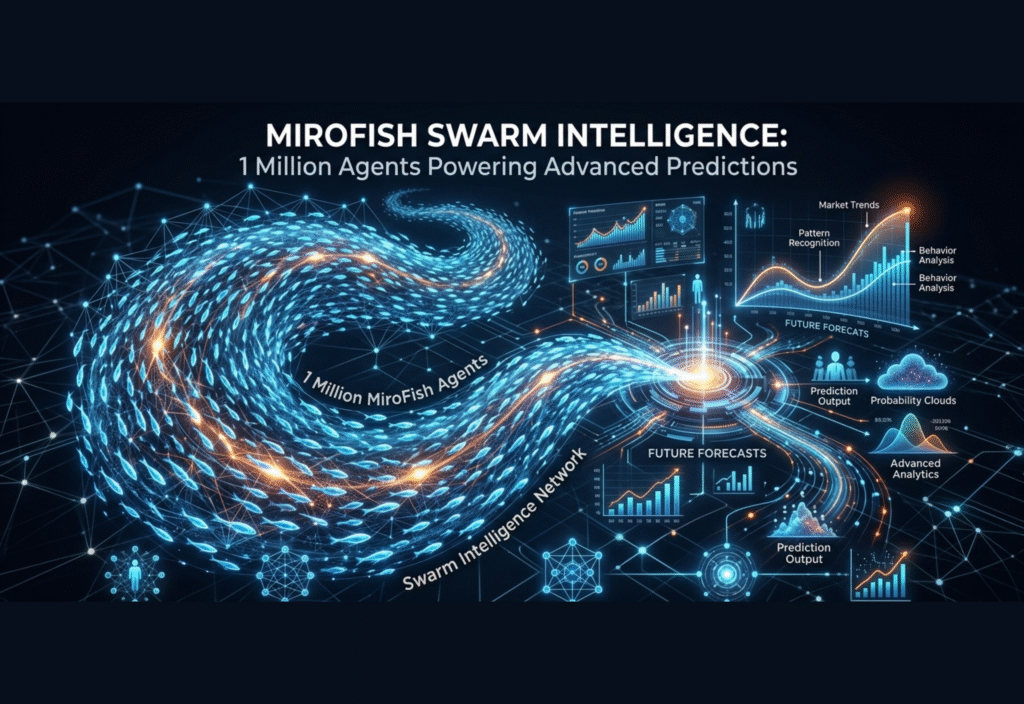
One of the most exciting innovations in this space is MiroFish Swarm Intelligence, a system that leverages the power of 1 million intelligent agents working together. Inspired by nature and powered by modern computing, MiroFish represents a shift from traditional centralized AI models to decentralized, collaborative intelligence.
This article explores how MiroFish works, why it matters, and how it is redefining advanced prediction systems.
Understanding Swarm Intelligence
Swarm intelligence is a concept rooted in nature. It refers to the collective behavior of decentralized systems made up of many simple agents interacting locally with one another.
Natural Inspiration
In nature, swarm intelligence can be seen in:
Schools of fish moving in perfect coordination
Ant colonies finding efficient paths to food
Flocks of birds changing direction simultaneously
Each individual follows simple rules, yet the group as a whole displays highly intelligent behavior.
Core Principles
Swarm intelligence systems typically share these characteristics:
Decentralization: No central authority controls the system
Self-organization: Patterns emerge naturally from interactions
Adaptability: The system responds dynamically to changes
Scalability: Performance improves with more agents
MiroFish takes these principles and applies them to computational intelligence.
What Is MiroFish Swarm Intelligence?
MiroFish is an advanced predictive system built on swarm intelligence. It uses a network of up to 1 million distributed agents, each performing small tasks and sharing information locally.
Instead of relying on a single large AI model, MiroFish distributes intelligence across many smaller units. These agents collaborate, compete, and adapt to generate highly accurate predictions.
Key Idea
“Many simple agents working together can outperform a single complex system.”
This approach allows MiroFish to process vast amounts of data efficiently while remaining flexible and resilient.
How MiroFish Works in Detail
1. Agent-Based Architecture
Each agent in the MiroFish system:
Processes a small subset of data
Makes local decisions
Communicates with nearby agents
Agents are lightweight and operate independently, making the system highly scalable.
2. Local Interactions Drive Global Intelligence
Agents don’t have a full view of the system. Instead, they:
Share insights with neighbors
Adjust behavior based on feedback
Reinforce useful patterns
Over time, these local interactions produce emergent intelligence—a global understanding that no single agent possesses.
3. Parallel Processing at Scale
With 1 million agents working simultaneously:
Tasks are processed in parallel
Predictions are generated faster
System efficiency increases dramatically
This parallelism is one of MiroFish’s biggest advantages.
4. Continuous Learning and Adaptation
MiroFish is not static. It evolves by:
Learning from new data
Updating agent behaviors
Refining prediction accuracy over time
This makes it ideal for dynamic environments where conditions change frequently.
Why 1 Million Agents Make a Difference
The scale of MiroFish is crucial to its performance.
Benefits of Large-Scale Swarms
Diversity of Insights: More agents mean more perspectives
Error Reduction: Collective decisions reduce individual mistakes
High Resilience: System continues even if some agents fail
Improved Accuracy: Patterns become clearer with more data points
Think of it as crowd intelligence—many small inputs combining into one powerful outcome.
Real-World Applications of MiroFish
1. Financial and Market Analysis
MiroFish can analyze vast datasets to:
Detect trends
Identify risks
Improve decision-making strategies
(Important: Predictions should be used responsibly; no system guarantees outcomes.)
2. Climate and Environmental Systems
Complex systems like weather and climate benefit from swarm intelligence:
Better forecasting models
Disaster prediction
Environmental simulations
3. Healthcare and Medical Research
MiroFish can support:
Disease prediction
Drug discovery
Patient data analysis
Its ability to process large datasets makes it valuable in research environments.
4. Smart Cities and Urban Planning
Swarm intelligence can optimize:
Traffic flow
Energy consumption
Public transportation systems
This leads to more efficient and sustainable cities.
5. Robotics and Autonomous Systems
MiroFish principles are ideal for:
Drone swarms
Robot coordination
Real-time navigation systems
Comparison with Traditional AI Models
| Feature | Traditional AI | MiroFish Swarm Intelligence |
|---|---|---|
| Control | Centralized | Decentralized |
| Scalability | Limited | Extremely High |
| Fault Tolerance | Low | High |
| Learning Style | Model Training | Emergent Behavior |
| Flexibility | Moderate | Very High |
Challenges and Limitations
Despite its advantages, MiroFish also faces challenges:
1. System Complexity
Managing millions of agents requires sophisticated design and monitoring.
2. Data Dependency
High-quality data is essential for accurate predictions.
3. Resource Requirements
Large-scale systems may require significant computing power.
4. Interpretability
Understanding how decisions emerge from swarm interactions can be difficult.
Ethical Considerations
As with any powerful technology, ethical use is essential.
Key Guidelines:
Use predictions responsibly
Avoid manipulation or unfair practices
Protect user privacy and data
Maintain transparency where possible
MiroFish should be seen as a decision-support tool, not a replacement for human judgment.
The Future of Swarm Intelligence
The future of systems like MiroFish is promising. Potential developments include:
Integration with advanced AI models
Real-time global prediction systems
Expansion into more industries
Improved transparency and explainability
Swarm intelligence could become a foundation for next-generation AI systems.
Conclusion
MiroFish Swarm Intelligence represents a major shift in how we approach prediction and data analysis. By leveraging 1 million agents working collaboratively, it delivers scalability, resilience, and advanced predictive capabilities.
This decentralized approach challenges traditional AI models and opens the door to more adaptive, efficient, and intelligent systems. As technology continues to evolve, MiroFish and similar innovations could play a key role in shaping the future of artificial intelligence.