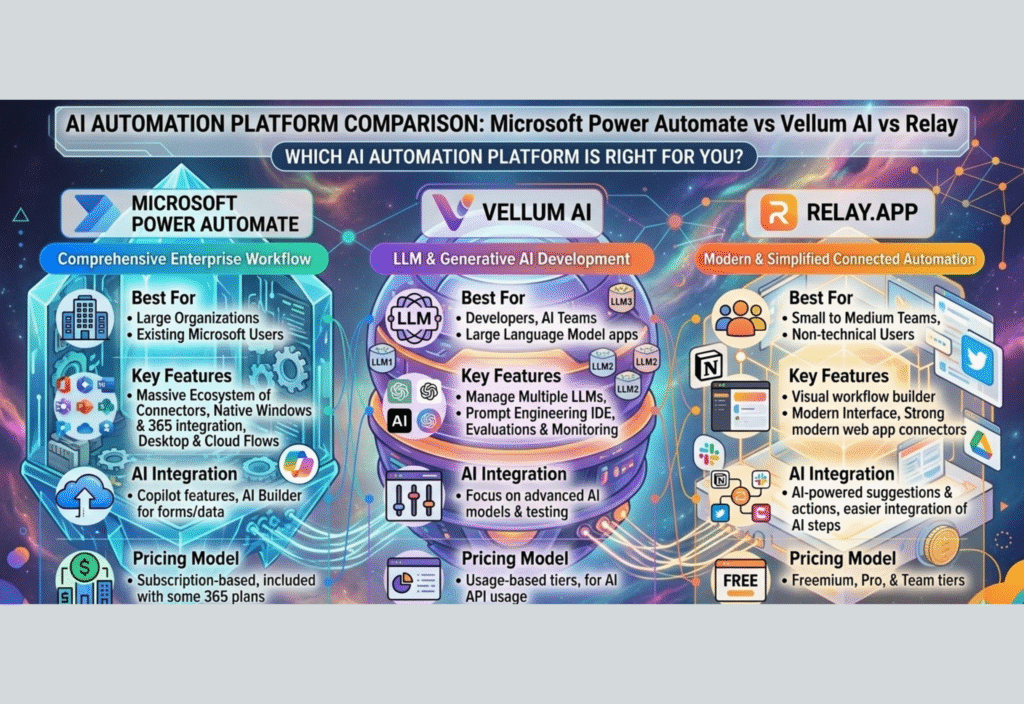
AI Automation Platform Comparison is essential for modern businesses looking to streamline workflows. Platforms like Microsoft Power Automate, Vellum AI, and Relay help teams save time, reduce errors, and boost productivity.
Among the top automation platforms in 2026, Microsoft Power Automate, Vellum AI, and Relay stand out for their unique strengths. Each platform caters to different needs, whether it’s enterprise integration, intelligent document handling, or team-focused workflows. This article explores all three platforms to help you decide which one fits your organization best.
What Are AI Automation Platforms?
AI automation platforms are software tools that use artificial intelligence to automate tasks across apps and systems. Instead of manually performing repetitive processes, businesses can rely on these platforms to handle workflows efficiently.
Some key benefits include:
Saving time on routine tasks
Reducing human error
Connecting multiple apps and systems seamlessly
Scaling automation as your business grows
For example, an AI platform can automatically transfer data between apps, generate summaries, or send notifications without human intervention. Over time, these tools free up teams to focus on higher-value tasks, such as decision-making and strategy.
Microsoft Power Automate – Enterprise-Grade Automation
Microsoft Power Automate is a powerful platform that integrates deeply with the Microsoft 365 ecosystem. It allows businesses to create complex workflows across Microsoft apps and third-party services.
Key Features
Pre-built connectors: Supports over 600 applications.
Cloud and desktop automation: Run workflows in both cloud and local apps.
AI Builder: Automates document processing, predictions, and form extraction.
Approval workflows: Manage document approvals and task notifications automatically.
Best For
Large organizations already using Microsoft 365, Teams, or Dynamics 365.
Pros
Seamless integration with Microsoft apps
Advanced AI features for intelligent automation
Enterprise-level security and compliance
Cons
Slightly complex for beginners
Higher cost for smaller teams
Additionally, Power Automate is ideal for companies that require scalable, secure, and feature-rich automation.
Vellum AI – Intelligent Knowledge Work Automation
Vellum AI focuses on automating knowledge-based tasks. Instead of just moving data, it can understand and process information, extract insights, and summarize documents.
Key Features
AI-powered document analysis and summarization
Automated research and reporting
Easy-to-use interface for non-technical users
Custom AI triggers based on content or context
Best For
Organizations that rely on documents, research, or content-heavy workflows.
Pros
Handles complex document workflows intelligently
Quick deployment without coding knowledge
AI-driven insights improve productivity
Cons
Fewer integrations than Microsoft Power Automate
Smaller user community for support
For instance, teams can automate report generation or research summaries, saving hours of manual work every week.
Relay – Simple Team-Focused Automation
Relay is designed for teams that need fast, easy, and collaborative automation. It focuses on approvals, notifications, and task management without requiring technical expertise.
Key Features
Drag-and-drop workflow builder
Team collaboration with task assignments and notifications
Integrates with productivity tools like Slack, Trello, and Gmail
Rapid workflow deployment
Best For
Small to medium-sized teams that want simple, efficient automation.
Pros
Very user-friendly
Quick to deploy workflows
Great for team collaboration
Cons
Limited AI capabilities
May not scale well for very large organizations
For example, a marketing team can automate approval requests for content, ensuring no delays while keeping the process simple.
Comparing Microsoft Power Automate, Vellum AI, and Relay
| Feature | Microsoft Power Automate | Vellum AI | Relay |
|---|---|---|---|
| Best For | Enterprises using Microsoft 365 | Knowledge work and documents | Small to medium teams |
| AI Capabilities | Advanced AI Builder, document analysis | AI-driven insights, summarization | Basic automation, minimal AI |
| Ease of Use | Moderate | Easy to moderate | Very easy |
| Integrations | 600+ apps | Limited | Productivity tools like Slack, Trello |
| Cost | High | Medium | Low to medium |
| Collaboration | Moderate | Moderate | Excellent |
As a result, each platform serves a different purpose depending on the user’s workflow and organizational needs.
How to Choose the Right Platform
When selecting an AI automation platform, consider these factors:
Business Size and Complexity
Large enterprises may benefit from Power Automate, while smaller teams may find Relay more suitable.Technical Expertise
Teams with limited technical skills may prefer Vellum AI or Relay due to their intuitive interfaces.Automation Goals
Document-heavy tasks: Vellum AI
Enterprise workflows: Power Automate
Quick team approvals: Relay
Budget
Consider costs relative to workflow complexity and user count.Integration Needs
Check which apps are essential for your team. Power Automate works best with Microsoft apps, while Relay and Vellum AI cover select third-party integrations.
Future of AI Automation Platforms
AI automation is evolving rapidly. Key trends include:
AI will provide suggestions, not just execute tasks
Increased integration with more apps and tools
Smarter document and data processing
Personalized automation for individual roles
Hybrid automation combining AI and rule-based workflows
Therefore, businesses that adopt the right platform now can stay ahead of these trends, improving productivity, reducing costs, and enhancing workflow intelligence.
Conclusion
Choosing the right platform depends on your team size, workflow needs, technical expertise, and budget.
Microsoft Power Automate is best for large enterprises needing advanced AI and deep integration with Microsoft 365.
Vellum AI works well for knowledge-heavy businesses requiring intelligent document processing and research automation.
Relay is ideal for small teams looking for simple, collaborative workflow automation without complex AI.
Ultimately, the right choice will help your business save time, reduce errors, and empower teams to focus on strategic tasks rather than repetitive work.