
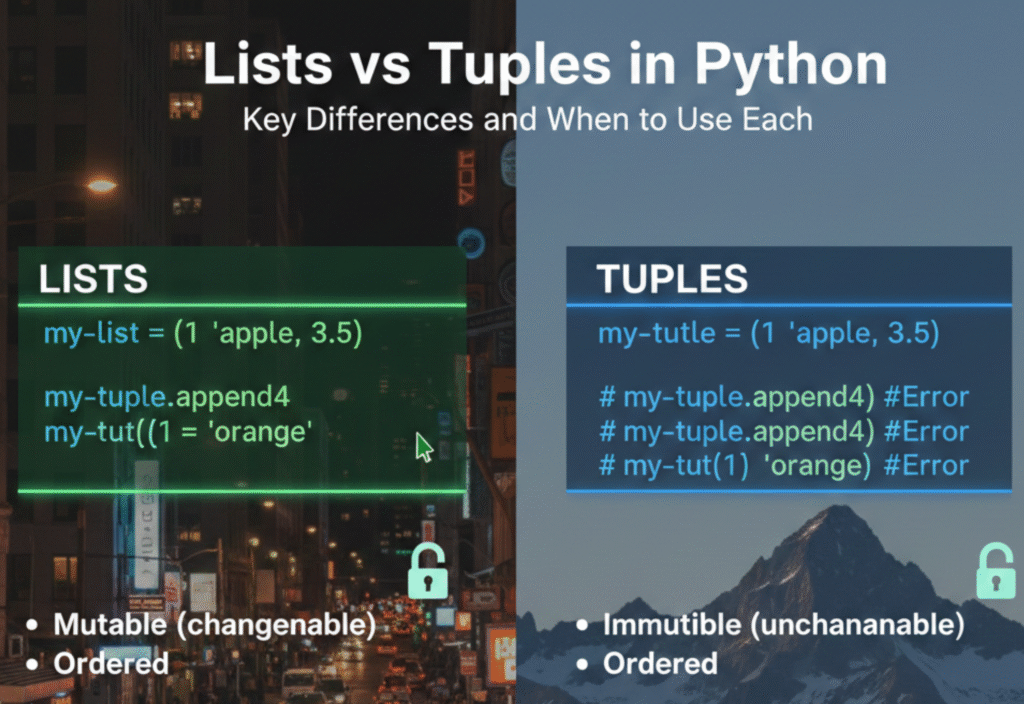
Understanding Python lists vs tuples is essential for every developer. While both are ordered collections, they differ in mutability, performance, and best use cases. Choosing the right one can make your code more efficient and error-free.
What Are Lists in Python?
A list in Python is a mutable, ordered collection of elements. This means that you can change, add, or remove elements in a list after it has been created. Lists are defined using square brackets [] and can hold elements of different data types, including numbers, strings, other lists, and even custom objects.
Example of a List
fruits = ["apple", "banana", "cherry"]
print(fruits)  # Output: ['apple', 'banana', 'cherry']
# Adding an element
fruits.append(“orange”)
print(fruits) # Output: [‘apple’, ‘banana’, ‘cherry’, ‘orange’]
# Removing an element
fruits.remove(“banana”)
print(fruits) # Output: [‘apple’, ‘cherry’, ‘orange’]
Lists are highly flexible and are ideal for situations where you need to modify your collection frequently.
What Are Tuples in Python?
A tuple is an immutable, ordered collection of elements. Once a tuple is created, you cannot change, add, or remove elements. Tuples are defined using parentheses () and, like lists, can hold elements of different data types.
Example of a Tuple
coordinates = (10, 20, 30)
print(coordinates)  # Output: (10, 20, 30)
# Trying to modify a tuple will raise an error
# coordinates[0] = 15 # This will raise TypeError
Tuples are commonly used when the data should remain constant and unchangeable, which can help prevent accidental modifications in your code.
Key Differences Between Lists and Tuples
| Feature | List | Tuple |
|---|---|---|
| Mutability | Mutable (can be changed) | Immutable (cannot be changed) |
| Syntax | Square brackets [] | Parentheses () |
| Performance | Slower due to mutability | Faster, because they are immutable |
| Methods Available | Many built-in methods (append, remove, pop, sort) | Limited methods (count, index) |
| Use Case | When data needs modification | When data must remain constant |
| Memory Efficiency | Uses more memory | More memory-efficient |
Mutability vs Immutability
The most important difference is mutability. A list can be changed after its creation, while a tuple cannot. This immutability makes tuples hashable, which means they can be used as keys in dictionaries, whereas lists cannot.
my_dict = {(1, 2): "tuple key"}  # Valid
# my_dict = {[1, 2]: "list key"}  # Invalid, TypeError
Performance Comparison
Tuples have a smaller memory footprint and slightly better performance than lists because their immutability allows Python to optimize storage and access speed. This makes tuples preferable when working with large datasets that do not need modification.
When to Use Lists
When you need to modify data: Add, remove, or change elements frequently.
When you need dynamic storage: Lists can grow and shrink as needed.
For iterative operations: Loops that involve frequent updates are best done with lists.
Example:
shopping_cart = []
shopping_cart.append("milk")
shopping_cart.append("bread")
shopping_cart.remove("milk")
print(shopping_cart)  # Output: ['bread']
When to Use Tuples
When data should not change: Protecting data integrity in your program.
As dictionary keys: Because tuples are hashable, they can be used as keys.
For fixed collections of items: E.g., coordinates, RGB color values, or database records.
Example:
coordinates = (50.123, 8.456)
print(coordinates)  # Output: (50.123, 8.456)
Mixing Lists and Tuples
Sometimes, lists and tuples can be used together. For instance, you may store tuples inside a list to represent immutable records in a collection that can still grow.
records = [(1, "Alice"), (2, "Bob")]
records.append((3, "Charlie"))
print(records)
# Output: [(1, 'Alice'), (2, 'Bob'), (3, 'Charlie')]
This approach combines the benefits of immutability (tuples) with the flexibility of dynamic collections (lists).
Summary
Both lists and tuples are essential Python data structures, each serving a unique purpose:
Lists: Mutable, versatile, and ideal for collections that need to change.
Tuples: Immutable, memory-efficient, and ideal for fixed data that must remain constant.
Choosing between them depends on the specific needs of your program, with considerations of mutability, performance, memory efficiency, and data integrity guiding your decision.