
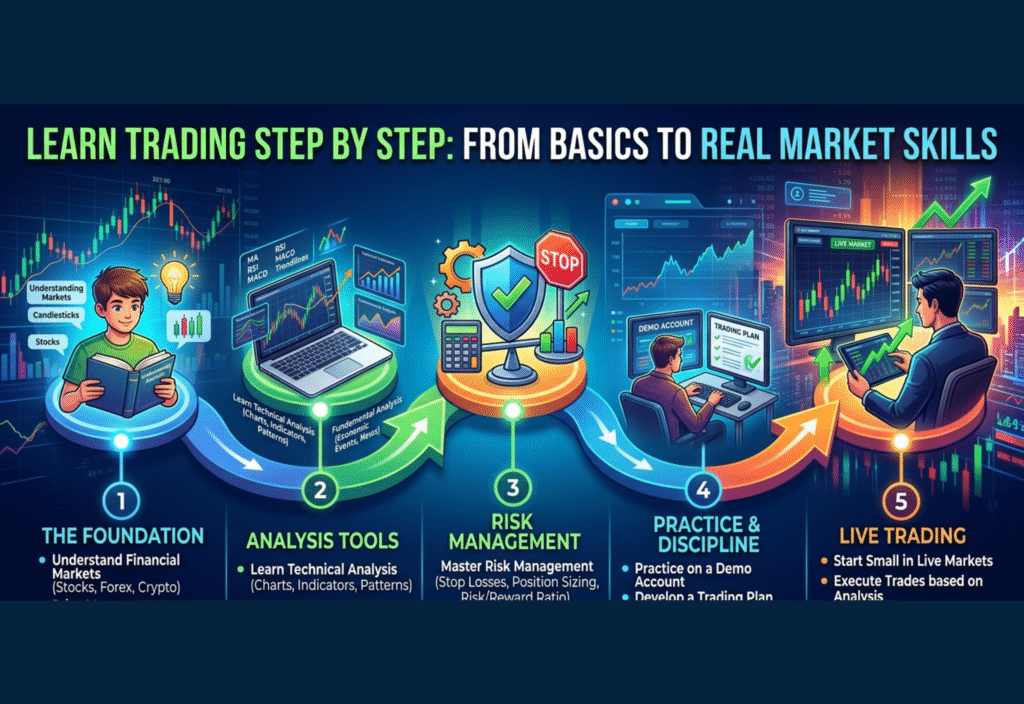
Learn trading step by step is the best way to build strong and lasting skills in the financial markets. Instead of rushing, beginners should focus on understanding the basics, practicing strategies, and managing risk properly. This guide will help you learn trading step by step, from beginner concepts to real market skills in a simple and structured way.
1. What Is Trading and How It Works
Trading is the process of buying and selling financial assets to earn profit from price movements. These assets can include stocks, currencies, crypto, or commodities. The goal is simple: buy at a lower price and sell at a higher price.
There are different types of trading:
- Intraday Trading: Buying and selling within the same day
- Swing Trading: Holding trades for a few days or weeks
- Position Trading: Long-term trades based on trends
Each style requires different skills and time commitment. Beginners should start with one style instead of trying everything at once.
2. Choose the Right Market
Before learning strategies, choose a market that suits you:
- Stock Market – Good for beginners and long-term traders
- Forex Market – High liquidity and fast movements
- Crypto Market – Highly volatile, higher risk and reward
- Commodities – Gold, oil, etc., often used for diversification
Each market behaves differently, so focus on one to build strong understanding.
3. Learn Basic Trading Terminology
To trade effectively, you must understand key terms:
- Bid/Ask: Buying and selling price
- Spread: Difference between bid and ask
- Leverage: Borrowed funds to increase trade size
- Margin: Required deposit to open a trade
- Lot Size: Amount of trade volume
- Stop Loss: Limits your loss automatically
- Take Profit: Locks your profit at a target
Understanding these terms helps you avoid mistakes and confusion.
4. Understand How the Market Moves
Markets move based on supply and demand. When more people want to buy, prices go up. When more people sell, prices go down.
There are three main types of market conditions:
- Uptrend: Prices are increasing
- Downtrend: Prices are decreasing
- Sideways Market: Prices move within a range
Identifying trends is one of the most important skills in trading.
5. Introduction to Technical Analysis
Technical analysis helps you read charts and predict price movements.
Key concepts include:
- Support & Resistance: Levels where price tends to reverse
- Trendlines: Direction of the market
- Candlestick Patterns: Price behavior signals
- Indicators: Tools that help analyze trends
Popular indicators:
- Moving Average
- Relative Strength Index (RSI)
- MACD
For charting, platforms like TradingView are widely used by traders.
6. Learn Fundamental Analysis
Fundamental analysis focuses on real-world factors that influence prices:
- Economic news and data
- Interest rates
- Inflation
- Company earnings (for stocks)
- Global events
For example, if a country’s economy improves, its currency may strengthen. Similarly, bad news can cause prices to drop.
7. Practice with a Demo Account
Before risking real money, practice using a demo account.
Platforms like MetaTrader 4 and MetaTrader 5 offer virtual trading environments.
Benefits:
- No financial risk
- Learn platform features
- Test strategies
- Build confidence
Practice at least 1–3 months before going live.
8. Build a Trading Strategy
A trading strategy is a set of rules you follow for every trade.
A good strategy includes:
- Entry point (when to buy/sell)
- Exit point (profit target)
- Stop loss (risk control)
- Risk-reward ratio
Example:
- Risk 10
- Aim for 20 profit
- Risk-reward ratio = 1:2
Always follow your strategy and avoid random decisions.
9. Risk Management: Protect Your Capital
Risk management is the most important part of trading.
Key rules:
- Risk only 1–2% of your capital per trade
- Always use stop-loss
- Avoid overtrading
- Do not use high leverage
- Never risk money you cannot afford to lose
Many traders fail not because of bad strategies, but because of poor risk management.
10. Trading Psychology and Discipline
Trading is more about mindset than tools.
Common emotional mistakes:
- Fear of losing
- Greed for more profit
- Impulsive decisions
- Revenge trading after losses
To control emotions:
- Follow your plan strictly
- Take breaks after losses
- Keep a trading journal
- Stay patient
Successful traders are disciplined, not emotional.
11. Start Live Trading Carefully
When you are confident:
- Start with small capital
- Trade small positions
- Avoid overtrading
- Focus on consistency, not big profits
Treat your first real account as a learning phase.
12. Keep Learning and Improving
Markets are always changing, so continuous learning is necessary.
You can:
- Study price action
- Read trading books
- Watch educational content
- Analyze past trades
- Follow market news
Learning never stops in trading.
13. Common Mistakes to Avoid
Beginners often:
- Trade without knowledge
- Ignore risk management
- Overuse leverage
- Follow random tips
- Expect quick profits
- Do not use stop-loss
Avoid these mistakes to improve your chances of success.
14. Build a Long-Term Mindset
Trading is not a get-rich-quick activity. It is a long-term skill.
To succeed:
- Stay consistent
- Be patient
- Follow rules
- Learn from losses
- Focus on growth, not shortcuts
Consistency over time leads to mastery.
Conclusion
Learning trading step by step is the safest way to build real market skills. Start with the basics, understand the market, practice on a demo account, and develop a proper strategy. Always focus on risk management and emotional control.
Trading is a journey, not a shortcut. With patience, discipline, and continuous learning, you can develop strong trading skills and gradually improve your results over time.