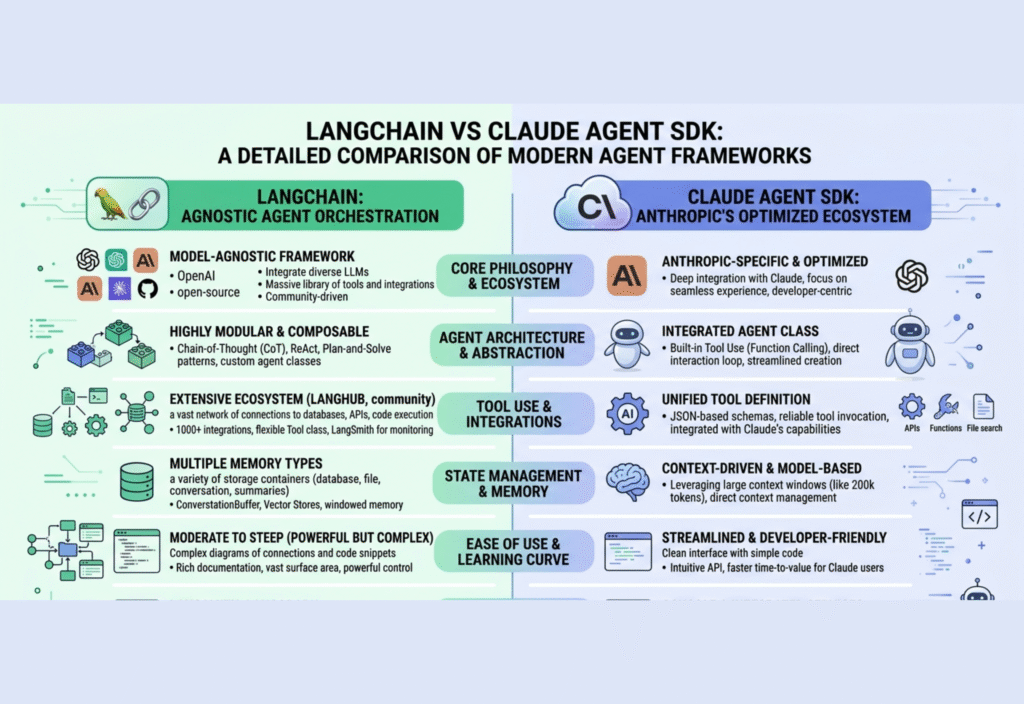
LangChain vs Claude SDK is one of the most discussed comparisons in modern AI development. As AI agents become more powerful, developers are choosing between these two frameworks to build intelligent, automated systems.
Two of the most prominent frameworks in this space are LangChain and the Claude Agent SDK, developed by Anthropic. While both aim to empower developers to build intelligent agents, they differ significantly in architecture, philosophy, and use cases.
This in-depth guide explores every major aspect of these frameworks, helping you understand which one is better suited for your projects.
Understanding AI Agents and Their Importance
Before diving into the comparison, it is important to understand what AI agents actually are.
An AI agent is a system that can:
- Interpret user input
- Make decisions based on context
- Execute multi-step actions
- Interact with external tools and environments
Unlike traditional AI models that only generate responses, agents are designed to complete tasks autonomously. For example:
- Booking tickets
- Automating workflows
- Conducting research
- Managing data pipelines
This shift from passive AI to active AI systems is what makes agent frameworks so important today.
What is LangChain?
LangChain is an open and highly flexible framework built for developers who want complete control over AI-powered applications. It provides a modular ecosystem where each component can be customized.
Architecture and Design Philosophy
LangChain is built around the idea of composability. Developers can combine:
- Language models
- Prompt templates
- Chains (sequences of operations)
- Memory modules
- Tools and APIs
This modular design allows you to build anything from a simple chatbot to a highly advanced multi-agent system.
Key Components of LangChain
1. Chains
Chains allow you to link multiple steps together. For example, an agent might:
- Take user input
- Process it
- Query a database
- Generate a response
2. Agents
Agents in LangChain decide which action to take based on the input. They can dynamically choose tools and workflows.
3. Memory
Memory enables the system to retain context across interactions, which is essential for conversational AI.
4. Tool Integration
LangChain supports integration with:
- APIs
- File systems
- Databases
- External services
Strengths of LangChain
- Extremely flexible and customizable
- Large ecosystem and community support
- Supports complex workflows and logic
- Ideal for research and experimentation
Limitations of LangChain
- Can become complex quickly
- Requires more setup and debugging
- Performance overhead in large systems
What is Claude Agent SDK?
The Claude Agent SDK is a modern framework designed to simplify agent development while maintaining high levels of safety and reliability.
Unlike LangChain, which gives developers full control, Claude SDK provides a structured and guided approach.
Design Philosophy
The Claude SDK focuses on:
- Simplicity
- Predictability
- Safety
It is designed for developers who want to build production-ready applications without dealing with excessive complexity.
Key Features of Claude Agent SDK
1. Native Tool Usage
Claude models can directly interact with tools, reducing the need for complex orchestration layers.
2. Structured Outputs
The SDK ensures consistent and reliable responses, which is crucial for business applications.
3. Built-in Safety Mechanisms
Safety is a core focus, helping prevent harmful or unintended outputs.
4. Minimal Setup
Developers can get started quickly without managing multiple components.
Strengths of Claude Agent SDK
- Easy to use and beginner-friendly
- Reliable and predictable outputs
- Strong focus on safety and alignment
- Efficient performance
Limitations of Claude Agent SDK
- Less flexible than LangChain
- Smaller ecosystem
- Limited customization for complex workflows
Head-to-Head Comparison
Flexibility
- LangChain offers complete control over architecture
- Claude SDK provides limited but structured flexibility
If you want full customization, LangChain is better.
Ease of Use
- LangChain requires understanding multiple components
- Claude SDK is straightforward and easier to learn
Beginners often prefer Claude SDK.
Performance
- LangChain may introduce latency due to chaining
- Claude SDK is optimized for direct execution
Claude SDK can be faster in many scenarios.
Safety and Reliability
- Claude SDK is built with safety-first principles
- LangChain depends on how you implement safeguards
For sensitive applications, Claude SDK is stronger.
Scalability
- LangChain scales well for complex systems
- Claude SDK scales efficiently for structured tasks
Both are scalable, but in different ways.
Real-World Use Cases
LangChain Use Cases
- Multi-agent collaboration systems
- Advanced research assistants
- Custom AI workflows
- Data processing pipelines
Claude Agent SDK Use Cases
- Customer support automation
- Business process automation
- Safe AI assistants
- Enterprise-grade applications
Developer Experience: A Practical Perspective
Working with LangChain often feels like building with LEGO blocks—you can create anything, but it takes time and planning.
On the other hand, the Claude Agent SDK feels more like using a ready-made system where most complexities are already handled.
This difference is crucial:
- LangChain = Power + Complexity
- Claude SDK = Simplicity + Reliability
Future Trends in AI Agent Frameworks
The competition between frameworks like LangChain and Claude Agent SDK is shaping the future of AI development.
Key trends include:
- More autonomous agents
- Better reasoning capabilities
- Improved safety standards
- Hybrid frameworks combining flexibility and simplicity
We are moving toward a future where AI agents will handle increasingly complex real-world tasks with minimal human input.
Final Verdict
Choosing between these two frameworks depends on your goals:
- Choose LangChain if you need full control, flexibility, and advanced customization
- Choose Claude Agent SDK if you want simplicity, speed, and safety
Both frameworks are powerful in their own way, and the best choice depends on your specific use case.
Conclusion
AI agent frameworks are redefining how applications are built. Whether you use LangChain or the Claude Agent SDK, understanding their strengths and limitations is essential.
As the technology continues to evolve, developers who master these frameworks will be better positioned to build the next generation of intelligent systems.