
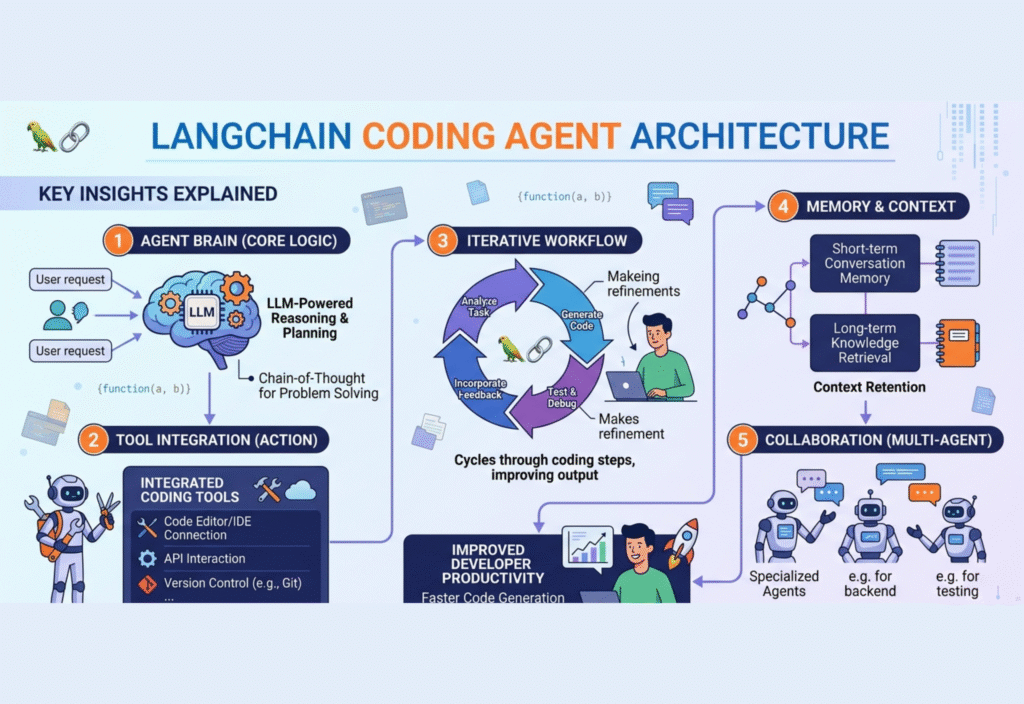
Artificial intelligence is rapidly transforming how we build software, automate workflows, and solve complex problems. Among the most impactful developments in this space is the evolution of AI agents—systems capable of reasoning, acting, and improving their own outputs. One of the leading frameworks enabling this transformation is LangChain, which has recently introduced a powerful coding agent architecture.
This article provides a deep and comprehensive explanation of this architecture, its components, working principles, benefits, challenges, and future implications.
Introduction to LangChain and AI Agents
LangChain is an open-source framework designed to help developers build applications powered by large language models (LLMs). These models are capable of understanding and generating human-like text, but on their own, they have limitations.
LangChain extends their capabilities by enabling:
Tool usage
External data access
Memory retention
Multi-step reasoning
An AI agent built using LangChain is not just a passive system that answers questions. Instead, it is an active system that can plan, execute, and adapt.
What is the Coding Agent Architecture?
The coding agent architecture is a structured system where an AI model is capable of performing coding tasks in an autonomous loop. This means the AI can:
Write code
Execute code
Analyze errors
Improve results iteratively
This is different from traditional AI models that only generate a single output. The coding agent continues working until it achieves a successful outcome.
Core Principle
The fundamental idea is to simulate a developer’s workflow:
Understand the problem
Plan a solution
Write code
Test the code
Fix errors
Repeat until success
This loop creates a highly capable and adaptive system.
Architecture Overview
The coding agent architecture in LangChain is built around several key components working together seamlessly.
1. Language Model (Brain of the System)
At the center of the architecture is the language model. It acts as the reasoning engine that:
Interprets user input
Breaks tasks into steps
Generates code
Makes decisions
This component drives the intelligence of the system.
2. Tool Integration Layer
One of the most powerful features of LangChain is its ability to integrate external tools.
These tools may include:
Python interpreters
APIs
Databases
Search engines
File systems
The agent can decide when and how to use these tools to complete a task effectively.
3. Memory System
Memory allows the agent to store and recall information across interactions. This is crucial for:
Multi-step tasks
Long conversations
Context-aware decision-making
There are typically two types of memory:
Short-term memory (current task context)
Long-term memory (stored knowledge)
4. Planning and Reasoning Module
Before executing actions, the agent creates a plan. This includes:
Breaking down tasks into smaller steps
Determining the order of operations
Identifying required tools
This planning ability makes the system more reliable and efficient.
5. Execution Engine
The execution engine is responsible for running the generated code or commands. It:
Executes scripts
Calls APIs
Processes outputs
Returns results to the model
This feedback loop is essential for iterative improvement.
6. Feedback Loop (Self-Improvement)
The coding agent continuously evaluates its own output and improves it through iteration.
The loop works as follows:
Generate code
Execute code
Analyze output
Identify errors
Fix issues
Repeat
This self-correcting mechanism is one of the most important innovations in the architecture.
How the Coding Agent Works (Step-by-Step)
Let’s walk through a simplified workflow:
Step 1: User Input
A user provides a task, such as:
“Write a Python script to analyze a dataset.”
Step 2: Task Understanding
The agent interprets the request and identifies:
Required programming language
Necessary steps
Tools needed
Step 3: Planning
The agent creates a structured plan:
Load dataset
Clean data
Perform analysis
Display results
Step 4: Code Generation
The model generates code for each step.
Step 5: Execution
The code is executed using a tool like a Python interpreter.
Step 6: Evaluation
The agent checks:
Errors
Output accuracy
Performance
Step 7: Refinement
If something is wrong, the agent:
Modifies the code
Re-runs it
Improves the solution
This loop continues until the task is completed successfully.
Why This Architecture is a Breakthrough
The coding agent architecture represents a major advancement in AI for several reasons:
1. True Automation
Instead of requiring step-by-step human instructions, the agent can independently solve problems.
2. Developer Productivity Boost
Developers can:
Generate code faster
Automate repetitive tasks
Debug more efficiently
3. Complex Problem Solving
The system can handle tasks that require multiple steps, something traditional models struggle with.
4. Dynamic Decision Making
Unlike static models, the agent adapts based on real-time feedback.
Real-World Applications
The potential applications of coding agents are vast.
Software Engineering
Writing functions
Debugging applications
Generating test cases
Refactoring code
Data Science
Data cleaning
Visualization
Statistical analysis
Machine learning workflows
Automation
File handling
Report generation
API automation
System monitoring
DevOps
Script automation
Deployment tasks
Log analysis
Education
Teaching programming concepts
Providing coding examples
Helping with assignments
Advantages of Coding Agent Architecture
Increased Efficiency
Tasks that once took hours can now be completed in minutes.
Reduced Human Effort
Developers can focus on higher-level tasks while AI handles repetitive work.
Scalability
Agents can handle multiple tasks simultaneously.
Continuous Learning
The system improves over time through feedback and iteration.
Limitations and Challenges
Despite its strengths, the architecture has limitations.
1. Accuracy Issues
AI-generated code is not always perfect and may require human review.
2. Security Risks
Executing AI-generated code can be dangerous if not properly controlled.
3. Resource Intensive
Running models and executing code repeatedly requires significant computing power.
4. Over-Reliance on AI
Excessive reliance may reduce human coding skills over time.
5. Debugging Complexity
Sometimes it can be difficult to trace why the agent made a specific decision.
Best Practices for Using Coding Agents
To maximize effectiveness and safety:
Always review AI-generated code
Use sandboxed environments for execution
Validate outputs before deployment
Combine AI with human expertise
Limit permissions for critical systems
Future of Coding Agents
The future of coding agents is extremely promising. We can expect:
More advanced reasoning capabilities
Better integration with real-world systems
Increased autonomy in complex workflows
Improved safety mechanisms
Wider adoption across industries
In the coming years, AI may evolve into a true collaborative partner for developers, capable of handling large portions of the software development lifecycle.
Conclusion
The introduction of the LangChain coding agent architecture marks a significant milestone in the evolution of artificial intelligence. By combining reasoning, execution, memory, and tool usage, this architecture enables AI systems to go beyond simple responses and actively solve problems.
While there are still challenges to overcome, the potential is enormous. From automating coding tasks to transforming entire industries, coding agents are set to play a major role in shaping the future of technology.