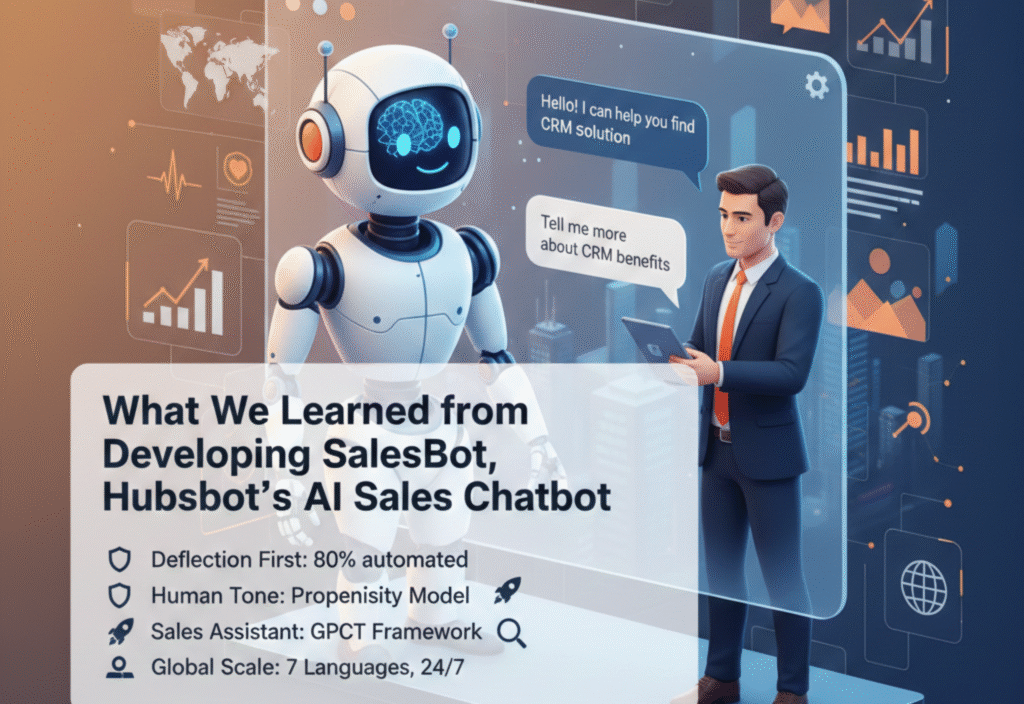
The HubSpot AI sales chatbot, SalesBot, is transforming the way businesses manage their sales process. By automating lead qualification, personalizing customer interactions, and providing instant responses, the HubSpot AI sales chatbot helps sales teams save time and increase conversions. In this article, we explore the key lessons learned from developing SalesBot and its impact on modern sales strategies.
Understanding the Real Role of an AI Sales Chatbot
One of the first lessons learned was that an AI sales chatbot is not meant to replace sales teams, but to empower them. SalesBot was designed to handle repetitive tasks such as answering common questions, qualifying leads, and routing conversations—freeing human sales reps to focus on high-value interactions.
Key insight:
AI works best when it supports humans, not when it tries to imitate them completely.
This mindset helped shape SalesBot into a productivity tool rather than a replacement solution.
Data Quality Is More Important Than AI Complexity
While advanced machine learning models are powerful, SalesBot’s success depended heavily on clean, structured, and relevant data. Poor data leads to poor conversations, no matter how advanced the AI is.
Lessons learned:
CRM data accuracy is critical
Customer intent data improves responses
Historical chat data helps train better models
SalesBot performed best when it had access to reliable HubSpot CRM data, enabling smarter and more contextual conversations.
Personalization Drives Meaningful Conversations
One of the strongest takeaways from developing SalesBot was the importance of AI-driven personalization. Generic chatbot responses often lead to disengagement, while personalized conversations significantly improve outcomes.
How SalesBot used personalization:
Greeting users by name
Referencing past interactions
Suggesting relevant products or demos
This approach helped create conversations that felt relevant, helpful, and human—key factors in modern B2B sales success.
Simplicity Beats Over-Automation
Another major learning was that over-automation can harm the user experience. While AI can handle complex logic, users prefer clear, simple interactions.
Best practices identified:
Short and direct responses
Clear CTAs (book a demo, talk to sales, learn more)
Easy handoff to human agents
SalesBot was designed to avoid long, confusing conversations and instead guide users efficiently toward their goals.
AI Must Understand Intent, Not Just Keywords
Early chatbot systems relied heavily on keyword matching, which often led to irrelevant responses. SalesBot was built with natural language processing (NLP) to understand intent rather than exact wording.
Why intent matters:
Users phrase questions differently
Context changes meaning
Sales conversations are non-linear
By focusing on intent recognition, SalesBot delivered more accurate answers and smoother conversations, improving user trust.
Continuous Learning Is Essential for AI Success
One of the most important lessons was that AI chatbots are never truly “finished.” SalesBot required continuous monitoring, training, and optimization to improve performance.
Ongoing improvement strategies:
Reviewing chat transcripts
Updating response logic
Retraining models with new data
This iterative approach ensured SalesBot evolved alongside customer behavior and sales strategies.
Trust and Transparency Build User Confidence
Users are more comfortable engaging with AI when expectations are clear. SalesBot was designed to be transparent about its role as an AI assistant.
What worked well:
Clearly identifying as a chatbot
Offering human support when needed
Avoiding misleading or overly human claims
Transparency helped build trust and reduced frustration, especially in high-intent sales conversations.
Measuring the Right Metrics Matters
Another critical learning was understanding which metrics truly define success for an AI sales chatbot.
Key performance indicators (KPIs):
Lead qualification rate
Conversion to meetings or demos
Engagement duration
Handoff success to sales reps
Focusing on these metrics allowed HubSpot to measure real business impact rather than just chatbot activity.
AI Sales Chatbots Improve Speed and Scalability
SalesBot demonstrated how AI can dramatically improve response speed and scalability. Unlike human teams, SalesBot could engage thousands of visitors simultaneously, 24/7.
Business benefits:
Faster lead response times
Global availability
Consistent messaging
This scalability is especially valuable for growing SaaS and B2B companies.
The Future of AI in Sales Conversations
Developing SalesBot revealed that the future of sales lies in hybrid AI-human collaboration. AI will handle qualification, personalization, and insights, while humans focus on strategy, negotiation, and relationship-building.
Emerging trends:
Deeper CRM-integrated chatbots
Predictive sales conversations
Voice and multimodal AI assistants
SalesBot is just one example of how conversational AI will continue to transform sales operations.
Final Thoughts
The journey of developing SalesBot, HubSpot’s AI sales chatbot, offered valuable lessons about data, personalization, simplicity, and human-centered AI design. The most important takeaway is that successful AI tools are built around real user needs, not just advanced technology.