
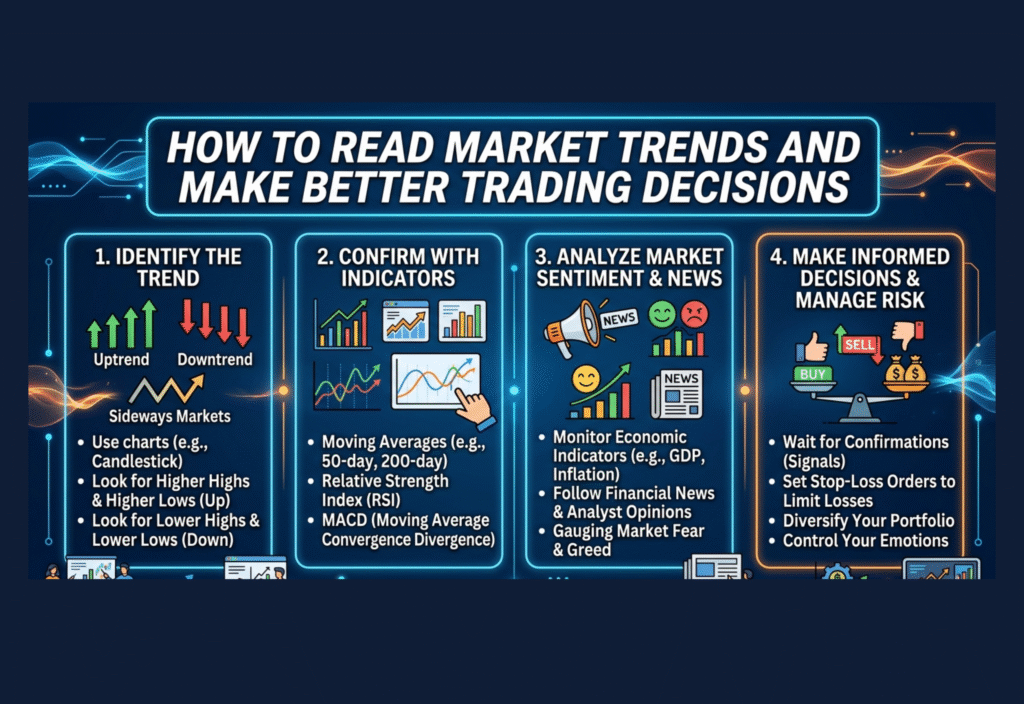
Market Trends Analysis is a key skill that helps traders understand the direction of the market and make better decisions. By applying proper market trends analysis, you can identify uptrends, downtrends, and key opportunities in trading. Moreover, mastering market trends analysis allows you to reduce risks and improve your overall trading performance.
Many beginners struggle because they try to predict the market without understanding its direction. However, successful traders focus on analyzing trends and following them. In this guide, you will learn how to read market trends and use them to make better trading decisions.
What Are Market Trends?
Market trends refer to the general direction in which the price of an asset is moving over time. These trends can move upward, downward, or sideways.
An uptrend means prices are rising, while a downtrend means prices are falling. On the other hand, a sideways trend indicates that the market is moving within a range without a clear direction.
Understanding these trends is important because it helps traders decide when to enter or exit a trade. For example, in an uptrend, traders usually look for buying opportunities, while in a downtrend, they focus on selling.
Types of Market Trends
1. Uptrend (Bullish Market)
An uptrend occurs when prices consistently move higher, forming higher highs and higher lows. This indicates that buyers are in control of the market.
In such conditions, traders often look for opportunities to buy. However, it is important to wait for small pullbacks before entering a trade.
2. Downtrend (Bearish Market)
A downtrend happens when prices consistently move lower, creating lower highs and lower lows. This means that sellers are dominating the market.
In a downtrend, traders usually look for selling opportunities. Additionally, understanding when a downtrend might end is crucial for avoiding losses.
3. Sideways Trend (Range Market)
A sideways trend occurs when the price moves within a specific range without a clear upward or downward direction.
In this situation, the market is uncertain. Therefore, traders often wait for a breakout before making decisions.
How to Identify Market Trends
1. Use Trendlines
Trendlines are one of the simplest tools to identify trends. By connecting price highs or lows, you can visually see the direction of the market.
If the trendline is moving upward, it indicates an uptrend. If it is moving downward, it shows a downtrend.
2. Analyze Higher Timeframes
Higher timeframes such as daily or weekly charts provide a clearer picture of the market direction. In addition, they help reduce noise and false signals.
For example, a stock may appear to be in a downtrend on a 1-hour chart but still be in an uptrend on a daily chart.
3. Use Technical Indicators
Indicators like moving averages can help identify trends. For instance, when the price stays above a moving average, it often indicates an uptrend.
Similarly, when the price stays below a moving average, it suggests a downtrend. Therefore, indicators provide confirmation for your analysis.
4. Observe Market Structure
Market structure refers to the pattern of highs and lows in price movement. Higher highs and higher lows indicate an uptrend, while lower highs and lower lows indicate a downtrend.
By analyzing market structure, you can better understand the strength and direction of the trend.
Factors That Influence Market Trends
Market trends are influenced by several factors, including:
Economic data such as inflation and interest rates
News and global events
Market sentiment and investor behavior
Supply and demand dynamics
For example, positive economic news can push prices higher, while negative news can cause a decline.
How to Make Better Trading Decisions
1. Trade in the Direction of the Trend
One of the most effective strategies is to follow the trend. If the market is in an uptrend, look for buying opportunities. Conversely, in a downtrend, consider selling.
Trading against the trend is risky and often leads to losses. Therefore, aligning your trades with the trend increases your chances of success.
2. Wait for Confirmation
Instead of entering trades immediately, wait for confirmation signals. This can include candlestick patterns, breakouts, or indicator signals.
As a result, you reduce the chances of entering false trades and improve accuracy.
3. Combine Multiple Tools
Using multiple analysis tools together provides better results. For example, combining trendlines with indicators can give stronger confirmation.
However, avoid overcomplicating your strategy. Keep it simple and effective.
4. Manage Your Risk
Even when following trends, risk management is essential. Always use stop-loss orders to protect your capital.
Moreover, never risk more than you can afford to lose. Proper risk management ensures long-term survival in trading.
Common Mistakes When Reading Trends
Many traders make mistakes when analyzing trends, such as:
Ignoring higher timeframes
Entering trades without confirmation
Trading against strong trends
Overusing indicators
Not practicing patience
However, avoiding these mistakes can significantly improve your trading results.
Importance of Patience and Discipline
Patience and discipline are key qualities of successful traders. Instead of forcing trades, wait for the right opportunity.
Discipline helps you stick to your strategy, while patience ensures that you enter trades at the right time. Together, they form the foundation of consistent trading success.
Conclusion
Reading market trends is an essential skill for making better trading decisions. By understanding different types of trends, using technical tools, and following market structure, you can improve your trading accuracy.
Moreover, combining trend analysis with proper risk management and discipline will help you achieve long-term success. Remember, trading is not about guessing—it is about analyzing and following the market intelligently.
Therefore, always focus on learning, practicing, and improving your skills to become a better trader over time.