
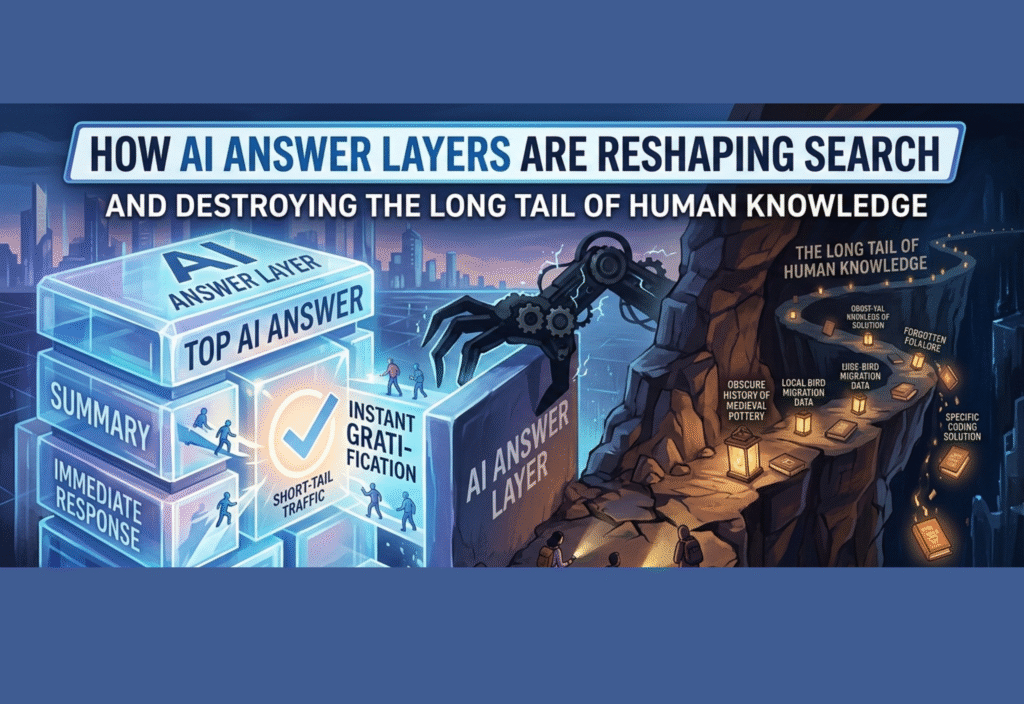
In the past two decades, the way humans access knowledge has undergone a dramatic transformation. From printed encyclopedias and libraries to search engines and online databases, information has become more accessible than ever. However, the rise of AI-powered “answer layers” on top of search engines is changing not just how we search, but what we know, with implications for the preservation of the long tail of human knowledge.
While AI answer layers offer speed, convenience, and clarity, they also risk narrowing the diversity of information users encounter. Understanding these shifts is critical to preserving the depth and richness of human knowledge in an increasingly AI-driven world.
What Are AI Answer Layers?
AI answer layers are systems that sit above traditional search engines and synthesize information for the user. Unlike classic search engines that display lists of links, AI answer layers generate concise, readable answers, often combining information from multiple sources into a single response.
For example, instead of querying “the causes and effects of the 1918 Spanish flu pandemic” and sifting through dozens of scholarly articles, an AI answer layer may produce a single summary covering key causes, global effects, and statistical highlights. While this saves time, it also centralizes control over what information is presented, and which sources are highlighted or omitted.
Key Features of AI Answer Layers:
Summarization: Condenses multiple sources into a single, coherent answer.
Contextual Understanding: Attempts to interpret user intent for more accurate responses.
Source Prioritization: Prefers high-authority sources, often overlooking niche or less-cited content.
Interactivity: Users can ask follow-up questions and receive refined answers in real time.
These characteristics make AI answer layers extremely convenient, but they also introduce challenges for knowledge diversity.
The Appeal of Instant Answers
Modern users value speed and efficiency. AI answer layers cater to this demand by providing:
Time-saving solutions: Users spend less time sifting through dozens of sources.
Simplified comprehension: Complex topics are condensed into easy-to-understand summaries.
Accessibility: Even those with limited research skills can access high-level information quickly.
However, the very features that make AI appealing also encourage intellectual shortcuts, limiting the exploration of broader or less mainstream sources.
Understanding the Long Tail of Human Knowledge
The “long tail” concept originates from economics and refers to niche markets that lie beyond mainstream demand. In knowledge terms, the long tail includes rare, specialized, or obscure information—everything from academic studies in small journals to regional historical accounts, independent research blogs, and discussion forums where unusual ideas are explored.
Historically, researchers and curious individuals often stumbled upon these long-tail sources by exploring beyond the most popular results. These discoveries fueled creativity, innovation, and deeper understanding.
How AI Answer Layers Are Flattening the Long Tail
AI answer layers, by design, focus on efficiency and relevance. While this is helpful for quick answers, it systematically reshapes knowledge discovery:
Consolidation Around Popular Sources: AI favors widely cited or authoritative content, pushing niche knowledge further into obscurity.
Information Flattening: Complex subjects and alternative perspectives are condensed into single, simplified summaries.
Reduced Exploration: Users rarely click through to original sources, missing out on diverse viewpoints or specialized knowledge.
Popularity Feedback Loop: Content already widely accessed is more likely to be surfaced again, further marginalizing minority or unique perspectives.
This process risks eroding the long tail, diminishing the diversity of human knowledge available to society.
Real-World Impacts
The implications of AI-driven search are far-reaching:
Intellectual Homogenization: Users are exposed primarily to mainstream ideas, limiting critical thinking and curiosity.
Loss of Serendipity: Many historical discoveries were accidental encounters with obscure texts—a process reduced by AI answer layers.
Impact on Research and Creativity: Students, researchers, and creators may unconsciously limit inquiries to what AI deems relevant.
Cultural Bias: Minority perspectives and local knowledge may disappear from digital consciousness as algorithms prioritize dominant sources.
Example Scenario:
An independent historian publishes research on regional folklore. Traditional search would allow dedicated users to find this rare work. AI answer layers, however, might prioritize general encyclopedic summaries, effectively burying the historian’s findings. Over time, this niche knowledge risks disappearing from collective awareness.
Responsibilities of AI Developers
The design of AI answer layers shapes the future of knowledge. Developers can take steps to mitigate the risks:
Source Transparency: Clearly display all sources used in AI-generated answers.
Promote Diversity: Include underrepresented perspectives and niche publications.
Customizable Outputs: Allow users to select depth, perspective, or source types.
Encourage Exploration: Features like “read more” links and source rankings can nudge users toward diverse content.
Role of Content Creators
Creators also play a key role in preserving knowledge diversity:
Maintain Niche Content: Continue publishing specialized or underrepresented topics.
SEO with Depth: Ensure content is discoverable without sacrificing nuance.
Include Multiple Perspectives: Provide detailed analyses and alternative viewpoints for AI to surface.
How Users Can Adapt
Even with AI answer layers dominating search, users can maintain intellectual diversity:
Use AI as a Guide, Not an Authority: Start with AI summaries but explore original sources.
Engage with Full Sources: Follow citations or links for deeper understanding.
Seek Alternative Viewpoints: Deliberately explore content beyond mainstream results.
Cultivate Curiosity: Dedicate time to rare or niche content for broader perspectives.
The Future of Knowledge in an AI World
AI answer layers represent both an opportunity and a challenge. They deliver speed, clarity, and accessibility, but they risk flattening the richness of human knowledge. To preserve intellectual depth, future AI systems must:
Highlight diverse sources
Encourage exploration beyond mainstream content
Support transparency and user control
Society faces a fundamental choice: Will AI narrow our understanding, or will it expand it? The answer will shape human knowledge for generations to come.