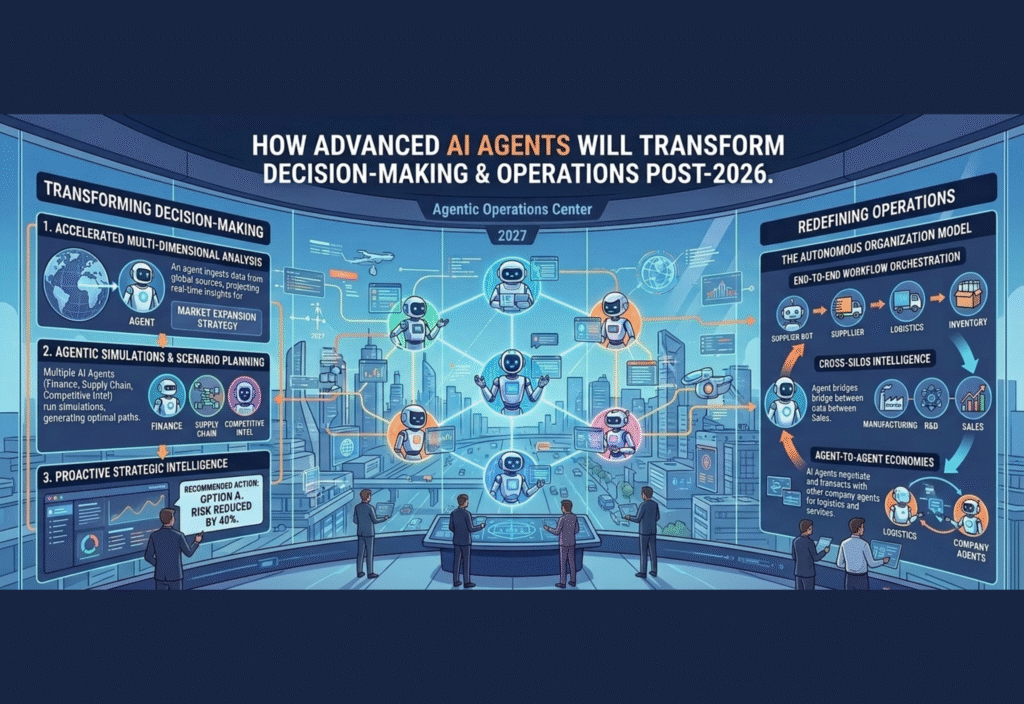
The world is entering a new phase of technological evolution where artificial intelligence is no longer limited to simple automation. After 2026, advanced AI agents will become powerful systems capable of handling complex decisions and managing operations across industries. These agents will not only assist humans but will increasingly take independent actions based on data, context, and learned experience.
The transformation driven by AI agents will reshape how organizations function, how leaders make decisions, and how everyday tasks are performed. This shift will influence everything from business strategy to customer experience, creating a future where intelligence is embedded in every process.
Understanding Advanced AI Agents
Advanced AI agents are systems designed to act autonomously in dynamic environments. Unlike traditional software, they are capable of learning, adapting, and making decisions without constant human supervision. These agents combine multiple technologies such as machine learning, natural language processing, and real-time analytics.
What makes them different is their ability to understand context. Instead of simply following rules, they interpret situations, evaluate options, and choose actions that lead to the best possible outcome. Over time, they improve their performance by learning from previous decisions and outcomes.
After 2026, these agents will become more reliable and more widely adopted, making them a central part of digital transformation strategies worldwide.
The Shift in Decision-Making
Decision-making has traditionally been a human-driven process supported by data and experience. However, as data volumes grow and environments become more complex, human decision-making alone is no longer sufficient.
Advanced AI agents will transform this process by enabling faster, more accurate, and more consistent decisions.
Data-Driven Intelligence
AI agents will process vast amounts of structured and unstructured data within seconds. They will identify patterns, detect anomalies, and generate insights that humans might miss. This will allow organizations to base decisions on evidence rather than assumptions.
For example, in financial markets, AI agents will continuously monitor global trends, analyze risks, and execute decisions instantly. This level of speed and precision will reduce uncertainty and improve outcomes.
Real-Time Decision Systems
One of the most significant changes will be the rise of real-time decision systems. AI agents will operate continuously, monitoring live data and responding immediately to changes.
In industries like healthcare, this will be especially impactful. AI agents will monitor patient conditions in real time, detect early warning signs, and support medical professionals in making timely decisions. This will enhance both efficiency and patient safety.
Predictive and Proactive Capabilities
Future AI agents will move beyond reactive decision-making. They will anticipate future events and take preventive actions.
In manufacturing, for instance, AI agents will analyze machine performance and predict failures before they occur. This will allow companies to perform maintenance proactively, reducing downtime and saving costs.
Similarly, in retail, AI agents will forecast demand trends, ensuring that inventory levels are always optimized.
Transformation of Business Operations
Operations form the backbone of any organization, and advanced AI agents will bring a major shift in how these operations are managed.
End-to-End Automation
AI agents will enable complete automation of workflows across departments. From data collection to execution, processes will become seamless and interconnected.
In e-commerce businesses, AI agents will handle order processing, inventory management, and customer interactions simultaneously. This integration will eliminate delays and improve overall efficiency.
Intelligent Process Optimization
Beyond automation, AI agents will continuously analyze operational performance. They will identify inefficiencies, suggest improvements, and implement changes in real time.
For example, in logistics, AI agents will determine the most efficient delivery routes by considering traffic conditions, weather, and fuel consumption. This will lead to faster deliveries and reduced operational costs.
Enhanced Customer Experiences
Customer expectations are evolving, and personalization has become a key factor in business success. Advanced AI agents will enable highly personalized interactions by understanding individual preferences and behaviors.
They will provide tailored recommendations, respond to queries instantly, and adapt communication styles based on user behavior. This will create a more engaging and satisfying customer experience.
Industry-Wide Impact
The influence of advanced AI agents will extend across multiple sectors, transforming how each industry operates.
Healthcare
AI agents will support diagnosis, treatment planning, and patient monitoring. They will analyze medical data quickly and provide insights that help doctors make better decisions.
Finance
In the financial sector, AI agents will handle fraud detection, risk assessment, and automated trading. Their ability to process large datasets will improve accuracy and reduce financial risks.
Education
Education systems will benefit from personalized learning experiences. AI agents will adapt content based on student performance, helping learners progress at their own pace.
Manufacturing
Factories will become smarter with AI-driven systems managing production lines, predicting maintenance needs, and ensuring quality control.
Government and Public Services
Governments will use AI agents to improve public services, manage resources efficiently, and make data-driven policy decisions.
Opportunities Created by AI Agents
The rise of advanced AI agents will open new opportunities for innovation and growth.
Organizations will be able to scale operations without significantly increasing costs. Decision-making will become faster and more reliable, allowing businesses to respond quickly to changing market conditions.
New job roles will also emerge, focusing on AI management, oversight, and strategy. While some traditional roles may decline, new opportunities will arise in areas that require creativity, critical thinking, and human judgment.
Challenges and Considerations
Despite the advantages, the adoption of AI agents comes with challenges that must be addressed carefully.
One of the main concerns is job displacement, as automation may replace certain tasks. Organizations will need to focus on reskilling employees to adapt to new roles.
Ethical considerations are also important. AI systems must be designed to make fair and unbiased decisions. Transparency in how decisions are made will be essential to build trust.
Data privacy and security will remain critical issues. As AI agents rely on large amounts of data, protecting this information will be a top priority.
Another concern is over-reliance on AI. While AI agents can make decisions, human oversight will still be necessary to ensure accountability and control.
The Future Landscape After 2026
After 2026, AI agents will become more integrated into everyday life and business environments. They will collaborate with humans rather than replace them entirely.
Organizations that embrace this technology early will gain a competitive advantage. They will operate more efficiently, make better decisions, and deliver superior customer experiences.
At the same time, societies will need to adapt to this transformation by updating regulations, improving education systems, and promoting responsible AI development.
Conclusion
Advanced AI agents are set to redefine how decisions are made and how operations are managed. Their ability to analyze data, predict outcomes, and act independently will make them a powerful force in shaping the future.
The shift will not happen overnight, but its impact will be profound. Businesses, governments, and individuals who understand and adopt this technology will be better positioned to succeed in the coming years.
The future will not be about replacing humans with machines. Instead, it will be about creating a balanced partnership where human intelligence and artificial intelligence work together to achieve better results.