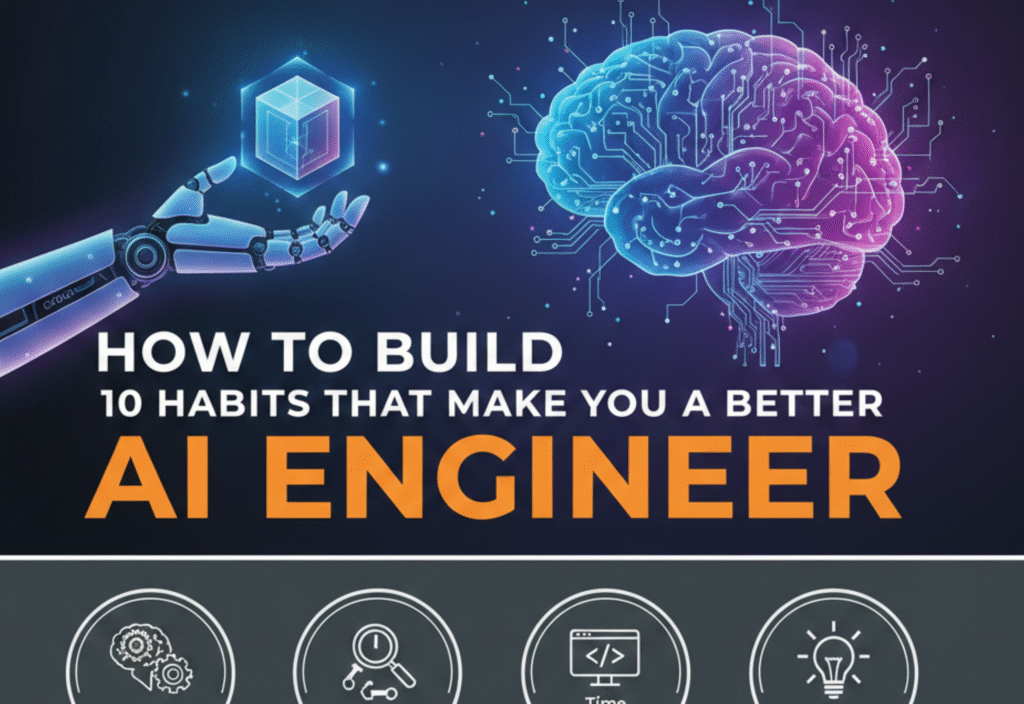
Artificial Intelligence (AI) is one of the fastest-growing fields in technology today. Becoming a skilled AI engineer requires more than just coding knowledge; it demands consistent learning, problem-solving skills, and a mindset tuned to innovation. By building the right habits, you can accelerate your growth and stand out in this competitive field.
Here’s a guide on how to build 10 habits that make you a better AI engineer.
1. Dedicate Time for Daily Learning
AI is constantly evolving. To stay ahead:
Spend at least 30–60 minutes daily reading research papers, blogs, or tutorials.
Follow AI thought leaders and research groups on social media.
Use platforms like arXiv, Medium, or Towards Data Science to discover trends.
Habit tip: Keep a dedicated notebook or digital log of new concepts learned daily.
2. Practice Coding Consistently
AI engineering relies heavily on programming skills, especially in Python, R, or Java:
Solve coding problems regularly on platforms like LeetCode, HackerRank, or Kaggle.
Work on small AI projects to apply what you learn.
Refactor code to improve efficiency and readability.
Habit tip: Commit to writing at least 50–100 lines of AI-focused code daily.
3. Master Math and Statistics Fundamentals
A strong foundation in linear algebra, calculus, probability, and statistics is critical:
Understand how algorithms work under the hood.
Practice solving real problems using mathematical tools.
Review concepts periodically to retain understanding.
Habit tip: Dedicate 15–30 minutes daily to solving math problems relevant to AI.
4. Experiment With AI Models
Practical experimentation builds intuition:
Implement models from scratch and compare with pre-built frameworks.
Tweak parameters and observe outcomes.
Learn from failures and optimize iteratively.
Habit tip: Keep a personal log of experiments, successes, and lessons learned.
5. Document Your Work Thoroughly
Clear documentation helps future reference and collaboration:
Write detailed READMEs for projects.
Comment code effectively.
Maintain a personal knowledge base of key algorithms and techniques.
Habit tip: Update documentation immediately after completing tasks to avoid forgetting details.
6. Stay Updated With AI Research
AI research moves fast. Staying current ensures you’re not left behind:
Subscribe to AI journals and newsletters.
Attend webinars, conferences, or virtual meetups.
Summarize important research in your own words.
Habit tip: Allocate at least 2–3 hours weekly to read and analyze recent papers.
7. Collaborate and Seek Feedback
Learning in isolation slows growth. Collaboration enhances skills:
Contribute to open-source AI projects.
Share your work with peers or mentors for feedback.
Participate in hackathons or competitions.
Habit tip: Schedule regular code reviews or pair-programming sessions.
8. Focus on Problem-Solving
AI engineers are problem solvers, not just coders:
Practice breaking down complex problems into smaller components.
Apply AI to real-world scenarios.
Explore multiple solutions before settling on one.
Habit tip: Keep a “problem-solving journal” to track challenges and solutions.
9. Learn Data Handling and Preprocessing
Data is the backbone of AI. Effective data management is essential:
Clean and preprocess datasets carefully.
Explore and visualize data for insights.
Understand feature engineering and selection techniques.
Habit tip: Dedicate part of your workflow to data exploration before model building.
10. Cultivate a Growth Mindset
AI engineering requires perseverance:
Embrace failures as learning opportunities.
Continuously refine your skills.
Stay curious and open to new approaches.
Habit tip: Reflect weekly on challenges overcome and skills improved.
Conclusion
Building these 10 habits creates a strong foundation for excelling as an AI engineer. Daily learning, coding practice, experimentation, documentation, and a growth mindset together ensure continuous improvement. By following these habits consistently, you’ll not only enhance your technical skills but also become a more effective problem solver in the AI space.
Success in AI isn’t just about knowing algorithms—it’s about how you approach learning, problem-solving, and innovation every single day.