
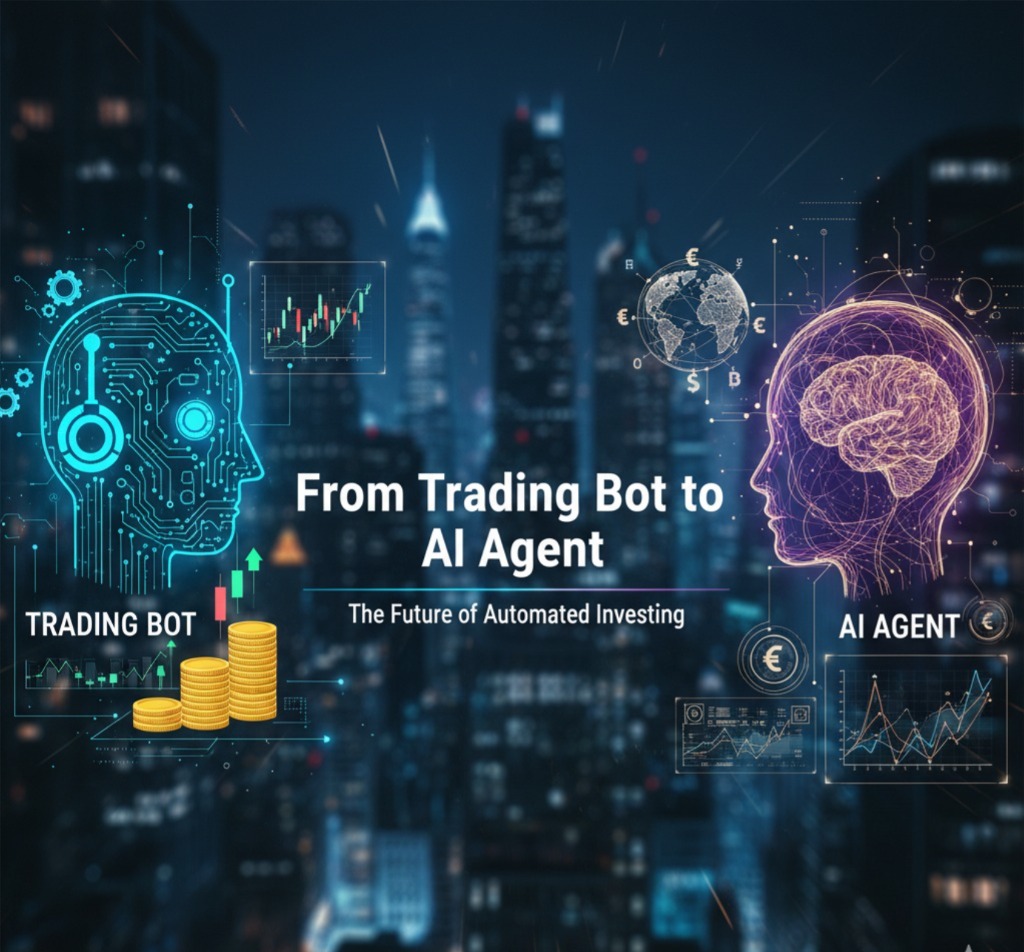
Imagine a trading bot that doesn’t just follow fixed rules but learns, adapts, and trades smarter than humans — faster, emotion-free, and more profitable. AI trading agents are revolutionizing modern investing by analyzing markets in real time, optimizing strategies, and spotting opportunities that traditional bots often miss. In this guide, we’ll show you how to transform a basic trading bot into a fully intelligent AI-powered agent.
Step 1: Pick Your Market to Maximize AI Agent Profits
Before you build your AI agent, decide which market and assets it will trade:
Stocks: Great for long-term trends and historical pattern analysis.
Cryptocurrency: Perfect for high-volatility and fast-moving environments.
Forex & Commodities: Ideal for short-term trades and real-time monitoring.
Next, define the trading style — day trading, swing trading, or portfolio management. Your AI agent needs these parameters to align its learning goals and optimize decision-making.
Step 2: Fuel Your AI Trading Agent with Smart Data
Data is the backbone of any AI system. Even the most advanced algorithm fails without high-quality, structured data.
Gather and clean:
Market Data: Prices, volume, trends, and volatility indicators.
Sentiment Data: Social media trends, news headlines, and global events.
Fundamental Data: Financial statements, economic reports, and company performance metrics.
Then, engineer features your AI agent can learn from, such as moving averages, RSI, volatility ratios, and sentiment scores. Well-prepared data allows the AI to detect patterns and make informed predictions.
Step 3: Turn Your Bot into a Smarter AI Trading Agent
Traditional bots simply follow pre-set rules, such as:
“If the price crosses above the 50-day moving average, buy.”
While useful, traditional bots cannot adapt to unexpected market changes.
AI Trading Agents, on the other hand, use machine learning, neural networks, and reinforcement learning to:
Learn from past market data
Identify new patterns in real time
Adjust strategies automatically based on performance
Over time, your AI agent becomes smarter, adapting to market volatility and discovering new opportunities while minimizing risk.
Step 4: Train, Test, and Optimize Your AI Trading Agent
Training your AI agent is critical. Start with historical data to validate its decisions:
Backtesting: Evaluate performance in bullish, bearish, and sideways markets.
Paper trading: Simulate live trading before connecting to real broker APIs.
This ensures your AI agent is not only intelligent but also stable, reliable, and safe to use in live trading conditions.
Step 5: Deploy and Monitor Your AI Trading Agent
Deploy your AI agent with reliable APIs such as Alpaca, Binance, or Interactive Brokers.
Even though the AI trades autonomously, continuous monitoring is essential:
Track performance via dashboards and analytics
Update models as market conditions change
Fine-tune parameters to maximize profits
AI trading agents are dynamic — they continuously learn and adapt, giving you a competitive edge in the market.
Final Thoughts: Empower Your Trading with AI
AI trading agents are not here to replace traders — they empower them. By integrating AI into your trading workflow, you can:
Trade faster and more efficiently
Remove emotional decision-making
Discover new profitable opportunities
Stay ahead in rapidly evolving markets
Traders who adopt AI trading agents today will dominate tomorrow’s financial markets. Transform your simple bot into a smart, adaptive AI agent and unlock the full potential of automated, intelligent trading.

that the osm lines
i really like it