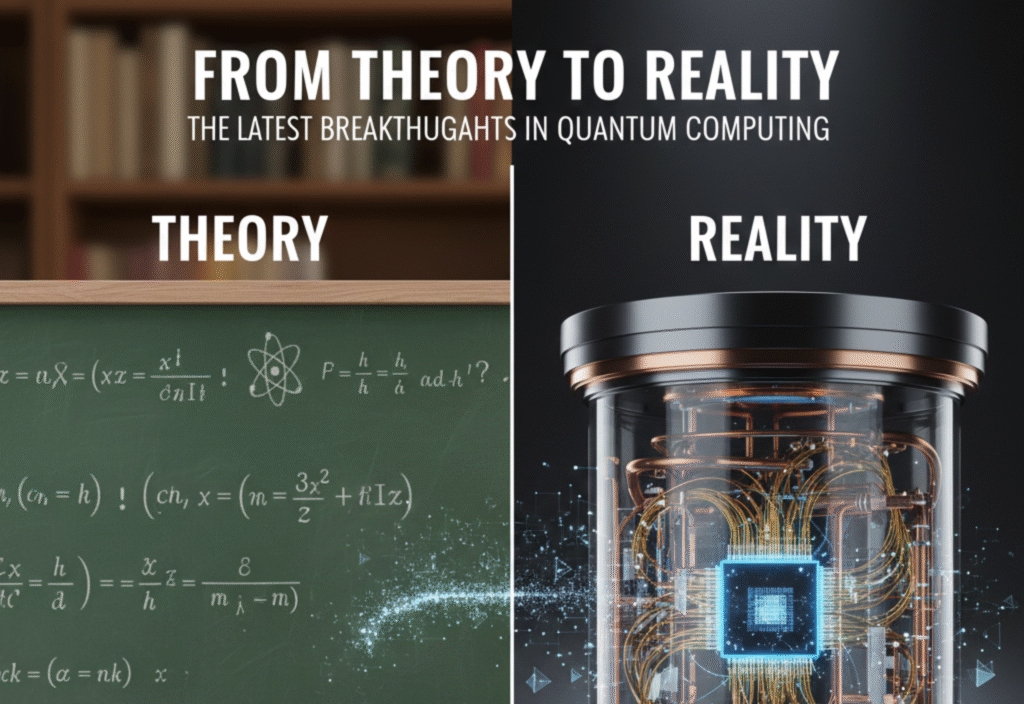
Quantum computing breakthroughs are rapidly transforming what was once purely theoretical science into practical technology. Over the past few years, researchers and companies worldwide have achieved remarkable advances that bring quantum computers closer to solving real-world problems in medicine, finance, and energy.
Recent breakthroughs in hardware design, quantum algorithms, and error correction have accelerated progress dramatically. While fully fault-tolerant quantum computers are still under development, the pace of innovation suggests that quantum computing may soon reshape industries such as healthcare, finance, cybersecurity, energy, and artificial intelligence.
Understanding Quantum Computing Fundamentals
To appreciate recent breakthroughs, it helps to understand how quantum computing differs from classical computing.
Classical computers use bits, which exist in a definite state of either 0 or 1. Quantum computers use qubits, which exploit principles of quantum mechanics:
Superposition: A qubit can exist in multiple states simultaneously, allowing parallel computations.
Entanglement: Qubits can become linked so that changes in one instantly influence another.
Quantum interference: Helps emphasize correct computational paths while suppressing incorrect ones.
These properties enable quantum computers to potentially solve certain problems exponentially faster than traditional computers.
Hardware Breakthroughs Transforming Theory into Practice
IBM
IBM has made significant progress in superconducting qubit processors and quantum cloud access. Their roadmap includes scaling systems beyond thousands of qubits while improving stability and coherence time. IBM’s open-access quantum platforms allow researchers worldwide to experiment with real quantum hardware.
Google demonstrated a landmark achievement often called quantum supremacy, where a quantum processor performed a specific task faster than classical supercomputers. Although practical applications remain limited, this milestone proved quantum advantage is achievable.
Microsoft
Microsoft is pursuing topological qubits, which promise greater stability and reduced error rates. The company is also investing heavily in quantum software ecosystems and hybrid classical-quantum cloud solutions.
Intel
Intel is applying semiconductor manufacturing expertise to quantum chip fabrication, focusing on scalable silicon-based qubits that may integrate more easily with existing computing infrastructure.
Innovative Quantum Startups Accelerating Progress
Alongside big tech corporations, specialized startups are driving innovation:
IonQ develops trapped-ion quantum computers known for long coherence times and high fidelity.
Rigetti Computing builds hybrid quantum-classical computing systems accessible via cloud platforms.
D-Wave Systems focuses on quantum annealing for optimization challenges used in logistics, manufacturing, and research.
Quantinuum combines hardware and quantum software development, emphasizing enterprise-ready applications.
These companies diversify technological approaches, which helps accelerate breakthroughs across the field.
Quantum Error Correction: A Critical Milestone
One of the biggest obstacles to practical quantum computing has been qubit fragility. Environmental disturbances, temperature fluctuations, and electromagnetic interference can introduce computational errors.
Recent advances include:
Improved error correction codes
More stable superconducting materials
Advanced cryogenic cooling technologies
Better quantum control electronics
These improvements are essential for building scalable, reliable quantum computers capable of complex calculations.
Software and Algorithmic Advances
Hardware alone is not enough. Quantum algorithms and programming tools are evolving rapidly:
Quantum machine learning algorithms
Optimization algorithms for logistics and finance
Molecular simulation frameworks for chemistry and medicine
Hybrid classical-quantum computing architectures
Programming languages and toolkits are becoming more accessible, allowing developers without deep physics backgrounds to participate.
Real-World Applications Emerging Today
Healthcare and Drug Discovery
Quantum simulations can model complex molecular structures with unprecedented accuracy. This may accelerate drug development, vaccine design, and personalized medicine.
Financial Services
Quantum optimization can improve portfolio analysis, fraud detection, and market risk simulations. Financial institutions are already experimenting with pilot programs.
Cybersecurity and Encryption
Quantum computing threatens traditional cryptography but also enables quantum-safe encryption methods that could secure future communications.
Climate Science and Energy
Researchers are using quantum simulations to design efficient solar cells, batteries, and sustainable materials to address global environmental challenges.
Artificial Intelligence Integration
Quantum computing may enhance AI training efficiency, enabling faster pattern recognition and complex data modeling.
Challenges That Still Remain
Despite impressive progress, several barriers must be overcome:
Scalability Issues – Maintaining stable qubits at scale remains difficult.
High Costs – Quantum hardware requires sophisticated cooling and infrastructure.
Talent Shortage – Skilled quantum engineers and researchers are limited.
Software Maturity – Many applications are still experimental.
Commercial Viability – Clear business value must be demonstrated consistently.
These challenges mean widespread adoption may take several more years.
Global Investment and Research Momentum
Governments, universities, and private companies worldwide are investing billions into quantum research. National quantum initiatives in the US, Europe, China, and other regions aim to establish leadership in this emerging technology.
This global competition is accelerating innovation and collaboration simultaneously.
The Future Outlook: Gradual but Transformational
Experts generally agree that quantum computing will evolve gradually rather than overnight. Early advantages will likely appear in niche sectors such as:
Complex optimization
Materials science
Pharmaceutical research
Financial modeling
Eventually, broader applications could transform computing, artificial intelligence, and scientific discovery.
Hybrid systems combining classical supercomputers with quantum processors are expected to dominate the near-term landscape.
Conclusion
Quantum computing is transitioning from theoretical exploration to practical experimentation faster than many expected. Breakthroughs in hardware, algorithms, and error correction are steadily closing the gap between research and real-world applications.
Although challenges remain, the trajectory is clear: quantum computing is no longer just a scientific curiosity. It is becoming a powerful technological platform with the potential to reshape industries, accelerate innovation, and expand the boundaries of what computers can achieve.