The Robot Learning Career Path is one of the most exciting and in-demand journeys in today’s technology landscape. Robotics has evolved beyond traditional automation: modern robots can learn from data, adapt to new environments, and make intelligent decisions autonomously. With the rise of artificial intelligence and machine learning, the ability to develop and program intelligent robots is now a highly sought-after skill.
Following a structured career path allows learners to progress from basic programming and mathematical foundations to advanced reinforcement learning, computer vision, and real-world robotic applications. Whether your goal is to work in research, industrial robotics, autonomous vehicles, or AI-driven automation, this guide will help you understand the skills, tools, and roadmap required to become an expert in robot learning.
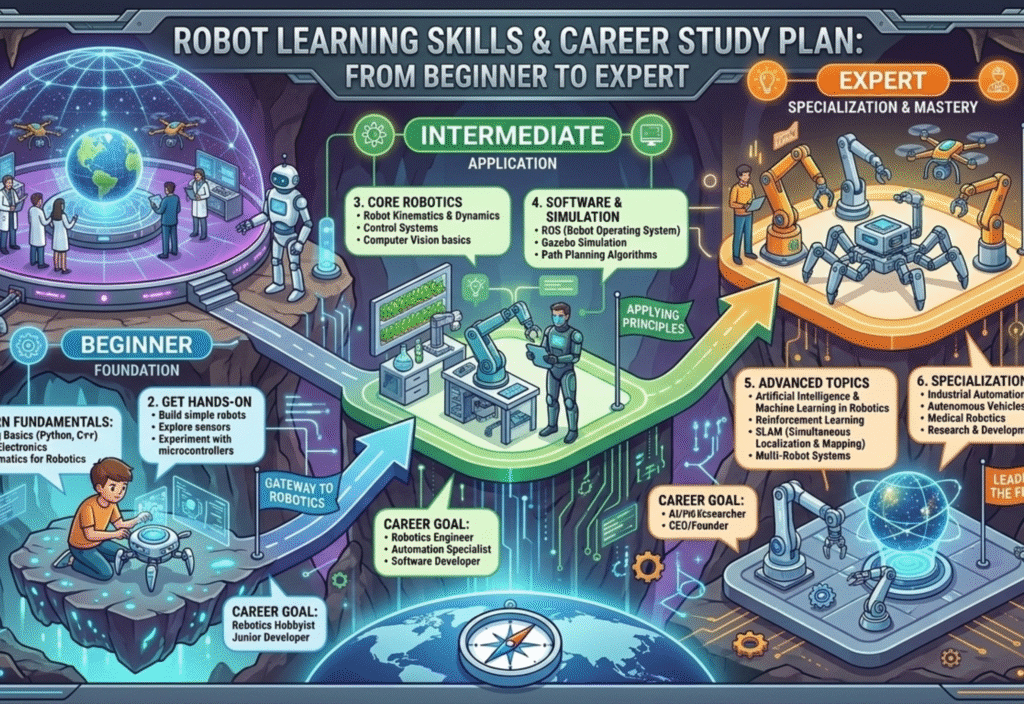
Phase 1: Beginner Skills for the Robot Learning Career Path (0–6 Months)
The first phase is all about laying a strong foundation. Without basic programming, mathematics, and computer science knowledge, advanced topics in robot learning will be difficult to grasp.
1. Programming Fundamentals
Programming is the core of robotics and AI. Beginners should start with:
Python – widely used for AI, machine learning, and robotics projects
C++ – essential for robotics control systems and performance-critical code
MATLAB – useful for simulations and academic research in robotics
Focus areas in programming include:
Variables, data types, and control flow
Functions and modules
Object-oriented programming (classes and objects)
File handling and data manipulation
Pro Tip: Start with Python due to its simplicity and robust AI libraries such as TensorFlow, PyTorch, and OpenCV.
2. Mathematics for Robot Learning
Mathematics is essential for understanding robotic algorithms, data analysis, and AI models. Key areas include:
Linear Algebra – for matrices, vectors, and transformations
Probability and Statistics – for decision-making under uncertainty
Calculus – for optimization, derivatives, and motion planning
Discrete Mathematics – for algorithms and logic
A solid understanding of these concepts will make machine learning, control systems, and robotics algorithms much easier to learn.
3. Computer Science Fundamentals
A beginner should also learn core computer science topics, including:
Algorithms and data structures (lists, trees, graphs, and sorting/searching algorithms)
Operating system basics (processes, memory management, and file systems)
Networking fundamentals (data communication for multi-robot systems)
Software development practices (version control with Git, code documentation, and testing)
Phase 2: Intermediate Skills for the Robot Learning Career Path (6–18 Months)
After mastering the basics, learners should focus on machine learning, robotics fundamentals, and simulation tools. This phase bridges theory with hands-on application.
1. Machine Learning Basics
Machine learning is crucial for robot learning. It allows robots to detect patterns and make decisions autonomously.
Key topics include:
Supervised learning (classification and regression)
Unsupervised learning (clustering, dimensionality reduction)
Neural networks and deep learning basics
Model evaluation, cross-validation, and hyperparameter tuning
Tools and Frameworks:
TensorFlow – for deep learning models
PyTorch – widely used in AI research and reinforcement learning
Scikit-learn – for classic machine learning algorithms
Project Ideas:
Predicting robot arm movement based on sensor input
Object classification using images from a camera
2. Robotics Fundamentals
To implement robot learning, you need to understand how robots move, sense, and act. Core topics:
Kinematics – understanding robot movement and joint calculations
Dynamics – forces and torques acting on robots
Motion planning – planning safe paths for robot navigation
Sensors and actuators – integrating cameras, LiDAR, IMUs, and motors
Key Tool: Robot Operating System (ROS) – ROS provides a framework to develop, simulate, and control robots efficiently.
3. Simulation and Testing
Before deploying algorithms to real robots, simulations provide a safe environment for experimentation.
Popular tools:
Gazebo – integrates with ROS for realistic robot simulations
Webots – versatile robotics simulator for educational and professional use
NVIDIA Isaac Sim – advanced AI-driven robot simulation platform
Simulation allows you to test AI models and control systems without the risk or cost of damaging real hardware.
Phase 3: Advanced Skills for the Robot Learning Career Path (18–36 Months)
In the advanced phase, you focus on reinforcement learning, computer vision, and real-world robotics applications. This phase is where beginners transform into experts.
1. Reinforcement Learning
Reinforcement learning (RL) is a method where robots learn by trial and error to maximize rewards. It is used in:
Autonomous navigation
Robotic manipulation and object grasping
Adaptive decision-making in dynamic environments
Popular RL frameworks:
OpenAI Gym – for training RL agents
Stable Baselines3 – easy-to-use RL library for Python
2. Computer Vision for Robotics
Robots need vision to understand their surroundings. Computer vision allows:
Object detection and recognition
Scene understanding
Visual navigation and mapping (SLAM)
Tools: OpenCV, PyTorch, TensorFlow
Example Project:
Train a robot to navigate a maze using camera input, detecting obstacles and mapping the environment.
3. Learning from Demonstration
Instead of programming every motion, robots can learn tasks by observing human demonstrations:
Industrial robots learning assembly tasks
Collaborative robots learning safe human interaction
Teaching robotic arms precise movements for production
This method accelerates learning and reduces programming complexity.
Building a Portfolio for the Robot Learning Career Path
A strong portfolio demonstrates practical skills. Employers value projects more than certificates.
Portfolio Project Ideas:
Autonomous delivery robot
Robotic arm performing pick-and-place tasks
Object recognition robot using computer vision
Reinforcement learning-based robot in simulation
Hosting projects on GitHub shows recruiters your coding and problem-solving skills and connects you to the global robotics community.
Career Opportunities in the Robot Learning Career Path
The demand for robot learning experts is growing rapidly. Potential roles include:
Robotics Engineer
AI and Machine Learning Engineer
Autonomous Systems Developer
Research Scientist in Robotics
Robotics Software Developer
Top companies investing in robotics and AI:
Boston Dynamics – advanced mobile robots
Tesla – autonomous driving technology
NVIDIA – AI platforms and robotics simulations
OpenAI – robotics research with AI
Industries such as healthcare, logistics, and manufacturing also actively hire robot learning specialists.
Tips to Accelerate Your Robot Learning Career Path
Success in robot learning comes from continuous practice and real-world application.
Code and experiment daily
Join robotics competitions and hackathons
Contribute to open-source robotics projects
Stay updated with research papers and AI breakthroughs
Network with robotics communities and forums
Consistency and practical experience accelerate growth more than theoretical knowledge alone.
Recommended Study Plan
Months 0–6: Python, C++, Math foundations, Computer Science basics
Months 6–12: Machine learning fundamentals, basic robotics concepts, simulation tools
Months 12–18: Advanced robotics, deep learning, ROS projects
Months 18–24: Reinforcement learning, computer vision, learning from demonstration
Months 24–36: Real-world robotics projects, portfolio building, research contributions
Following this structured plan ensures a comprehensive understanding of both theoretical and practical aspects of robot learning.
Conclusion
The Robot Learning Career Path offers an exciting and high-impact opportunity for anyone interested in AI, robotics, and automation. By following a structured roadmap, from beginner programming and math to advanced reinforcement learning and computer vision, you can become an expert and contribute to the next generation of intelligent machines.
Dedication, continuous learning, hands-on experience, and project building are the keys to success in this field. With persistence, you can master the Robot Learning Career Path and open doors to some of the most innovative and in-demand roles in technology today.