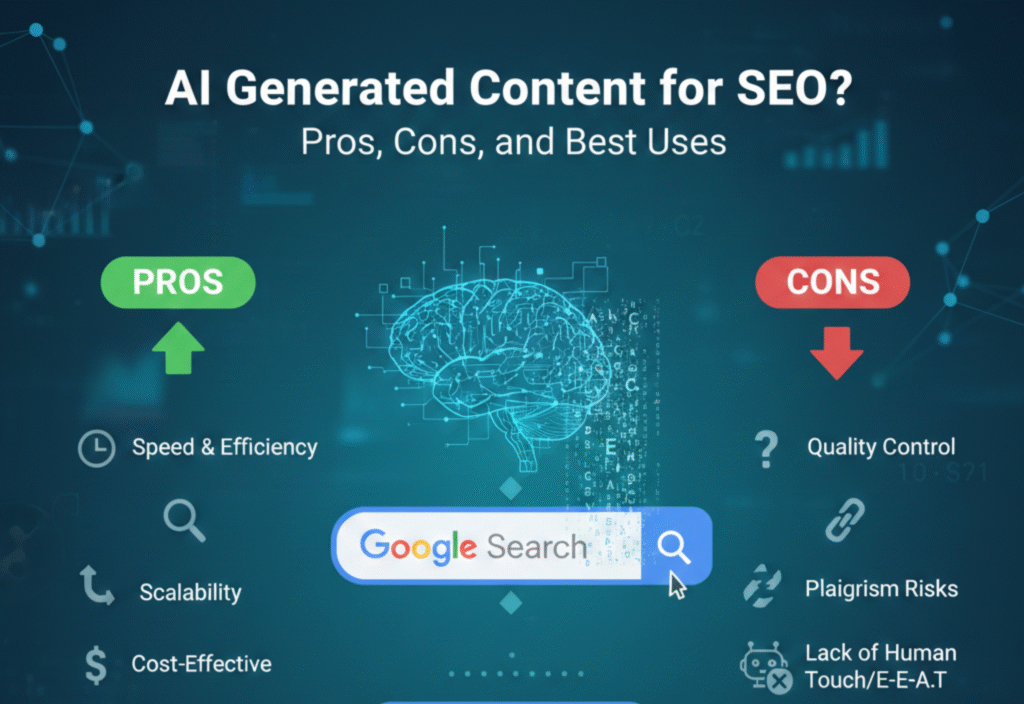
Artificial Intelligence (AI) has transformed the way digital content is created. From blog posts and product descriptions to social media captions and email campaigns, AI-generated content is now widely used by marketers, bloggers, and businesses. However, one important question still concerns many website owners and SEO professionals: Does AI-generated content really work for SEO?
What Is AI-Generated Content?
AI-generated content refers to text created using artificial intelligence models trained on large amounts of data. These tools analyze patterns in language to generate human-like content based on prompts or instructions.
Common examples include:
Blog articles
Website landing pages
Product descriptions
Meta titles and descriptions
FAQs and knowledge base content
AI tools can generate content quickly, but quality depends on how well the content is planned, edited, and optimized.
Google’s Stance on AI-Generated Content
Google does not automatically penalize AI-generated content. According to Google’s guidelines, the focus is on content quality, not how the content is produced. If AI-generated content is helpful, original, and written for users, it can rank well.
However, content created only to manipulate rankings, stuffed with keywords, or lacking value may violate Google’s spam policies—whether written by humans or AI.
In short: AI content is allowed, low-quality content is not.
Does AI-Generated Content Work for SEO?
Yes, AI-generated content can work for SEO when:
It is original and valuable
It satisfies search intent
It follows on-page SEO best practices
It is reviewed and refined by humans
AI is best seen as a content assistant, not a complete replacement for human writers.
Pros of AI-Generated Content for SEO
1. Faster Content Creation
AI can produce content in minutes instead of hours. This allows websites to scale content production and publish more frequently, which is beneficial for SEO.
2. Cost-Effective
Hiring writers for every piece of content can be expensive. AI tools reduce content creation costs, especially for startups and small businesses.
3. SEO Optimization Support
AI can help generate:
SEO-friendly headings
Meta titles and descriptions
Keyword-optimized drafts
Structured content for better readability
4. Consistency in Tone and Structure
AI ensures consistent formatting, tone, and structure across multiple pages, which improves user experience and brand identity.
5. Useful for Data-Driven Content
AI performs well for content such as:
Comparisons
Feature lists
How-to guides
Technical explanations
Cons of AI-Generated Content for SEO
1. Lack of Original Insight
AI cannot provide real-world experience, personal opinions, or expert insights. Content without originality may struggle to stand out in competitive niches.
2. Risk of Low-Quality or Generic Content
Without proper prompts and editing, AI content can sound repetitive, vague, or generic—qualities that hurt SEO performance.
3. Limited E-E-A-T Signals
Google values Experience, Expertise, Authoritativeness, and Trust (E-E-A-T). AI alone cannot demonstrate real experience or credibility.
4. Potential for Factual Errors
AI may generate outdated or incorrect information, which can harm trust and rankings if not fact-checked.
5. Over-Optimization Risk
AI-generated content may overuse keywords or follow patterns too strictly, making the content feel unnatural.
Best Uses of AI-Generated Content for SEO
AI works best when used strategically. Below are the most effective and safest ways to use AI for SEO.
1. Content Drafting and Ideation
Use AI to create:
First drafts
Content outlines
Topic ideas
Blog structures
Then refine the content manually for accuracy, tone, and depth.
2. Meta Titles and Meta Descriptions
AI is excellent for generating multiple SEO-optimized title and description variations quickly.
3. FAQs and Supporting Content
AI works well for:
Frequently asked questions
Glossaries
Help articles
Informational sections
4. Product Descriptions (With Editing)
AI can generate bulk product descriptions, but human editing is essential to ensure uniqueness and brand voice.
5. Content Updates and Rewriting
AI is useful for:
Refreshing old articles
Improving readability
Rewriting content for clarity
Optimizing existing content for SEO
How to Use AI Content Without Hurting SEO
To get the best SEO results, follow these best practices:
Always review and edit AI content
Add expert insights and examples
Optimize for search intent, not just keywords
Avoid duplicate or thin content
Combine AI efficiency with human creativity
Use plagiarism checks for safety
Ensure content is helpful and user-focused
AI-Generated Content vs Human-Written Content
| Aspect | AI-Generated Content | Human-Written Content |
|---|---|---|
| Speed | Very fast | Slower |
| Cost | Low | Higher |
| Creativity | Limited | High |
| SEO Support | Strong | Strong |
| Original Insight | Weak | Strong |
| E-E-A-T Value | Limited | High |
The best SEO strategy is a hybrid approach—AI for efficiency and humans for quality.
The Future of AI Content in SEO
AI will continue to play a growing role in content creation, but search engines are also becoming smarter at evaluating content quality. Websites that rely purely on mass-produced AI content may struggle, while those that use AI thoughtfully will benefit.
The future of SEO lies in helpful, high-quality, and user-centric content, regardless of whether it’s written by humans, AI, or both.
Conclusion
So, does AI-generated content work for SEO?
Yes—but only when used the right way.
AI-generated content can:
Speed up content creation
Support SEO optimization
Reduce costs
Improve consistency
However, it should never replace human oversight. To succeed in SEO, AI content must be edited, enhanced, and aligned with user intent and quality standards.