In 2026, the tech industry is evolving at an unprecedented pace, and careers in artificial intelligence and data science are becoming more critical than ever. Many professionals are now asking, “What is the difference between a Data Scientist vs AI Engineer?” Understanding these roles is essential for anyone looking to choose the right career path in technology. Both positions involve working with data, machine learning, and advanced technologies, but their responsibilities, skills, and career trajectories differ significantly.
What is a Data Scientist?
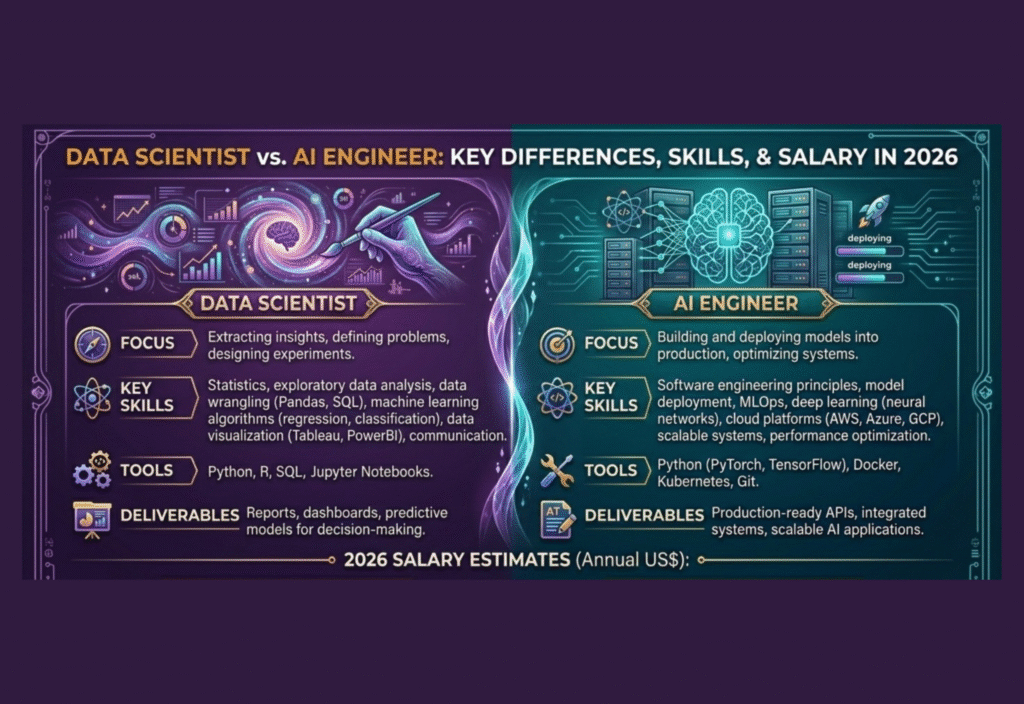
A Data Scientist is a professional who analyzes large datasets to uncover patterns, trends, and insights that help organizations make informed decisions. They focus on understanding historical and real-time data, predicting future trends, and communicating findings to decision-makers.
Key Responsibilities of a Data Scientist
Collecting and cleaning structured and unstructured data
Performing statistical analysis and predictive modeling
Building machine learning models for analysis and predictions
Creating dashboards and data visualizations for stakeholders
Communicating insights clearly to technical and non-technical teams
Data Scientists often work across industries such as finance, healthcare, e-commerce, and marketing. For instance, a Data Scientist at an e-commerce company may analyze customer behavior to improve product recommendations and increase sales.
What is an AI Engineer?
An AI Engineer focuses on designing, building, and deploying intelligent systems using machine learning and artificial intelligence technologies. Unlike Data Scientists, AI Engineers implement algorithms and develop AI-powered applications that can automate processes, recognize patterns, or interact with humans.
Key Responsibilities of an AI Engineer
Designing and developing AI and machine learning systems
Creating algorithms and neural networks for AI applications
Deploying models into production environments
Optimizing AI systems for efficiency and scalability
Maintaining and improving AI-powered software applications
For example, an AI Engineer may develop a recommendation engine, chatbots, or self-learning automation tools used in businesses and consumer applications.
Data Scientist vs AI Engineer – Key Differences
Although both careers involve advanced technology and data, the focus and approach of each role differ.
| Aspect | Data Scientist | AI Engineer |
|---|---|---|
| Primary Focus | Analyzing data to extract insights | Building and deploying AI systems |
| Key Tasks | Data cleaning, statistical analysis, predictive modeling | Algorithm development, neural networks, AI deployment |
| Tools Used | Python, R, SQL, Tableau, Power BI | Python, TensorFlow, PyTorch, cloud AI platforms |
| End Goal | Insight-driven decision-making | Automating tasks and creating intelligent applications |
| Industry Impact | Business intelligence, marketing, finance | Robotics, automation, AI-driven products |
Skills Needed for a Data Scientist in 2026
Data Scientists require a combination of analytical, technical, and communication skills to succeed in the modern data-driven world.
Essential Data Scientist Skills:
Statistical analysis and probability theory
Machine learning fundamentals
Programming languages: Python, R, SQL
Data visualization tools: Tableau, Power BI, Matplotlib
Critical thinking and problem-solving
Strong communication for presenting findings
Skills Needed for an AI Engineer in 2026
AI Engineers need strong programming and engineering skills along with knowledge of AI frameworks and algorithms.
Essential AI Engineer Skills:
Machine learning and deep learning techniques
Programming in Python, Java, or C++
Neural networks and advanced AI algorithms
Software engineering principles and cloud deployment
AI model optimization and maintenance
Understanding of AI platforms like TensorFlow, PyTorch, or Keras
Salary Comparison: Data Scientist vs AI Engineer in 2026
Both careers are highly lucrative, but AI Engineers often earn slightly higher salaries due to the complexity and implementation responsibilities of AI systems.
Data Scientist: Entry-level salaries are competitive, while senior Data Scientists at top tech companies can earn six-figure salaries with bonuses.
AI Engineer: Due to specialization in AI deployment and system design, salaries are generally higher than Data Scientists, especially for engineers working in automation, robotics, or AI-driven platforms.
Salary varies by region, company size, and experience level, but both careers are financially rewarding with strong growth potential.
Job Demand and Career Opportunities
The demand for both Data Scientists and AI Engineers continues to grow rapidly in 2026. Industries such as finance, healthcare, e-commerce, cybersecurity, and autonomous technology are actively hiring professionals for these roles.
Data Scientist Opportunities:
Business intelligence and data analysis
Predictive modeling for decision-making
Customer behavior and market analysis
AI Engineer Opportunities:
Developing intelligent automation systems
Creating AI-powered products and platforms
Robotics, autonomous vehicles, and AI research
Both fields promise strong career growth, global opportunities, and the chance to work on cutting-edge technology.
Choosing Between Data Scientist and AI Engineer
Your choice depends on your skills, interests, and career goals.
Consider Data Science if you enjoy:
Analyzing data and spotting trends
Using statistics to solve real-world problems
Presenting data-driven insights to stakeholders
Consider AI Engineering if you enjoy:
Building AI applications and intelligent systems
Working with neural networks and machine learning models
Deploying automation or AI products in production
Both careers offer exciting challenges, high salaries, and the opportunity to work on innovative technology.
Conclusion
In 2026, both Data Scientists and AI Engineers play crucial roles in the tech landscape. While Data Scientists focus on extracting actionable insights from data, AI Engineers concentrate on building intelligent systems that perform tasks automatically.
Choosing the right path requires understanding your strengths, interests, and career goals. Both professions provide financially rewarding opportunities, job stability, and a chance to shape the future of technology.