
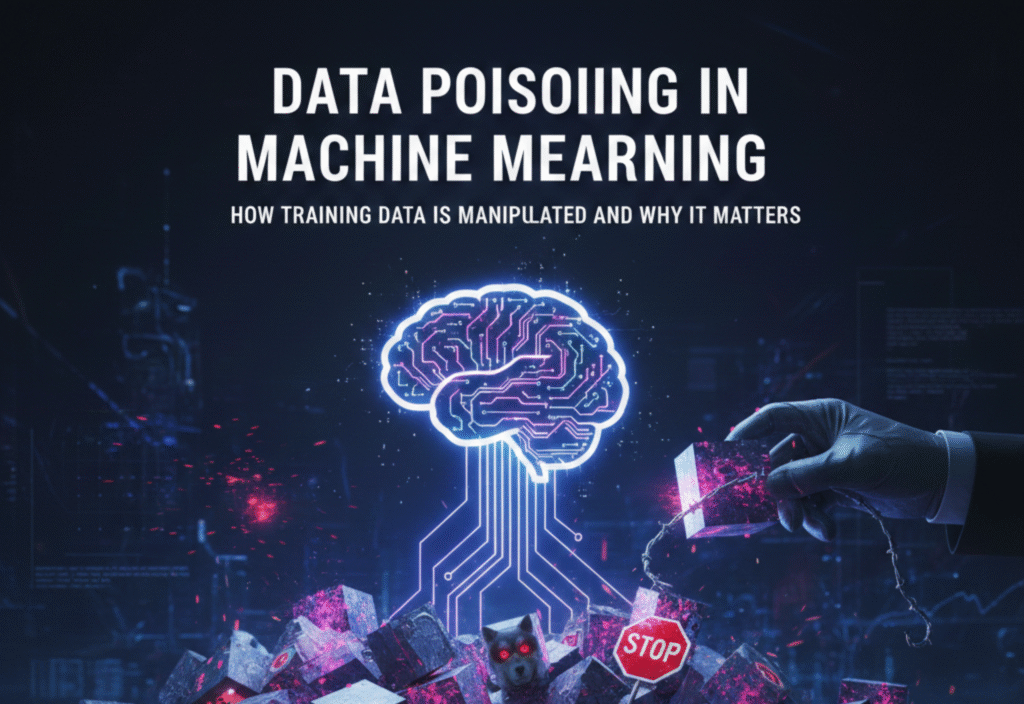
Machine learning systems are only as trustworthy as the data they learn from. As AI models increasingly influence high‑stakes decisions—ranging from healthcare diagnostics and financial risk scoring to content moderation and autonomous systems—the integrity of training data has become a critical security concern. One of the most dangerous and least understood threats to modern AI is data poisoning.
Data poisoning occurs when an attacker deliberately manipulates training data to corrupt a machine learning model’s behavior. Unlike traditional cyberattacks that target infrastructure or software vulnerabilities, data poisoning targets the learning process itself. The result can be biased predictions, hidden backdoors, silent performance degradation, or catastrophic failure in real‑world deployments.
What Is Data Poisoning in Machine Learning?
Data poisoning is a type of adversarial attack where malicious data is intentionally injected into a model’s training dataset. The goal is to influence the learned parameters so the trained model behaves in a way that benefits the attacker.
Unlike test‑time attacks (such as adversarial examples), data poisoning happens before or during training. Because modern ML pipelines often rely on large, automated, or crowdsourced datasets, attackers may not need direct system access—only the ability to influence the data source.
At its core, data poisoning exploits a fundamental assumption of machine learning: that training data is representative, clean, and honest.
Why Data Poisoning Is a Serious Threat
1. ML Systems Trust Data by Default
Most machine learning algorithms are designed to learn patterns, not question intent. If poisoned data looks statistically valid, the model will treat it as truth.
2. Large-Scale Datasets Are Hard to Audit
Modern foundation models and deep learning systems train on millions—or billions—of data points. Manually verifying every sample is impossible, making subtle attacks extremely difficult to detect.
3. Poisoning Can Be Silent and Persistent
A successful poisoning attack may not cause obvious failures. Instead, it can introduce small biases, targeted misclassifications, or hidden triggers that remain undetected for months.
4. High-Impact Real-World Consequences
Poisoned models can lead to:
Discriminatory hiring or lending decisions
Incorrect medical diagnoses
Manipulated recommendation systems
Security vulnerabilities in autonomous systems
Types of Data Poisoning Attacks
1. Label Flipping Attacks
In label flipping, attackers change the labels of training examples while keeping the input data intact.
Example:
Images of spam emails are mislabeled as “not spam,” causing an email filter to gradually allow more spam through.
Impact:
Reduced accuracy
Systematic misclassification
Erosion of trust in predictions
2. Backdoor (Trojan) Attacks
Backdoor attacks insert specific patterns—called triggers—into training data. When the trigger appears at inference time, the model behaves in a predefined malicious way.
Example:
A stop sign image with a small sticker causes a self‑driving car model to classify it as a speed‑limit sign.
Why It’s Dangerous:
Normal inputs behave correctly
Triggered behavior activates only under attacker-defined conditions
Extremely hard to detect through standard validation
3. Clean-Label Poisoning
In clean‑label attacks, both the data and labels appear legitimate. The attacker subtly modifies inputs so they influence the model’s decision boundary.
Example:
Slightly altered images that look identical to humans but shift model behavior.
Key Risk:
Traditional data cleaning and label verification fail to catch these attacks.
4. Availability Attacks
These attacks aim to reduce overall model performance rather than create targeted behavior.
Goal:
Make the model unreliable or unusable.
Common Techniques:
Injecting noisy or contradictory data
Flooding datasets with irrelevant samples
5. Targeted Poisoning Attacks
Targeted attacks focus on specific inputs or users.
Example:
A face recognition system fails to identify a particular individual while working normally for everyone else.
How Attackers Poison Training Data
1. Exploiting Open Data Sources
Many ML projects rely on publicly available datasets scraped from the web. Attackers can:
Upload poisoned content to public platforms
Manipulate forums, repositories, or image datasets
Seed misleading information at scale
2. Compromising Data Pipelines
If attackers gain access to data ingestion pipelines, they can modify data before it reaches the training stage.
3. Crowdsourcing Manipulation
Systems that use user‑generated labels or feedback (e.g., ratings, flags, reviews) are especially vulnerable.
4. Supply Chain Attacks
Pretrained models and third‑party datasets may already contain poisoned samples, passing risk downstream to every organization that uses them.
Real-World Examples of Data Poisoning
Search and Recommendation Systems
Manipulated click data can bias search rankings or product recommendations, favoring specific content or vendors.
Financial Fraud Detection
Poisoned transaction data can teach fraud models to ignore certain attack patterns.
Healthcare AI
Incorrect or biased medical records can cause diagnostic models to underperform for specific populations.
Autonomous Vehicles
Small visual triggers in training images can cause misclassification of road signs, with potentially fatal consequences.
Why Data Poisoning Is Hard to Detect
Poisoned data often looks statistically normal
Attacks may affect only edge cases
Model accuracy metrics may remain high
Validation datasets may be similarly contaminated
Unlike traditional malware, there is no clear “signature” of a data poisoning attack.
Defending Against Data Poisoning Attacks
1. Data Provenance and Lineage Tracking
Track where data comes from, how it was collected, and how it changes over time.
2. Robust Data Validation
Outlier detection
Statistical consistency checks
Distribution shift monitoring
3. Secure Data Pipelines
Access controls
Encryption at rest and in transit
Auditable ingestion workflows
4. Adversarial Training and Robust Models
Train models to be less sensitive to small perturbations in data.
5. Ensemble and Redundancy Approaches
Using multiple models trained on different datasets can reduce the impact of a single poisoned source.
6. Human-in-the-Loop Oversight
Critical datasets should include expert review, especially for high‑risk domains.
Regulatory and Ethical Implications
As governments move toward AI regulation, data integrity is becoming a compliance issue—not just a technical one. Poisoned data can lead to:
Legal liability
Regulatory penalties
Ethical violations
Loss of public trust
Organizations deploying AI must treat data security with the same seriousness as software security.
The Future of Data Poisoning Threats
With the rise of:
Foundation models
Automated web-scale data collection
Synthetic data generation
Data poisoning attacks are likely to become more sophisticated and harder to detect. Defending against them will require collaboration between ML engineers, security teams, and policymakers.
Conclusion
Data poisoning in machine learning represents a fundamental threat to the reliability, fairness, and safety of AI systems. By manipulating training data, attackers can silently control model behavior in ways that are difficult to detect and costly to fix.
As AI becomes embedded in critical infrastructure and decision‑making, protecting training data is no longer optional—it is essential. Understanding how data poisoning works, why it matters, and how to defend against it is a core requirement for anyone building or deploying machine learning systems in 2026 and beyond.