
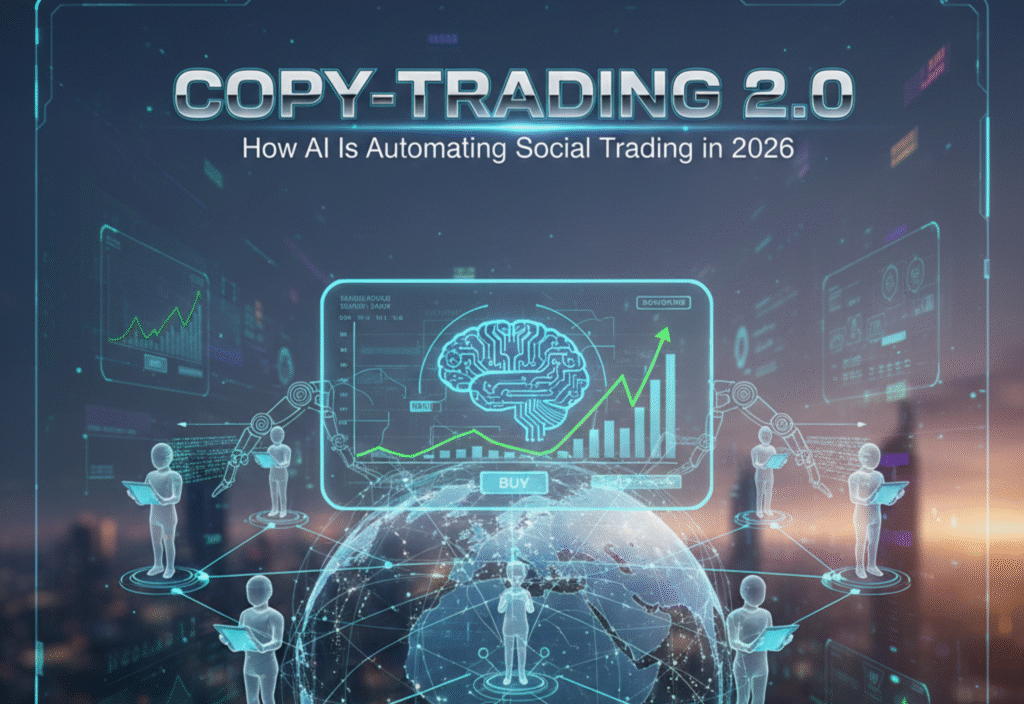
AI copy-trading 2026 is transforming the world of investing, making social trading faster, smarter, and fully automated for retail investors.
The Rise of Copy-Trading
Social trading gained popularity in the early 2010s with platforms like eToro, ZuluTrade, and Covesting. These platforms enabled users to mirror the trades of top-performing investors, providing a bridge between novices and experienced traders. While this system democratized trading, it had its limitations:
Lag in execution: Human reactions caused delays in copying trades.
Emotional biases: Following traders meant inheriting their psychological biases, such as panic selling.
Limited scalability: Tracking multiple traders manually was inefficient.
The stage was set for a technological overhaul, and AI emerged as the natural next step.
What Is Copy-Trading 2.0?
Copy-Trading 2.0 is the integration of AI and machine learning into social trading networks. Rather than passively following a human trader, investors now leverage AI-powered systems that analyze market trends, historical performance, and risk factors in real-time. These systems can automatically execute trades, optimize portfolios, and even select which traders to follow based on advanced predictive algorithms.
Key Features of AI-Driven Copy-Trading
Predictive Analytics
AI algorithms can forecast market movements by analyzing massive datasets, including news, social media sentiment, and macroeconomic indicators. This allows copy-trading platforms to anticipate profitable trades and adjust strategies faster than humans ever could.Automated Risk Management
Modern copy-trading systems use AI to dynamically manage risk. Stop-loss orders, leverage adjustments, and portfolio diversification are optimized in real-time based on both trader performance and market volatility.Behavioral Analysis of Traders
Instead of blindly following someone because of past success, AI examines a trader’s behavioral patterns. For instance, it identifies whether their profits came from high-risk bets or consistent low-risk strategies, helping users make smarter choices.Personalized Portfolio Optimization
AI-driven platforms can create individualized trading strategies. By analyzing an investor’s risk tolerance, investment goals, and preferred sectors, AI customizes the trades being copied for optimal performance.
How AI Improves Social Trading Outcomes
The benefits of AI in copy-trading extend beyond automation:
Faster Execution: Trades can be copied in milliseconds, minimizing slippage and ensuring users mirror performance accurately.
Reduced Emotional Bias: AI eliminates human emotional errors, such as panic selling or overtrading, resulting in more disciplined investment behavior.
Enhanced Diversification: AI can follow multiple traders and strategies simultaneously, spreading risk across different assets and markets.
Continuous Learning: Machine learning algorithms adapt to changing market conditions, constantly refining strategies for better returns.
Real-World Examples in 2026
Several platforms have pioneered Copy-Trading 2.0:
AI-Trader Pro uses deep learning to analyze millions of trades daily and automatically replicates high-probability trades in user accounts.
SocialQuant AI evaluates social sentiment and trader credibility to recommend whom to copy, optimizing for both growth and risk.
NeuralPortfolios offers hyper-personalized portfolios that combine AI insights with social trading data, allowing users to benefit from both human expertise and machine precision.
Challenges and Considerations
Despite its advantages, Copy-Trading 2.0 is not without challenges:
Data Privacy: AI-driven platforms require vast amounts of personal and financial data. Users must ensure their data is protected.
Algorithmic Risks: Even the best AI can fail in unprecedented market conditions, making diversification essential.
Regulatory Oversight: With increasing automation, regulatory authorities are introducing stricter guidelines to protect retail investors.
The Future of Copy-Trading
By 2030, copy-trading could become fully autonomous, with AI agents capable of simulating human strategies, anticipating market shocks, and providing personalized investment advice in real-time. The combination of AI and social trading has the potential to level the playing field for retail investors, making sophisticated trading strategies accessible to anyone with an internet connection.
Conclusion
Copy-Trading 2.0 represents a paradigm shift in social trading. AI integration has transformed passive followers into active participants in a data-driven, automated, and optimized trading ecosystem. While risks remain, the potential for higher returns, reduced emotional bias, and smarter investment decisions makes this new era of copy-trading an exciting frontier in finance. In 2026, the fusion of AI and social trading is no longer just a concept—it’s the future of investing.