
AI automation tools are becoming a core part of how modern work is done. From automating repetitive tasks to building intelligent workflows that can analyze data and make decisions, these tools are changing productivity at every level. Whether you are just starting your journey, working in a team, or managing a large organization, choosing the right AI automation tools is essential.
This guide provides a detailed, practical, and completely original explanation of how to choose the best AI automation tools based on your needs, goals, and level of experience.
What Are AI Automation Tools?
AI automation tools are software solutions that use artificial intelligence to perform tasks automatically. These tasks can include data processing, communication, workflow management, and decision-making.
Instead of manually handling repetitive work, AI tools can:
- Automate workflows
- Process large amounts of data
- Generate content or responses
- Integrate with other applications
- Learn and improve over time
The goal is simple: reduce manual work while increasing efficiency and accuracy.
Why Choosing the Right AI Automation Tool Is Important
Selecting the right tool is critical because it directly impacts your productivity and results.
If you choose the wrong tool, you may face:
- Limited functionality
- Difficulty in learning and usage
- Poor integration with other systems
- Wasted time and money
On the other hand, the right tool can:
- Save hours of manual work
- Improve workflow efficiency
- Help scale your operations
- Provide better insights and automation
Types of AI Automation Tools
Understanding the different types of tools will help you make better decisions.
No-Code AI Automation Tools
These tools are designed for beginners and non-technical users.
They usually offer:
- Drag-and-drop interfaces
- Pre-built templates
- Simple workflow creation
Developer-Focused Tools
These tools are more advanced and are used by developers.
They allow:
- Custom coding
- Advanced workflows
- API integrations
- Full control over automation
Enterprise AI Automation Platforms
These are used by large organizations.
They provide:
- High-level security
- Scalability
- Advanced automation capabilities
- Integration with legacy systems
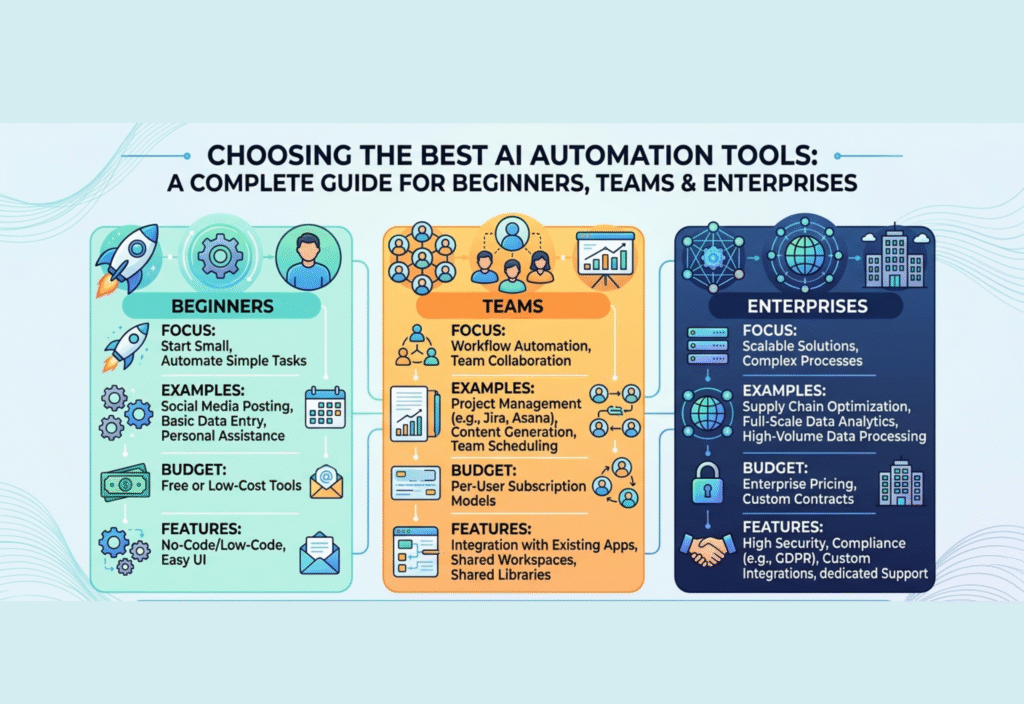
Choosing AI Tools for Beginners
If you are a beginner, your focus should be on simplicity and ease of use.
Look for tools that offer:
- User-friendly interfaces
- No coding requirements
- Pre-built workflows
- Tutorials and community support
At this stage, you can start with simple automations like:
- Sending automated emails
- Basic data organization
- Simple task automation
The goal is to learn how automation works without feeling overwhelmed.
Choosing AI Tools for Teams
Teams need tools that allow collaboration and coordination.
Important features for teams include:
- Multi-user access
- Workflow sharing
- Real-time collaboration
- Integration with existing tools
Team-based automation can be used for:
- Project management
- Marketing campaigns
- Customer support workflows
The tool should help improve teamwork and streamline communication.
Choosing AI Tools for Enterprises
Enterprises require advanced, scalable, and secure solutions.
Key considerations include:
- Data privacy and security
- Scalability for large operations
- Advanced automation capabilities
- Integration with multiple systems
Enterprise tools are often used for:
- Complex workflows
- Large-scale data processing
- Cross-department automation
At this level, reliability and performance are very important.
Key Features to Look For in AI Automation Tools
No matter your level, certain features are essential:
1. Ease of Use
The tool should be easy to understand and operate.
2. Integration
It should work with other tools you already use.
3. Scalability
The tool should grow as your needs increase.
4. Flexibility
You should be able to customize workflows.
5. Reliability
The tool should perform tasks consistently without errors.
6. Security
Data protection should always be a top priority.
Common Use Cases of AI Automation Tools
AI automation can be applied in many areas:
Business Operations
- Automating workflows
- Managing tasks
- Handling repetitive operations
Marketing
- Content generation
- Social media automation
- Email campaigns
Customer Support
- Chatbots
- Automated responses
- Ticket management
Data Management
- Data cleaning
- Reporting
- Analysis and insights
Mistakes to Avoid When Choosing AI Tools
Many people make mistakes when selecting tools.
Avoid:
- Choosing complex tools as a beginner
- Ignoring integration features
- Overlooking scalability
- Not testing the tool before use
- Focusing only on features instead of usability
Always test a tool before fully committing to it.
How to Choose the Right Tool Step by Step
Follow a simple process:
- Define your goal
- Identify your level (beginner, team, enterprise)
- List your required features
- Research available tools
- Test the tool
- Evaluate performance
- Make your final decision
This structured approach helps avoid mistakes.
Future of AI Automation Tools
AI automation is evolving rapidly.
Future trends include:
- More intelligent AI agents
- Fully autonomous workflows
- Better integration across platforms
- Increased personalization
- Smarter decision-making systems
The future will focus on AI working alongside humans, not replacing them.
Best Practices for Using AI Automation Tools
To get the best results:
- Start with small tasks
- Gradually build complex workflows
- Keep learning and experimenting
- Monitor performance regularly
- Update and improve your workflows
Consistency is key to success.
Conclusion
Choosing the best AI automation tools depends on your experience level, goals, and requirements. Beginners should focus on simplicity, teams should prioritize collaboration, and enterprises should look for scalability and security.
By understanding your needs and selecting the right tools, you can:
- Increase productivity
- Save time
- Improve efficiency
- Scale your workflows
AI automation is not just a trend—it is the future of work. Those who adopt and use it effectively will stay ahead in their careers and businesses.