
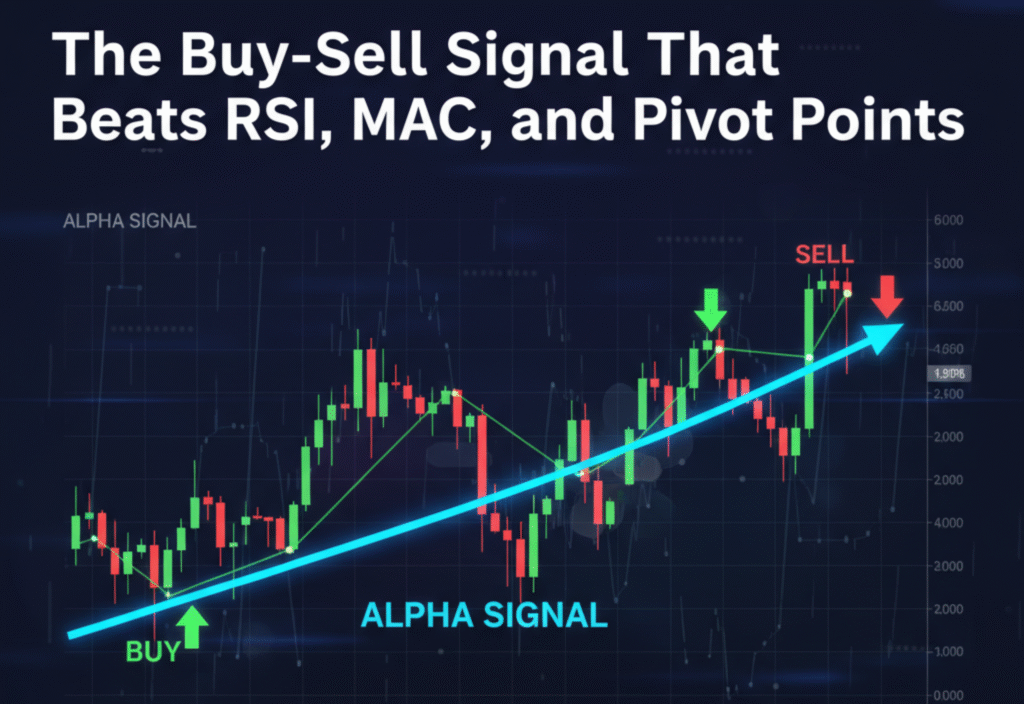
“In today’s fast-moving financial markets, a Buy/Sell Signal system offers traders more accuracy than relying solely on RSI, MACD, or pivot points.”
The practical solution is a buy/sell signal system — a method that combines multiple market factors to provide traders with better timing, clearer insights, and disciplined decision-making.
Note: This article is purely for market education and trading analysis. It does not promote gambling or haram activities.
Limitations of Traditional Indicators
RSI (Relative Strength Index)
RSI identifies overbought or oversold conditions, but during strong trends, it can generate misleading signals. Beginners often get confused when the market moves against the indicator.
MACD (Moving Average Convergence Divergence)
MACD helps identify trend changes, but as a lagging indicator, it often signals entries after the price has already moved, causing delayed decisions.
Pivot Points
Pivot points highlight support and resistance, but:
They ignore volume
They do not measure momentum
They do not account for volatility
In fast markets, relying solely on these tools can give an incomplete picture.
How the Buy/Sell Signal Outperforms Traditional Indicators
A buy/sell signal system uses a combined, balanced approach instead of relying on one tool.
1. Price Action Analysis
By studying candlestick patterns, market structure, and trend direction, traders can understand where the market is naturally moving.
2. Volume Confirmation
Volume shows real participation. When price movements are supported by strong volume, the signals become more reliable.
3. Momentum Filtering
Momentum indicators help distinguish weak and strong moves, reducing the chance of false entries.
4. Volatility Control
Filters prevent unnecessary trades during low-volatility or sideways markets, contributing to better risk management.
Key Benefits of Using Buy/Sell Signals
Greater accuracy in trending and ranging markets
Fewer false entries and emotionally-driven trades
Optimized timing for swing trading, day trading, and scalping
Works across stocks, forex, crypto, and commodities
Enhances discipline and trading consistency
Halal Perspective and Safety
This system is completely halal because it:
Does not involve interest (riba)
Does not promote gambling or speculative bets
Focuses solely on analysis, planning, and risk control
When trading is done with:
Proper risk management
Knowledge and discipline
Avoidance of over-leverage and greed
…it falls within ethical and responsible trading practices.
Final Thoughts
The purpose of buy/sell signals is not to get rich overnight, but to:
Understand the market better
Improve entry and exit timing
Keep risk under control
Traditional indicators like RSI, MACD, and pivot points are still useful, but when combined with a buy/sell signal system, traders gain more clarity, confidence, and consistency.
This approach represents a smart, disciplined, and halal-safe method of trading that supports long-term, sustainable performance.