
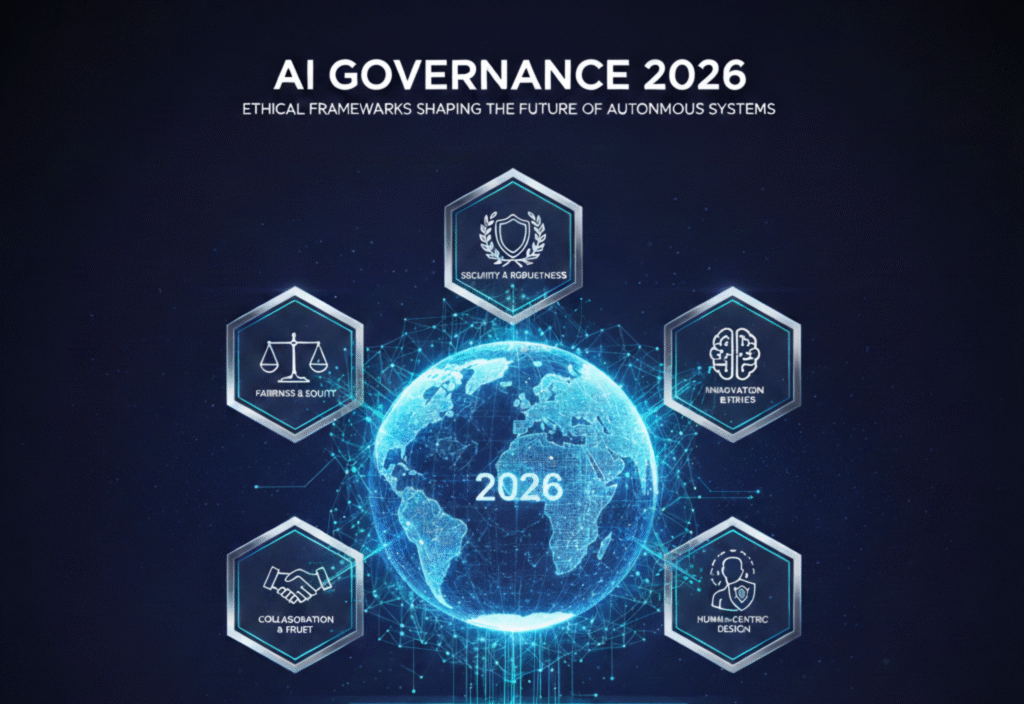
Artificial Intelligence (AI) is rapidly transforming industries, economies, and everyday life. In 2026, autonomous systems — including intelligent assistants, automated decision-making platforms, robotics, and predictive AI models — are becoming increasingly common. However, as AI grows more powerful, ethical governance becomes essential. AI governance refers to the policies, ethical principles, legal regulations, and organizational practices designed to ensure AI technologies are safe, transparent, fair, and beneficial for humanity. Without proper governance, AI could create risks such as bias, privacy violations, misinformation, or even safety concerns. That is why governments, organizations, and technology leaders are actively shaping ethical frameworks to guide AI development responsibly.
The Growing Importance of AI Governance
AI is no longer experimental technology; it is deeply integrated into healthcare, finance, education, security, marketing, and customer service. Autonomous systems can analyze massive datasets, predict outcomes, and make decisions faster than humans. While this efficiency brings innovation, it also raises ethical questions:
Can AI decisions be trusted?
Who is responsible if AI makes mistakes?
How do we prevent bias and discrimination?
How can user privacy be protected?
AI governance answers these questions by creating structured guidelines that ensure accountability, transparency, and fairness. Strong governance also helps build public trust, which is critical for continued AI adoption.
Global Organizations Leading AI Ethics
Many international bodies are helping shape ethical AI standards. For example, UNESCO promotes AI ethics focused on human rights, inclusion, sustainability, and social responsibility. Their framework encourages governments and companies to align AI innovation with societal values.
Similarly, the OECD has developed AI principles emphasizing transparency, accountability, robustness, and fairness. These principles influence national AI policies worldwide.
Technical standards are also crucial. The IEEE works on engineering guidelines for ethical AI design, ensuring technology developers follow responsible practices during system development.
These global efforts create consistency and encourage international cooperation in AI governance.
Government Regulations and Policy Developments
Governments are increasingly introducing AI-specific regulations. The European Union has been at the forefront, implementing risk-based AI regulatory frameworks that classify AI systems based on potential harm levels. High-risk applications such as healthcare diagnostics, biometric surveillance, or financial decision tools require strict compliance and transparency.
Other countries are also developing AI policies focusing on:
Data privacy protection
Ethical algorithm design
Transparency in automated decision-making
Cybersecurity standards
Public safety considerations
These regulations aim to encourage innovation while minimizing societal risks.
Corporate Responsibility in AI Governance
Technology companies play a major role in shaping ethical AI. Firms like Microsoft emphasize responsible AI principles such as fairness, reliability, safety, privacy, inclusiveness, and accountability. Meanwhile, Google has established AI ethics guidelines focusing on beneficial AI development and avoiding harmful applications.
Corporate governance initiatives often include:
Ethical AI review boards
Bias testing protocols
Transparency reports
Responsible data usage policies
Continuous monitoring of AI behavior
These steps help companies build trust while meeting regulatory requirements.
Core Ethical Principles Guiding AI Governance
Transparency and Explainability
Users should understand how AI systems make decisions. Explainable AI helps identify errors, biases, and unintended consequences.
Accountability
Organizations must take responsibility for AI outcomes. Clear accountability ensures trust and legal compliance.
Fairness and Inclusivity
AI should not reinforce social inequalities. Diverse training data, fairness audits, and inclusive design reduce bias.
Privacy Protection
AI often relies on large datasets, making privacy protection essential. Ethical frameworks prioritize consent, data security, and confidentiality.
Safety and Reliability
Autonomous systems must function consistently and safely, especially in critical sectors like healthcare, transportation, and infrastructure.
Challenges Facing AI Governance in 2026
Despite progress, several challenges remain:
Rapid technological evolution: AI advances faster than regulatory frameworks, creating gaps in governance.
Global inconsistency: Different countries have varying AI laws, making international compliance complex.
Data bias and misinformation: Poor-quality data can lead to unfair or misleading AI outputs.
Security risks: Autonomous systems can be vulnerable to cyberattacks or manipulation.
Public awareness: Many users still lack understanding of how AI works and its ethical implications.
Addressing these challenges requires continuous collaboration between governments, industry, academia, and civil society.
Role of Developers and Businesses
AI governance is not just about laws; developers and organizations must actively implement ethical practices. Key responsibilities include:
Conducting risk assessments before deployment
Monitoring AI behavior regularly
Ensuring diverse and unbiased datasets
Maintaining transparency with users
Following ethical design principles
Responsible AI development is becoming a competitive advantage, as customers increasingly value trust and transparency.
Future Trends in AI Governance
Looking beyond 2026, AI governance will likely evolve significantly:
Global ethical AI standards may become unified.
AI auditing and certification could become mandatory.
Autonomous AI agents will require clearer accountability rules.
Ethical AI education will expand among developers and users.
Collaboration between policymakers and technologists will increase.
These trends suggest governance will remain a central pillar of AI innovation.
Conclusion
AI governance in 2026 is essential for balancing innovation with responsibility. Ethical frameworks, international cooperation, corporate accountability, and regulatory oversight are shaping the future of autonomous systems. Proper governance ensures AI benefits society while minimizing risks related to bias, privacy, security, and transparency. As AI continues evolving, strong ethical foundations will determine whether technology truly serves humanity in a fair, safe, and sustainable way.