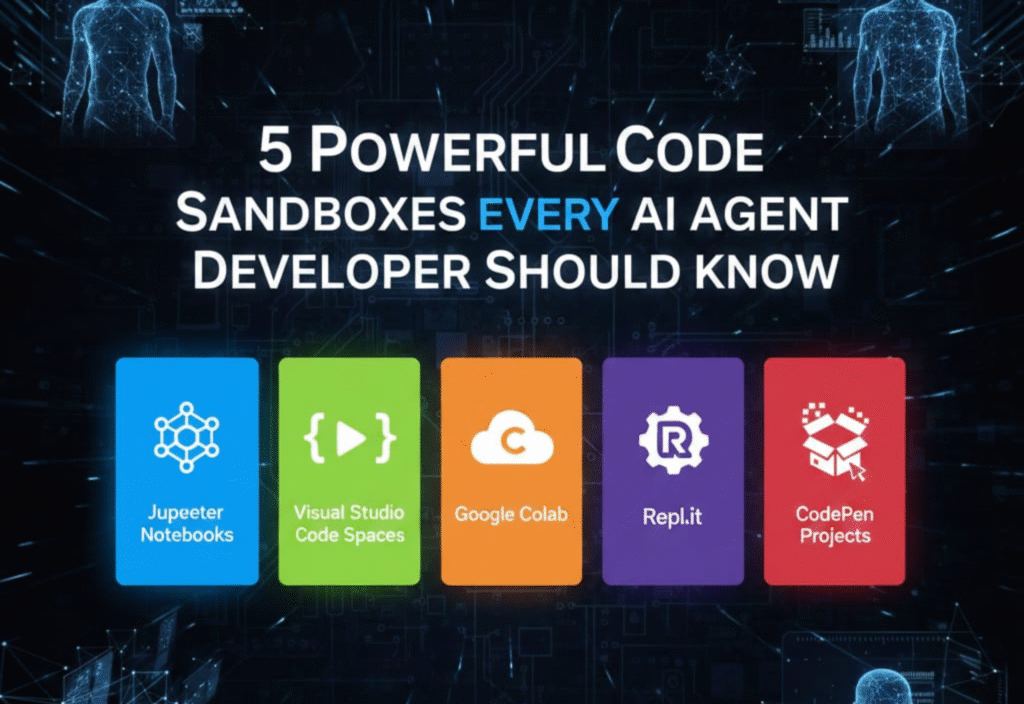
Developers building AI agents need safe and efficient environments to test their work. AI code sandboxes provide isolated, collaborative, and powerful tools for experimenting with AI agents, running models, and debugging algorithms without affecting production systems
A code sandbox is an isolated development environment that allows developers to run code without affecting the main system or production environment. Sandboxes are essential for prototyping AI agents, testing algorithms, and collaborating with teams. In 2026, a variety of sandboxes offer powerful features tailored for AI agent development, from cloud-based notebooks to interactive simulation platforms.
In this article, we’ll explore five of the most powerful code sandboxes every AI agent developer should know, including their key features, use cases, and advantages.
1. Replit – Collaborative Cloud IDE
Replit is a cloud-based development environment that supports dozens of programming languages, including Python, JavaScript, and Go. For AI agent developers, Replit offers:
Instant coding environment: No installation needed; start coding in seconds.
Collaboration: Real-time code sharing, pair programming, and multiplayer coding sessions.
Integrated hosting: Run your AI agent scripts in the cloud without local setup.
AI features: Replit Ghostwriter assists with code completion and debugging.
Use Cases:
Rapid prototyping of AI agent logic
Collaborative experiments on multi-agent systems
Testing scripts across different programming languages
Advantages:
Replit is beginner-friendly yet powerful for advanced projects. Its cloud nature eliminates the need for heavy local configurations, which is ideal for AI agents that require multiple dependencies.
2. Google Colab – AI-Focused Notebook Environment
Google Colab is a cloud-based Jupyter notebook service optimized for AI and ML workflows. It provides free access to GPUs and TPUs, making it a top choice for training models quickly.
Key Features:
Python notebooks with full ML support: Easily run TensorFlow, PyTorch, and scikit-learn.
Cloud GPU/TPU acceleration: Ideal for compute-intensive AI agent simulations.
Integration with Google Drive: Store datasets, models, and notebooks seamlessly.
Collaborative editing: Share notebooks and work together in real-time.
Use Cases:
Training reinforcement learning agents
Testing AI agent decision-making in simulated environments
Sharing reproducible experiments with the AI community
Advantages:
Google Colab removes the hassle of setting up complex environments, providing immediate access to powerful computing resources, which is especially useful for multi-agent simulations and large neural networks.
3. Kaggle Notebooks – Community-Driven Sandbox
Kaggle, a platform for data science competitions, offers Kaggle Notebooks, a free, cloud-hosted coding environment.
Features:
Access to massive datasets: Built-in integration with thousands of public datasets.
GPU support: Run AI models efficiently in the cloud.
Community collaboration: Share notebooks and fork others’ work to experiment.
Pre-installed ML libraries: TensorFlow, PyTorch, scikit-learn, and more.
Use Cases:
Developing AI agents using real-world datasets
Benchmarking agent performance on competition tasks
Learning from existing AI agent implementations
Advantages:
Kaggle Notebooks is perfect for AI agent developers who want to test models quickly on large datasets while leveraging a collaborative, community-driven environment.
4. Binder – Open-Source Interactive Environments
Binder allows developers to turn GitHub repositories into fully interactive, cloud-hosted environments. It’s open-source and designed to run notebooks and code reproducibly without local installation.
Key Features:
Runs directly from GitHub repositories: No downloads or setup required.
Supports multiple languages: Python, R, Julia, and more.
Custom environments: Specify dependencies using
requirements.txtorenvironment.yml.Reproducibility: Ensures that others can run your code exactly as intended.
Use Cases:
Sharing AI agent research with reproducible experiments
Demonstrating multi-agent system simulations online
Testing code in a standardized, isolated environment
Advantages:
Binder is ideal for academic research, open-source projects, and educational use. Its emphasis on reproducibility ensures that AI agent experiments are easy to share and replicate.
5. Deepnote – Interactive AI Development Platform
Deepnote is a collaborative data science platform designed for real-time teamwork and AI development. It combines the familiarity of Jupyter notebooks with advanced collaboration and integration tools.
Key Features:
Real-time collaboration: Multiple developers can edit the same notebook simultaneously.
Integration with cloud storage and databases: Connect to AWS S3, Google Drive, or SQL databases.
Version control: Track changes and revert easily.
GPU support: Train AI agents faster with cloud acceleration.
Use Cases:
Collaborative AI agent projects in teams
Reinforcement learning experiments with large datasets
Continuous experimentation in production-like environments
Advantages:
Deepnote bridges the gap between interactive experimentation and team-based development, making it ideal for distributed AI agent development and rapid prototyping.
Choosing the Right Sandbox for Your AI Agent Projects
When selecting a sandbox, consider the following:
Collaboration needs: Replit and Deepnote excel for team-based projects.
Compute requirements: Google Colab and Kaggle Notebooks offer free GPU/TPU acceleration.
Reproducibility: Binder ensures that experiments can be shared and replicated without setup errors.
Ease of setup: Replit and Deepnote provide minimal setup, great for rapid prototyping.
In 2026, most AI agent developers use a combination of these sandboxes to cover different needs: prototyping, collaboration, model training, and experimentation.
Conclusion
AI agent development is more complex than ever, and using powerful code sandboxes is essential for success. Whether you need fast prototyping, GPU acceleration, collaborative development, or reproducible research, tools like Replit, Google Colab, Kaggle Notebooks, Binder, and Deepnote provide flexible and robust solutions.