
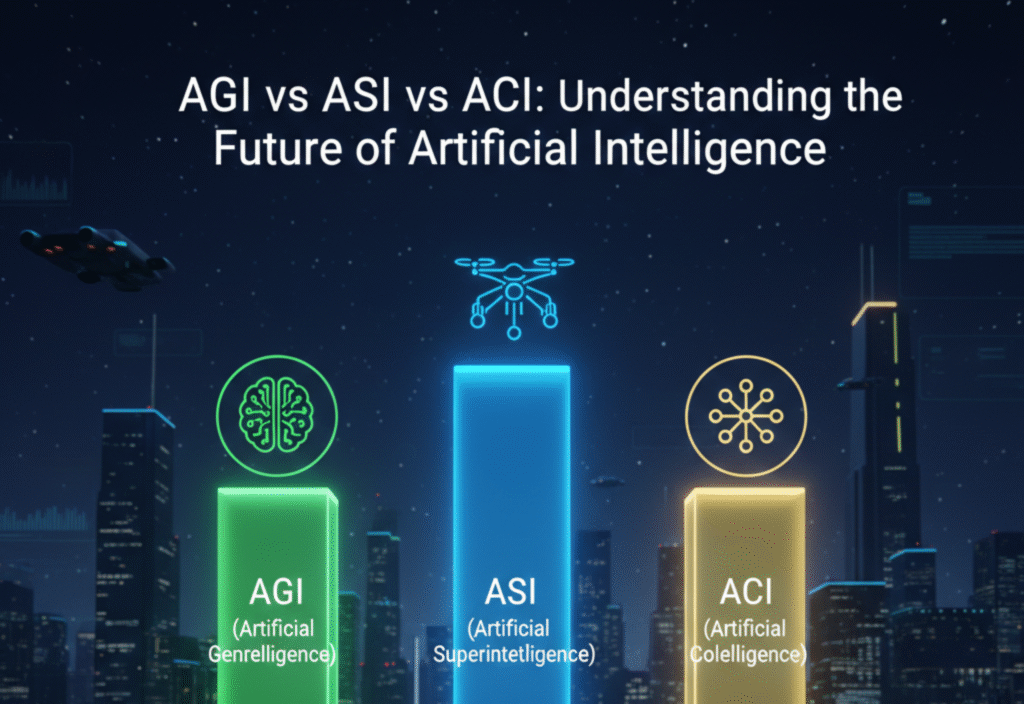
AGI vs ASI represents the next frontier of artificial intelligence. While AGI aims to replicate human-level intelligence, ASI could surpass it in ways humans cannot yet imagine. Understanding these AI types is essential for predicting the future of technology, society, and innovation.
What is AGI vs ASI?
Artificial General Intelligence (AGI) refers to systems that can perform any intellectual task a human can, with the ability to learn, adapt, and reason across diverse domains. Unlike narrow AI, which is designed for specific tasks, AGI is flexible, adaptable, and capable of general problem-solving.
Artificial Superintelligence (ASI), on the other hand, is a hypothetical AI that surpasses human intelligence in all areas, including creativity, decision-making, and strategic thinking. ASI could not only solve complex problems at superhuman speed but also improve its own intelligence recursively, potentially leading to rapid and unprecedented technological growth.
Key Differences Between AGI and ASI
| Feature | AGI | ASI |
|---|---|---|
| Intelligence Level | Human-equivalent | Superhuman |
| Learning Ability | Learns like a human | Self-improving exponentially |
| Scope | General problem-solving | All domains, faster & better than humans |
| Impact | Revolutionizes productivity | Potentially transforms society and civilization |
| Risks | Moderate | High, including existential risks |
The distinction between AGI and ASI lies in capability, speed, and risk. AGI may augment human decision-making, while ASI could fundamentally reshape the world in ways that are difficult to control or predict.
How AGI vs ASI Could Transform the Future
Healthcare:
AGI can provide personalized diagnosis and treatment plans, while ASI could discover cures for complex diseases that currently have no solutions.Science and Research:
AGI accelerates research by automating experiments, whereas ASI could theoretically solve problems beyond human comprehension, like advanced physics or climate modeling.Economy and Industry:
AGI could optimize workflows and decision-making in businesses. ASI could entirely redesign economies, supply chains, and resource allocation with unmatched efficiency.Society and Governance:
Ethical frameworks will be critical, as AGI aids policy decisions, and ASI may influence societal structures or global systems at unprecedented scales.
Challenges in Developing AGI vs ASI
Technical Complexity: AGI requires human-like reasoning across diverse domains, which is extremely hard to achieve.
Safety Concerns: ASI’s power could pose existential risks if objectives are not aligned with human values.
Ethical Issues: Determining the rights, responsibilities, and regulation of superintelligent AI remains a major challenge.
Resource Constraints: Training advanced AI systems requires massive computational resources, raising environmental and economic concerns.
Opportunities of AGI vs ASI in Real-World Applications
Education: Personalized AI tutors powered by AGI can adapt to each student’s learning style.
Space Exploration: ASI could analyze vast amounts of space data and plan complex missions autonomously.
Environmental Solutions: Both AGI and ASI could combat climate change through optimized energy systems and predictive modeling.
Creative Industries: AI could generate new ideas, music, art, and literature, expanding human creativity beyond its natural limits.
Conclusion
Understanding AGI vs ASI is essential as humanity stands at the cusp of a new era of intelligence. AGI aims to match human thinking, offering tools to enhance productivity and decision-making, while ASI could radically transform civilization—for better or worse. Preparing for this future requires careful research, ethical guidelines, and international collaboration to ensure AI serves humanity rather than threatens it.