Artificial Intelligence is growing rapidly, and understanding AI terms for beginners is becoming more important than ever. Whether you are a student, freelancer, or business owner, learning these basic AI concepts can give you a strong advantage. Most people use AI tools daily but don’t fully understand how they work. By learning a few essential terms, you can instantly get ahead of the crowd and use AI more effectively.
Yet, despite its growing importance, most people still don’t understand the basic concepts behind it. They use AI tools casually, without knowing how to unlock their full potential. This creates a huge opportunity for anyone willing to learn just a little more than the average person.
The truth is simple: you don’t need to become a programmer or data scientist to benefit from AI. You only need to understand a few key terms and how they work in real life.
In this in-depth guide, we’ll explore five essential AI terms in a simple and practical way. By the end, you’ll not only understand them—you’ll know how to use them to your advantage.
1. Machine Learning (ML): The Brain Behind Smart Systems
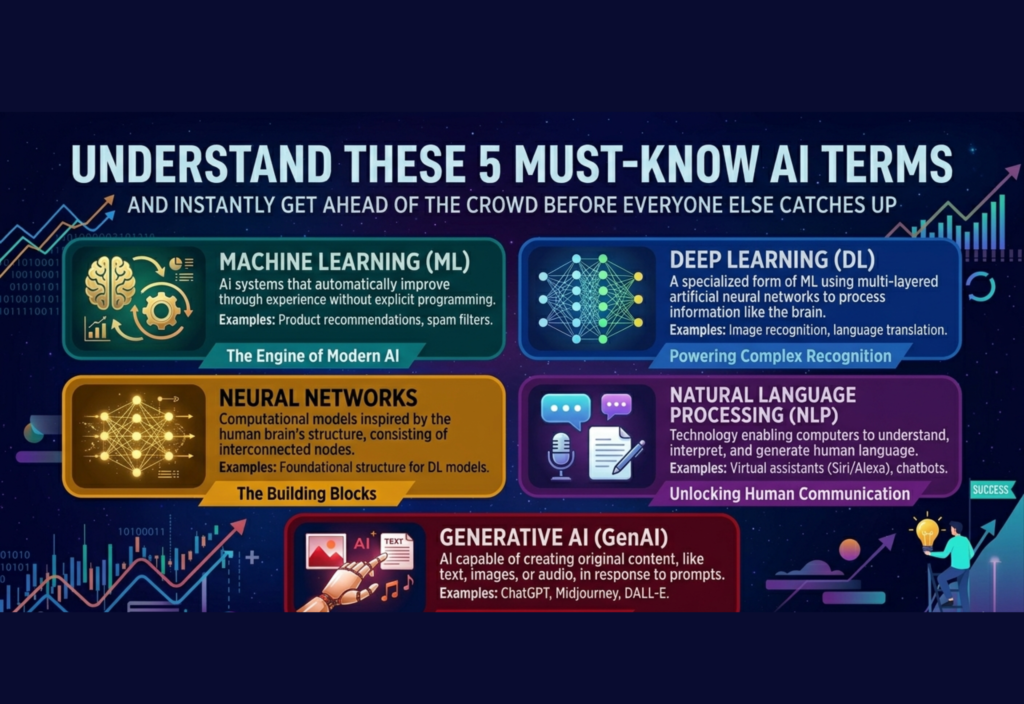
Machine Learning is the core technology that powers most modern AI systems. It allows computers to learn from data, identify patterns, and improve their performance without being explicitly programmed step-by-step.
Instead of writing rigid instructions, developers feed large amounts of data into a system. The system then analyzes that data and learns how to make predictions or decisions.
Real-Life Examples:
- YouTube suggesting videos based on your watch history
- Email services filtering spam automatically
- Banking systems detecting suspicious transactions
Why It’s Powerful:
Machine Learning improves over time. The more data it processes, the smarter it becomes. This is why apps and platforms feel more “personalized” the longer you use them.
Simple Analogy:
Think of Machine Learning like teaching a child. Instead of giving strict rules, you show examples. Over time, the child learns patterns and makes better decisions independently.
2. Natural Language Processing (NLP): Teaching Machines to Understand Humans
Natural Language Processing focuses on enabling machines to understand, interpret, and respond to human language—both written and spoken.
Human language is complex. We use slang, emotions, context, and tone. NLP helps machines make sense of all this and respond in a meaningful way.
Real-Life Examples:
- Chatbots answering customer questions
- Voice assistants responding to commands
- Translation tools converting languages instantly
Why It’s Important:
NLP removes the barrier between humans and machines. You don’t need to learn coding or special commands—you can simply talk or type naturally.
Simple Analogy:
It’s like teaching a robot not just vocabulary, but also how to understand meaning, intention, and context—just like a human conversation.
3. Neural Networks: The System That Mimics the Human Brain
Neural Networks are inspired by how the human brain works. They consist of layers of connected “neurons” that process information step by step.
Each layer learns something new from the data. Early layers detect basic patterns, while deeper layers understand more complex features.
Real-Life Examples:
- Face recognition in smartphones
- Self-driving cars identifying objects on the road
- Medical systems detecting diseases from scans
Why They Matter:
Neural Networks are what make AI capable of solving complex problems that traditional programming cannot handle efficiently.
Deep Learning:
A more advanced version called “Deep Learning” uses many layers of neural networks to achieve even higher accuracy and intelligence.
Simple Analogy:
Imagine a factory assembly line. Each worker (layer) performs a specific task, and together they produce a complete and refined result.
4. Generative AI: Creating Instead of Just Analyzing
Generative AI is one of the fastest-growing areas in artificial intelligence. Unlike traditional AI, which mainly analyzes data, generative AI can create new content.
It can generate text, images, music, videos, and even software code based on simple instructions.
Real-Life Examples:
- Writing blog posts or articles
- Generating AI art and designs
- Creating marketing content
- Assisting in coding and development
Why It’s a Game-Changer:
Generative AI dramatically increases productivity. Tasks that once took hours can now be completed in minutes.
It also opens doors for creativity—people without technical or artistic skills can now produce high-quality work.
Important Note:
While powerful, it should always be used responsibly and ethically—avoiding misuse, misinformation, or harmful content.
5. Prompt Engineering: The Skill That Separates Beginners from Experts
Prompt Engineering is the art of communicating effectively with AI systems. It involves crafting clear, detailed, and structured instructions to get the best possible output.
Most people make the mistake of giving vague prompts, which leads to poor results. Skilled users know how to guide AI properly.
Example Comparison:
Weak Prompt:
“Write about AI.”
Strong Prompt:
“Write a 1000-word beginner-friendly article explaining AI terms with real-life examples and simple language.”
The second prompt produces a far better result.
Why It’s So Valuable:
- Saves time by reducing trial and error
- Produces higher-quality results
- Gives you a competitive advantage in work and business
Simple Analogy:
Using AI without prompt engineering is like giving unclear instructions to a worker. Clear instructions lead to better outcomes.
How These 5 Terms Work Together
These concepts are not separate—they are connected:
- Machine Learning enables systems to learn
- Neural Networks power advanced learning
- NLP helps AI understand human language
- Generative AI creates new content
- Prompt Engineering helps you control the output
When combined, they create powerful tools that can transform industries and personal productivity.
Why Most People Fall Behind
Many people:
- Use AI tools without understanding them
- Rely on basic features only
- Avoid learning new concepts
This creates a gap between users and power users.
Those who take time to learn even these basics:
- Work faster
- Earn more opportunities
- Adapt quickly to new technologies
How You Can Start Using This Knowledge Today
You don’t need expensive courses or advanced degrees. Start with simple steps:
- Practice writing better prompts
- Use AI tools for daily tasks (writing, research, planning)
- Observe how AI responds and improve your inputs
- Stay updated with basic concepts
Consistency matters more than complexity.
The Future Belongs to Early Learners
AI is evolving rapidly. What feels new today will soon become standard.
The people who benefit the most are not necessarily experts—but those who start early and stay curious.
Understanding these five terms gives you a strong foundation. It helps you think differently, work smarter, and stay ahead of the curve.
Final Thoughts
Artificial Intelligence is not something to fear—it’s something to understand and use wisely.
By learning just these five key terms—Machine Learning, NLP, Neural Networks, Generative AI, and Prompt Engineering—you position yourself ahead of the majority.
The gap between those who understand AI and those who don’t is growing every day. The good news is that closing that gap doesn’t require years of effort—just the willingness to learn.
Start now, stay consistent, and you won’t just keep up—you’ll lead.