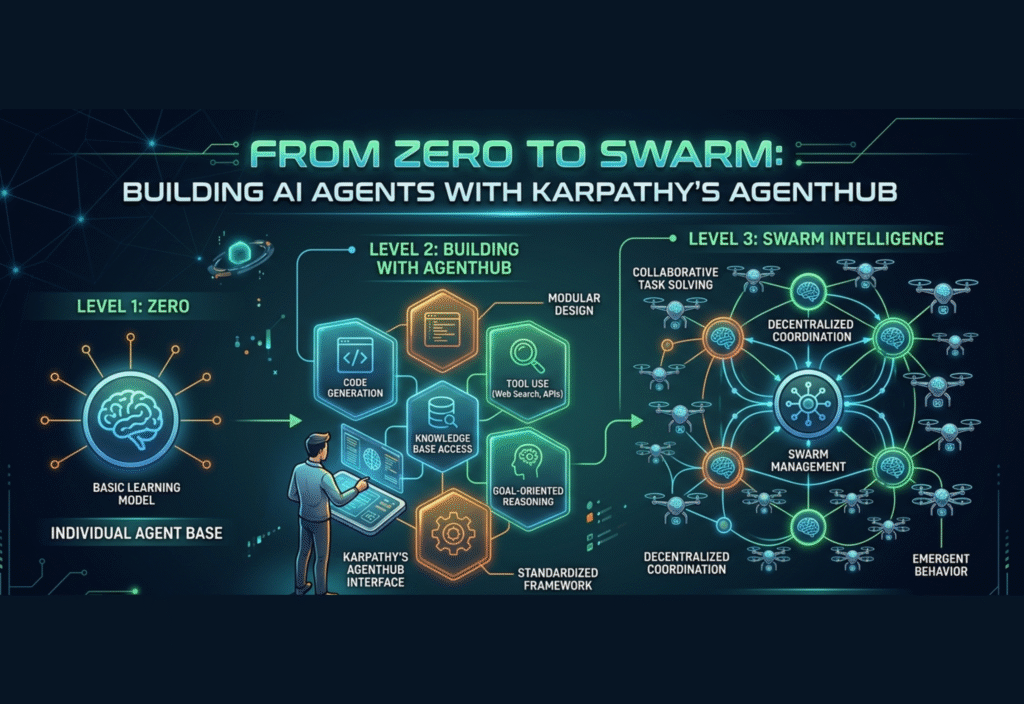
An AI agent swarm is transforming artificial intelligence by allowing multiple specialized agents to collaborate, share knowledge, and solve complex tasks efficiently. Whether you are a beginner or an experienced developer, this guide will take you from zero to building your own AI agent swarm using Karpathy’s AgentHub, providing practical examples, workflow strategies, and tips for scaling your system.
Understanding AI Agent Swarms
What Is an AI Agent Swarm?
An AI agent swarm is a network of AI agents working together to complete tasks more effectively than a single AI could. Each agent specializes in a role—such as research, development, critique, or planning—and communicates with other agents to achieve a shared goal.
This approach is inspired by swarm intelligence in nature, like bees or ants, where individuals collaborate efficiently without a centralized brain. In the AI world, swarms can handle complex projects like software development, content generation, data analysis, and business automation.
Key Components of an AI Agent Swarm
To build a functioning AI agent swarm, you need to understand its core components:
- The Brain (Language Model)
Every agent relies on a language model (LLM) such as GPT-4, Claude, or an open-source model. This model powers the reasoning and output of each agent. - Agents (The Workers)
Each agent is assigned a role and instructions. Common roles include:- Researcher: Gathers data and insights
- Developer: Writes code or executes tasks
- Critic: Reviews and improves outputs
- Planner: Organizes workflows and tasks
- Memory System
Agents need memory to track tasks, store intermediate results, and share knowledge. Memory can be:- Short-term: Conversation-level context
- Long-term: Databases, files, or embeddings
- Orchestrator (The Manager)
The orchestrator coordinates agents, routes tasks, and ensures iterative improvement. Without orchestration, agents may produce disorganized or redundant outputs.
Building Your First AI Agent Swarm
Setting Up Your Environment
Start by installing the necessary tools:
pip install openai python-dotenv
Create a .env file with your API key:
OPENAI_API_KEY=your_api_key_here
Creating Core Agents
Here’s a simple function to run a base agent:
from openai import OpenAI
client = OpenAI()
def run_agent(role, task):
response = client.chat.completions.create(
model=”gpt-4.1-mini”,
messages=[
{“role”: “system”, “content”: role},
{“role”: “user”, “content”: task}
]
)
return response.choices[0].message.content
Defining Specialized Agent Roles
Specialized agents give the swarm structure:
def researcher(task):
return run_agent(“You are a research expert.”, task)
def developer(task):
return run_agent(“You are a senior software engineer.”, task)
def critic(task):
return run_agent(“You are a quality reviewer.”, task)
How an AI Agent Swarm Collaborates
Feedback Loops and Iteration in AI Agent Swarms
The power of a swarm comes from iteration. For example:
def swarm_loop(task, iterations=3):
output = task
for _ in range(iterations):
research = researcher(output)
code = developer(research)
output = critic(code)
return output
Each cycle refines the output, producing higher-quality results than a single pass.
Orchestration and Memory for AI Agent Swarms
A well-coordinated swarm uses an orchestrator to:
- Assign tasks in sequence
- Track agent outputs
- Store results in memory for reference
Persistent memory ensures agents don’t forget previous work, making the swarm smarter over time.
Scaling and Improving Your AI Agent Swarm
Adding More Agents to Your AI Swarm
Expand the swarm with:
- Tester: Validates outputs
- Optimizer: Improves efficiency
- Writer: Creates documentation or reports
Integrating Tools and Memory
Agents become more powerful when integrated with:
- Web APIs for data
- Code execution environments
- Databases for long-term knowledge
Parallel Processing for Efficiency
Running multiple agents simultaneously increases speed and diversity of ideas. Parallel workflows can divide large tasks into smaller, manageable subtasks.
Real-World Applications of AI Agent Swarms
AI Agent Swarms in Software Development
- Auto-code generation
- Bug detection and fixing
- Code review and optimization
AI Agent Swarms for Content Creation
- Blog and article generation
- SEO optimization
- Script and report writing
AI Agent Swarms in Business Automation
- Customer support automation
- Workflow management
- Data-driven decision support
Common Mistakes and Best Practices
Avoid Overengineering Early
Start with 2–3 agents. Adding too many initially increases complexity and API costs.
Prompt Design and Role Clarity
Each agent must have a clear prompt and role. Ambiguous instructions lead to inconsistent outputs.
Cost Management
Multiple agents increase usage costs. Monitor API calls and optimize workflows to avoid overspending.
Future of AI Agent Swarms
Autonomous AI Teams
The future will see AI teams operating independently to complete complex projects, reducing human intervention for routine tasks.
Self-Improving AI Systems
With memory, feedback, and iterative loops, AI agent swarms will learn from past experiences to improve efficiency and accuracy.
Conclusion
Building an AI agent swarm starts simple:
- Assign clear roles to agents
- Create an orchestrator for coordination
- Implement memory for continuity
- Use iteration and feedback loops
By following these steps, anyone can go from zero to swarm, creating a powerful, collaborative AI system capable of solving complex problems efficiently. Karpathy’s AgentHub philosophy makes it accessible and practical, even for beginners.